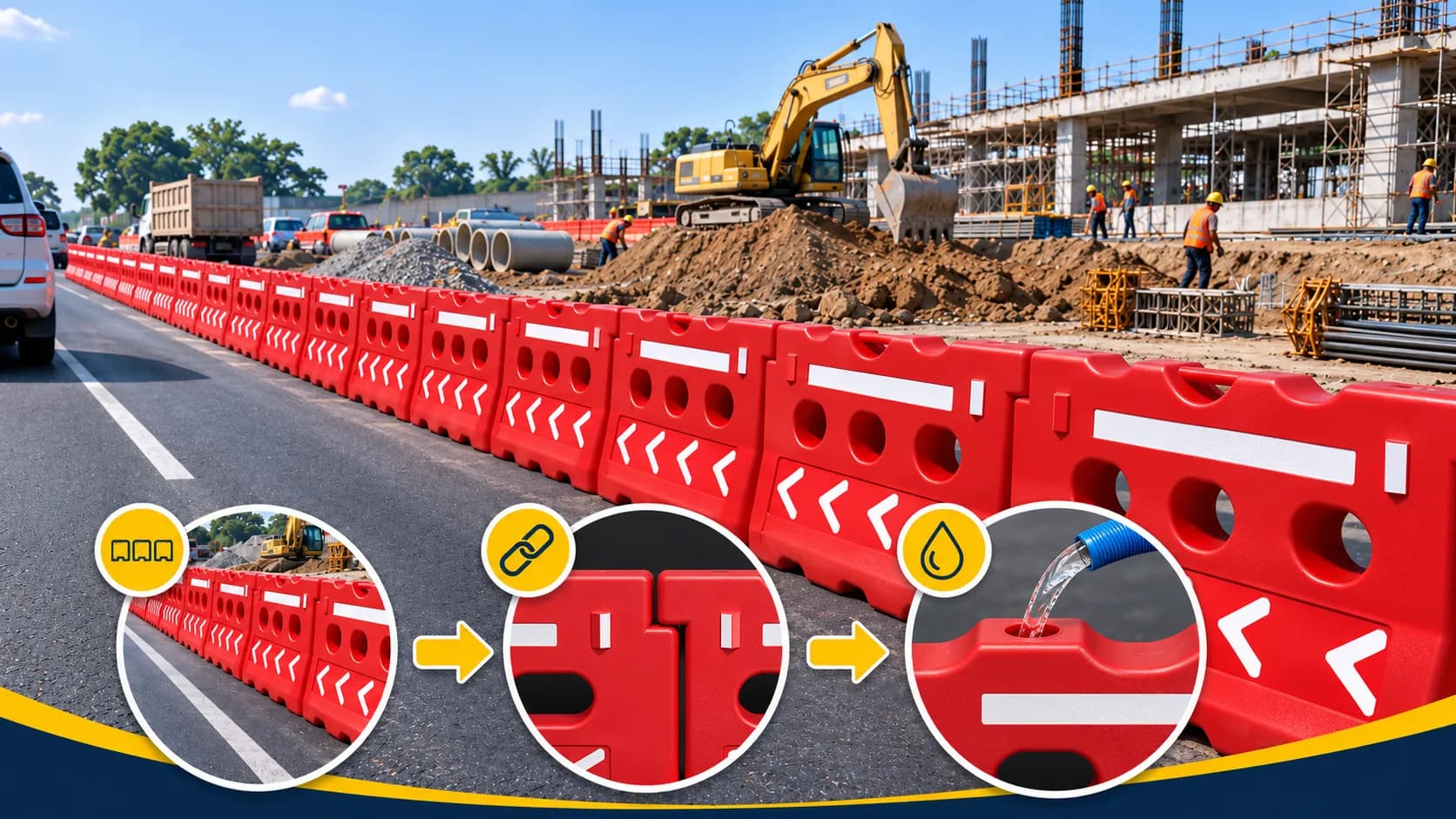
Water barriers or plastic road barriers are commonly installed in project areas, road sections undergoing repairs, and locations with temporary traffic arrangements. Their appearance is quite easy to recognize, particularly because of their bright colors and the way they are lined up along the road.
Although they may look simple, the use of water barriers still requires careful consideration. One important aspect is the material used to fill their hollow interiors.
Generally, water barriers use water as ballast. However, some types of plastic road barriers also allow sand to be used.
So, is it better to use water or sand? Does the greater weight of sand automatically make a barrier safer?
The answer depends on the type of product, site conditions, and installation requirements.
Should Water Barriers Be Filled with Water or Sand?
For general use as temporary road barriers, water is usually the more practical choice. It is easy to fill, and the water can be drained when the barrier needs to be moved.
Sand may be considered when additional ballast is required and the manufacturer specifically permits its use.
The difference between the two is not simply a matter of weight.
Water can be added through a hose and drained through a drainage opening. Meanwhile, sand requires different handling, particularly when it needs to be removed from inside the barrier.
Using sand also requires consideration of the product's structural capacity. This is because not all plastic barriers are designed to accommodate substantial additional loads.
That is why the choice of filling material should not be based solely on the assumption that the heavier a barrier is, the better its performance will be.
Why Do Water Barriers Need Ballast?
In October 2019, two water barriers on the Pandaan–Malang Toll Road attracted attention after surveillance cameras recorded them moving from their original positions.
The incident was reportedly related to strong winds and barriers that had lost water due to leaks.
The toll road operator subsequently replaced the damaged units and refilled the barriers with water.
The incident, reported by detikNews on October 29, 2019, demonstrates the importance of ballast in plastic road barriers.
Empty Barriers Are Easier to Move
Water barriers are generally manufactured with a hollow structure. When unfilled, they are relatively lightweight, making them easier to transport to the installation site.
This is one reason plastic road barriers are commonly used for temporary applications.
Workers can position the barriers before filling them.
Their Weight Increases After Filling
Water or sand placed inside the barrier acts as ballast.
The additional mass helps improve the barrier's stability against disturbances such as wind and minor contact, within the limitations of the product's design.
However, adding ballast does not mean that every water barrier can withstand a vehicle collision at high speed. Such capabilities require specific designs and safety testing.
Differences Between Water-Filled and Sand-Filled Barriers
From the outside, water barriers filled with either water or sand show no significant visual differences. However, the characteristics of the filling material affect their weight, installation process, and ease of maintenance.
Here is a comparison.
| Aspect | Water-Filled | Sand-Filled |
|---|---|---|
| Weight at the same volume | Lighter | Generally heavier |
| Filling | Using a hose or water-filling equipment | Using a funnel or other tools |
| Emptying | Can be drained through a drainage opening | More difficult to remove |
| Relocation | Practical after the water is drained | Requires additional handling |
| Availability | Depends on access to a water source | Depends on sand supply |
| Application | Temporary barriers that require mobility | Special applications if permitted by the manufacturer |

Water Is Easier to Use
The main advantage of water lies in how easily it can be added and removed.
Once the barrier is positioned, workers simply fill it through the designated filling opening according to the recommended volume.
When the project is completed, the water can be drained through the available drainage outlet.
This process makes the units easier to handle before they are moved or stored.
Sand Provides Greater Weight
At the same volume, dry sand generally has a greater mass than water.
This can be a consideration when an area requires additional ballast.
However, there are consequences. Sand is more difficult to remove, especially if the product's drainage opening is small or not designed for solid materials.
Damp sand can also clump together, making the emptying process more difficult.
Therefore, sand should only be used in accordance with the product's design, load limitations, and manufacturer instructions.
How Much Does a Water Barrier Weigh After Filling?
To understand the difference, we can use a simple calculation based on volume.
One liter of water has a mass of approximately one kilogram. Meanwhile, loose dry sand has a variable bulk density, with an illustrative value of approximately 1.6 kilograms per liter.
This means that within a space with a volume of one liter, dry sand can produce greater weight than water.
Example Calculation for a 90-Liter Road Barrier
If a road barrier has a capacity of 90 liters, then theoretically:
90 liters of water have a mass of approximately 90 kg.
90 liters of dry sand, assuming 1.6 kg/liter, have a mass of approximately 144 kg.
The difference is approximately 54 kg.
This calculation is only an illustration of the mass comparison, not an instruction to fill the entire barrier capacity with sand.
The permitted filling quantity must still follow the product specifications. A barrier's water capacity does not automatically mean that the same volume of sand can be used.
Example of Karpinus HDPE Road Barriers
PT Karya Pilar Nusantara offers two road barrier options with different capacities.
Road Barrier KPN 115 has a water capacity of 90 liters and an empty weight of approximately 5.5 kg.
Meanwhile, Road Barrier KPN 120 has a water capacity of 140 liters and an empty weight of approximately 9.5 kg.
When calculated theoretically based on full water capacity, their total masses are approximately 95.5 kg and 149.5 kg, respectively.
These figures are not mandatory operational weights. The actual filling volume must be adjusted according to installation requirements.
Information about the dimensions and capacities of each model is available on the Karpinus HDPE Road Barrier page.
When Should Water Be Used?
For most temporary barrier applications, water is a reasonable choice because it is simpler to use.
1. Projects with Changing Traffic Routes
During road repair work, barrier positions may change according to the project's stages.
Water-filled road barriers are easier to empty, allowing the units to be moved and rearranged.
This makes it easier to manage work areas that change over time.
2. Parking Areas and Public Facilities
Water-filled road barriers can also be used to mark vehicle access points, direct parking routes, or close off sections of facilities undergoing repairs.
When the area arrangement needs to be changed, workers can empty the units before moving them.
3. Events or Temporary Activities
The use of road barriers at an event generally requires installation and dismantling within a predetermined period.
By using water, workers do not need to perform additional work to remove solid materials from inside the barriers.
Nevertheless, the availability of a water source and a suitable drainage location still needs to be planned.
4. Locations That Require Rearrangement
Water barriers can be an option when an area requires reusable barriers.
After the water has been drained and the condition of the units has been inspected, the barriers can be stored or used at another location.
This is one of the practical advantages of water barriers compared to permanent barriers.
Under What Conditions Can Sand Be Considered?
Although water is more commonly used, sand can be an alternative under certain conditions.
For example, when project requirements call for heavier ballast and the manufacturer has confirmed that the product can accommodate it.
However, several factors must be checked first.
Additional Ballast Requirements
Sand can provide greater mass for the same volume. However, the amount of sand should not be determined without considering the capacity of the barrier body and its connections.
Additional ballast also does not automatically improve the barrier's ability to withstand vehicle collisions.
Relatively Fixed Installation Plans
Sand tends to be more troublesome when barriers need to be frequently dismantled and moved.
Therefore, from an operational standpoint, sand may be more suitable for installations that do not change frequently.
An assessment of site conditions and approval for the use of the filling material are still required.
How to Remove the Sand
Before deciding to use sand, check how the material will eventually be removed.
Drainage openings designed for water may not be practical for removing sand.
Do not assume that sand can be discharged through the same opening without difficulty.
In addition to requiring extra labor, an unsuitable emptying process can complicate product maintenance.
How to Fill Water Barriers Correctly
Water barriers should be filled after the units have been positioned at their intended installation locations.
The general steps are as follows.
1. Inspect the Condition of the Units
Make sure the road barrier body has no cracks or leaks. Also inspect the filling opening cap, drainage outlet, and connection components.
Damaged units should be repaired or replaced before use.
2. Determine the Installation Position
Place the barriers in the planned area.
For Karpinus road barriers, the arrangement between units must follow the capabilities of their connection system, using suitable straight or angled configurations rather than forcing them into sharp turns.
Make sure their placement does not obstruct vehicle routes, emergency access, or drainage channels.
3. Connect the Units
If using a modular arrangement, connect the barriers according to the installation instructions.
Check that the connections are properly secured before filling.
4. Fill with the Appropriate Material
For water-filled road barriers, use the filling opening provided at the top.
Add water according to the quantity specified in the product instructions or installation plan.
If the use of sand is permitted, follow the requirements regarding material type, filling method, and weight limits.
5. Recheck After Filling
Make sure all caps are properly secured and there are no leaks.
Also check the barrier positions, connection conditions, and visibility to road users.

Mistakes to Avoid When Filling Water Barriers
There are several mistakes that should be avoided when using water barriers.
Leaving barriers empty during use. An empty barrier weighs considerably less. If the application requires ballast, water loss caused by leaks can reduce its stability.
Filling without considering capacity. The quantity of filling material must comply with the product requirements. Overfilling or using unsuitable materials can cause structural problems.
Moving units while they are still full. Barriers should be emptied before being moved, unless a specific handling method has been approved by the manufacturer.
Ignoring the condition of the connections. Modular arrangements require connector inspections to ensure that each unit is installed according to its design.
Assuming that heavier barriers can necessarily withstand collisions. Weight is one factor affecting stability, but the ability to contain or redirect vehicles must be demonstrated through system design and testing.
For use on public roads or in high-risk locations, installation must still follow the traffic management plan and safety requirements established by the relevant authorities.
Choosing Plastic Road Barriers for Project Requirements
In addition to considering the filling material, the selection of road barriers should also take into account their material, dimensions, capacity, and connection system.
HDPE plastic road barriers are widely used for modular barrier applications because their construction is relatively lightweight when empty, and they can be positioned in various operational areas.
PT Karya Pilar Nusantara supplies Karpinus HDPE Road Barriers manufactured directly at the factory, with KPN 115 and KPN 120 models available.
Both models have different dimensions and water capacities, allowing their selection to be adjusted according to project area requirements, vehicle route arrangements, or temporary barrier needs.
Before procurement, it is advisable to check the length of the area to be separated, the required number of units, surface conditions, and installation requirements.
For applications requiring the use of sand, first confirm the suitability of the filling material and the permitted weight limit for the selected model.
Product information, specifications, and procurement requirements can be discussed through the official Karpinus Road Barrier from PT Karya Pilar Nusantara page.
Frequently Asked Questions About Water Barrier Filling
Do Water Barriers Have to Be Completely Filled with Water?
Not always. The amount of water required depends on the product design and its intended installation purpose. Follow the filling requirements provided by the manufacturer or the project's technical documents.
Can Plastic Road Barriers Be Filled with Sand?
Some products allow sand to be used. However, not all models have the same filling requirements. Make sure the manufacturer permits the use of sand and has established the filling limits.
Does Sand Make Water Barriers Stronger?
Sand can make a barrier heavier at the same volume. However, additional weight does not guarantee that the barrier can withstand vehicle collisions. Such capabilities must be assessed based on the design and test results.
Can the Water Inside a Water Barrier Be Drained?
On models equipped with drainage openings, the water can be removed before the units are moved or stored. Make sure the drainage outlet cap is properly reinstalled before the next use.
Can Water Barriers Be Used Repeatedly?
Yes, as long as their physical condition remains suitable and they meet the requirements for use. Inspection of the body, connections, caps, and potential leaks is still necessary before reinstallation.
Conclusion: Choose Water or Sand?
Both water and sand can function as ballast in types of water barriers designed to accommodate them.
The differences lie in their weight and ease of handling.
Water is more practical for temporary barrier applications because it is easy to fill and drain. Sand can provide greater ballast weight, but it requires additional consideration of the product's capacity and emptying process.
For general use, water is the more practical choice. Meanwhile, sand should only be used when it complies with the manufacturer's instructions and the technical requirements of the site.
By choosing the appropriate filling material, inspecting the condition of the barriers, and following installation procedures, water barriers can be used according to their intended functions.
For contractors, suppliers, government agencies, and project managers who require HDPE road barriers in specific quantities, PT Karya Pilar Nusantara offers Karpinus Road Barriers directly from the factory, with specifications that can be tailored through consultation regarding procurement requirements.