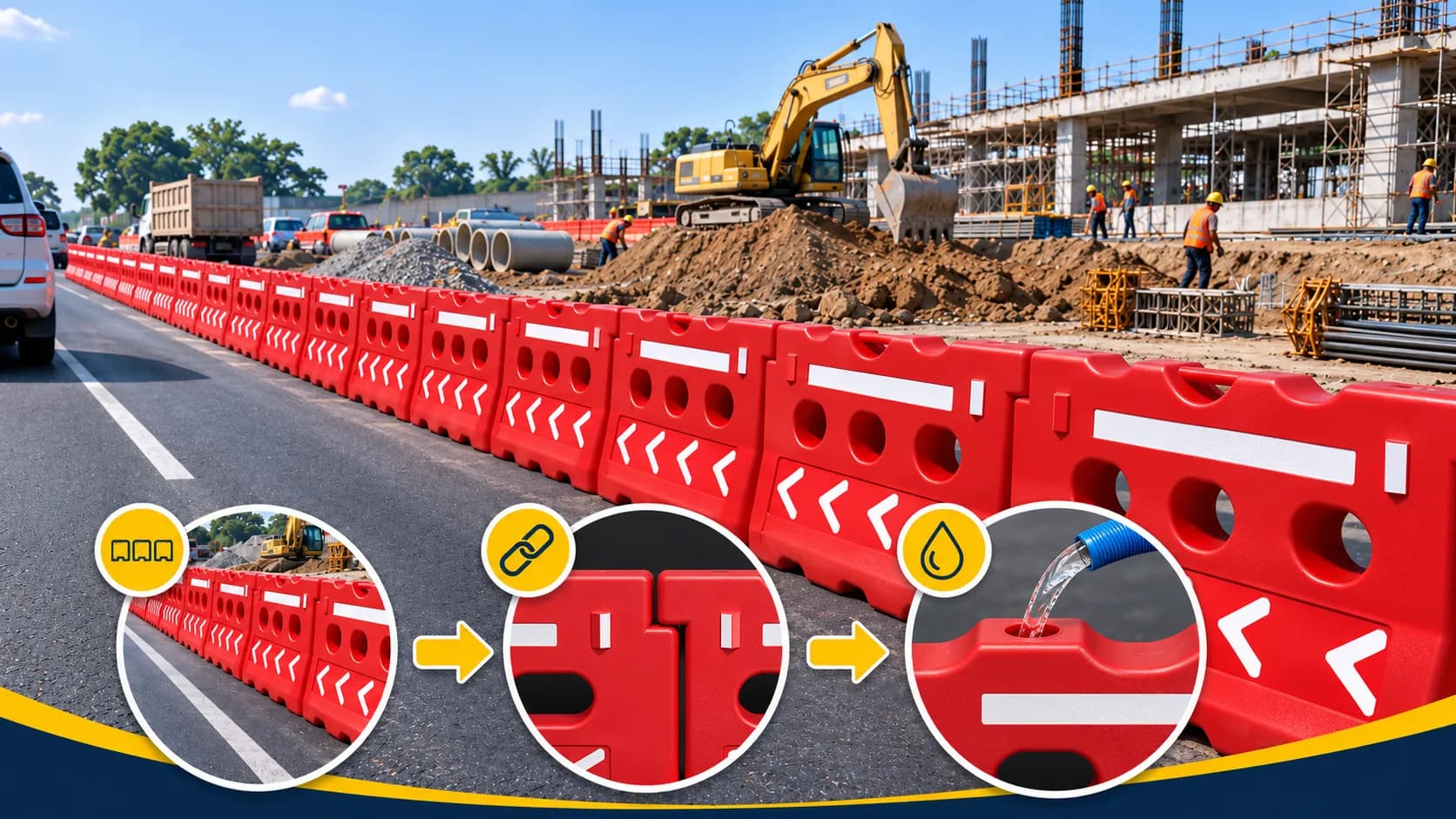
Construction work does not always take place in enclosed areas. In road repair projects, for example, vehicles still need to pass through even when part of the road is under construction. Likewise, in industrial areas, goods transportation activities often continue while facility construction or maintenance work is underway.
In these conditions, road barriers are needed to separate work areas from routes that remain in use. In addition to making boundaries clearer, barriers help drivers recognize changes in traffic routes and avoid areas they are not permitted to enter.
However, choosing road barriers for construction projects involves more than simply considering price or size. The type of work, site conditions, traffic flow, and duration of use must all be taken into account from the outset.
Plastic barriers that are easy to move may be suitable for temporary work, but they are not necessarily appropriate for locations requiring protection against vehicle impacts.
So, how do you determine which road barrier is right? Here are several things to consider before making a choice.
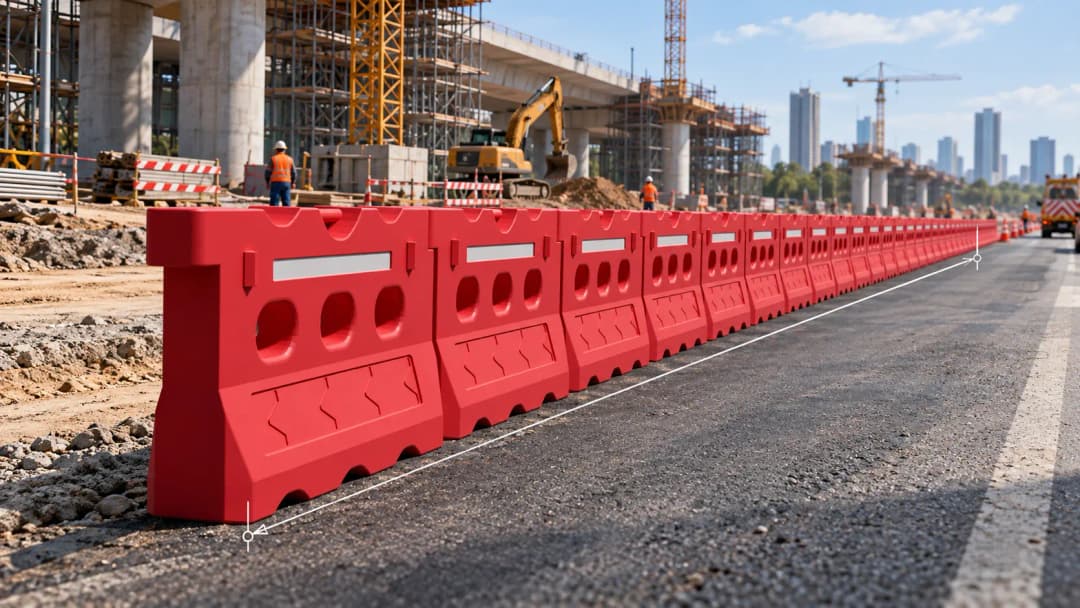
Why Should Road Barriers Be Matched to the Project?
Every project has different site conditions. Some projects last only a few days, while others take months. Some are located on busy public roads, while others are in factory environments or warehouse areas.
These differences affect the type of barrier used.
For temporary work, barriers that are easy to move are generally more practical. Their positions can be adjusted as the stages of work change, without requiring heavy equipment to relocate them.
Conversely, work along roads with high-speed traffic requires greater attention to impact risks. In these situations, barriers that only serve to guide traffic may not be sufficient.
Therefore, before selecting a product, project managers need to understand the actual function required of the barrier.
Is the barrier only being used to mark the boundaries of the work area? Is it needed to direct vehicles to another lane? Or is a system required that can restrain vehicles from entering a hazardous area?
The answers to these questions will help narrow down the appropriate barrier materials and types.
Different Project Areas Require Different Approaches
Road barriers are not only used in highway construction. They are also needed in building projects, industrial areas, warehouses, and public facilities.
Although all of these applications use barriers, the way they are positioned is not always the same.
Road Repair and Construction Projects
In roadwork, barriers are usually placed to clearly distinguish the construction area from lanes that vehicles can still use.
For example, when one side of a road is being repaired, barriers can be installed to separate the work site from the vehicle lane. Drivers can then recognize the boundary of the area they must not cross.
Water-filled plastic road barriers may be considered for temporary traffic lane management, provided they are consistent with the traffic safety plan.
However, on road sections with a high risk of impact, the selection of a protective system must comply with the project's safety requirements.
Building Projects and Construction Sites
Building construction areas generally involve project vehicles, material transportation, and workers entering and leaving the site.
Road barriers can be used to mark operational vehicle routes, restrict access to work sites, or separate areas that are not yet permitted for use.
For requirements that change frequently, modular barriers can make it easier to rearrange the work area.
For example, once material loading and unloading activities have been completed, the barriers can be moved to accommodate the next stage of work.
Industrial and Warehousing Areas
Industrial environments often have vehicle routes located close to work areas.
In locations like these, barriers can be used to mark machine maintenance areas, restrict vehicle access, or organize temporary routes while work is underway.
One important consideration is the type of vehicles operating in the area. Forklift routes, logistics truck routes, and light vehicle routes present different levels of risk.
Ordinary plastic barriers should not be regarded as protection against forklift or heavy vehicle collisions without appropriate technical evidence of their capabilities.
Parking Areas and Public Facilities
During parking area renovations, managers often need to close off part of the site without stopping all vehicle activity.
Modular barriers can help indicate which sections are still available for use and which areas are temporarily closed.
Similar applications can also be found at public events that require changes to vehicle routes, provided the barriers and supporting equipment are suited to the site's safety arrangements.

Plastic or Concrete Barriers: Which Is More Suitable?
In construction work, commonly used road barriers include plastic barriers and concrete barriers.
The two have different characteristics, particularly in terms of weight, ease of relocation, and protective function.
Plastic road barriers are generally made from polyethylene materials, including High Density Polyethylene (HDPE). They have a hollow structure and, in certain models, can be filled with water as ballast.
When empty, plastic barriers are relatively easy to transport and arrange. After they are positioned, water is added to increase their weight and help improve stability.
These characteristics make plastic road barriers a common consideration for traffic management and temporary area separation.
Meanwhile, concrete road barriers are significantly heavier and usually require equipment for transportation and installation.
Concrete barriers are often used in projects that require a heavier barrier structure. For vehicle impact protection, however, the design, connections, and performance of the concrete barrier system must still meet applicable technical requirements.
The following table provides an overview of their differences.
| Aspect | HDPE Plastic Barriers | Concrete Barriers |
|---|---|---|
| Weight | Relatively light when empty | Heavy |
| Relocation | More practical | Generally requires equipment |
| Use | Temporary lane and area management | Lane separation and protective systems according to design |
| Ballast | Can use water in certain models | Relies on mass and structural design |
| Position adjustment | Relatively easy | More difficult |
| Impact resistance | Depends on design and test results | Depends on design and test results |
It is important to distinguish that not all plastic barriers can restrain a vehicle that collides with them. Likewise, for concrete barriers, the ability to withstand impacts must be assessed based on the design of the overall system.
If the main objective is simply to clarify work area boundaries or direct temporary traffic, plastic barriers can be a practical option.
However, if a project requires protection against vehicle impacts, the product must be selected based on safety requirements and test evidence, rather than material alone.
What to Check Before Choosing a Road Barrier
After understanding the types of barriers available, the next step is to match them to site conditions.
Several of the following considerations often affect how smoothly barriers can be used throughout a project.
Consider the Duration of the Work
Short-term projects usually require barriers that are practical to install and remove.
For longer projects, however, material condition, stability, and ease of inspection become additional considerations.
Barriers used repeatedly should also be inspected before being reinstalled, particularly the connections, body, and water-filling points.
Consider Traffic Flow and Vehicle Types
Road conditions involving light vehicles are certainly different from routes used by heavily loaded trucks.
In addition to vehicle types, operating speeds and the distance between vehicles and the work area also need to be considered.
The greater the risk of vehicles leaving their designated routes, the more important it becomes to ensure that the barrier system provides an appropriate level of protection.
Consider the Surface and Layout of the Area
Barriers should be placed on sufficiently level and stable surfaces.
At locations that are sloped, uneven, or close to excavations, installation requires additional assessment to prevent the barriers from shifting easily or creating new hazards.
The shape of the route must also be checked. Not all modular road barriers are designed to follow curves or sharp changes in direction.
For products whose connections are designed to form a straight line, their use must respect these limitations.
Make Sure the Barriers Are Clearly Visible
Barrier color affects how easily drivers can recognize road boundaries.
Bright colors such as red, yellow, and orange are often used to make barriers easier to notice.
At night, reflectors help reflect light when illuminated by vehicle headlights.
Even so, reflectors are not a substitute for lighting or traffic signs. Both must still be suited to road conditions and the project's safety plan.
Understanding HDPE Road Barrier Dimensions and Specifications
In addition to material, size is an important consideration when selecting road barriers for projects.
Barriers of different sizes affect the space needed for placement, transportation, and the number of units required.
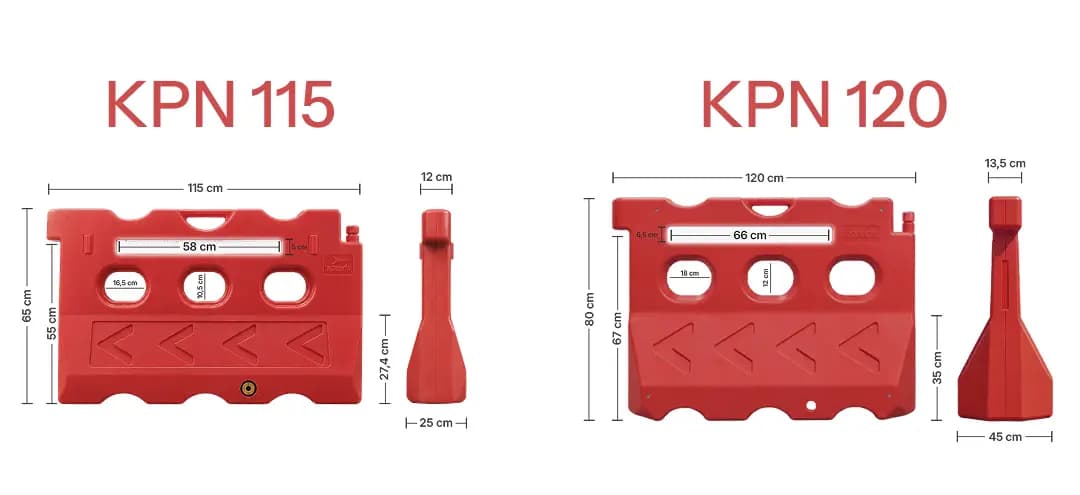
As a reference, PT Karya Pilar Nusantara offers two HDPE road barrier models: KPN 115 and KPN 120.
Road Barrier KPN 115
The KPN 115 model measures 115 cm in length, 25 cm in width, and 65 cm in height.
With a water capacity of 90 liters, this model can be used as a modular barrier to help manage vehicle routes and separate work areas.
Its dimensions may be a consideration for areas that need temporary barriers where placement space is relatively limited.
Road Barrier KPN 120
The KPN 120 model is larger, measuring 120 cm in length, 45 cm in width, and 80 cm in height.
Its water capacity reaches 140 liters.
The larger barrier surface may be a consideration for locations that require taller and wider area boundaries.
However, a larger size does not automatically indicate a greater ability to withstand vehicle impacts.
The following are the specifications of both models based on the product page.
| Specification | KPN 115 | KPN 120 |
|---|---|---|
| Length | 115 cm | 120 cm |
| Width | 25 cm | 45 cm |
| Height | 65 cm | 80 cm |
| Water capacity | 90 liters | 140 liters |
| Empty weight | 5.5 kg | 9.5 kg |
| Material | HDPE | HDPE |
Both models use HDPE material and are designed as modular barriers that can be arranged in a connected line.
Model selection should be based on site conditions, available space, the planned layout, and the required safety specifications.
Calculating Road Barrier Requirements on Site
After selecting a model, the next consideration is the number of units.
Calculation errors can result in procurement that does not match actual needs. If there are too few barriers, parts of the area may not be enclosed as planned. Conversely, purchasing too many can increase costs and storage requirements.
The first step is to measure the length of the route where barriers will be placed.
For example, if barriers will be installed to separate a work area from a vehicle lane, measure the length of the section that actually requires separation. Do not simply use the total length of the project if only part of the area needs to be separated.
The nominal length of each unit can be used for an initial estimate. However, the final calculation must account for the effective length after the connections are installed, the positions of the ends of the barrier line, and the shape of the area.
For work carried out in stages, the number of barriers required may also change as the work location moves.
Therefore, a planned layout drawing will be very helpful before the number of units is finalized.
Keep in mind that road barriers with straight-line connections should not be assumed capable of bending around curves. If the project route changes direction, the barrier configuration must first be checked, or another suitable system must be used.

Small Details Often Overlooked During Procurement
In addition to size and number of units, several product components should be checked before purchase.
These details may seem simple, but they can have a considerable impact once the barriers are used on site.
Water-filling opening. On hollow road barriers, this opening is used to add water as ballast after the units have been positioned. Ease of access for filling should be considered, especially when a large number of barriers are involved.
Drainage opening. The drain makes it easier to empty the water before the barriers are moved or stored. The condition of the cap should also be checked to prevent leaks.
Grip or handle. The handle helps workers lift and position the units while they are still empty. Make sure the handle is easy to reach and is not damaged.
Connection system. Modular barriers generally have components that connect one unit to another. Check that the connections match the product model and can be properly secured.
Reflectors. In locations with limited lighting, reflectors help improve barrier visibility when illuminated by headlights. Make sure their condition and placement are appropriate for the direction of approaching vehicles.
For projects involving large procurement quantities, inspecting the products before delivery is also important. In addition to confirming the quantity, buyers can check specification consistency and the required accessories.
Road Barrier Selection Mistakes to Avoid
One common mistake is assuming that all road barriers serve the same function.
In fact, a barrier designed to mark a traffic lane is not necessarily suitable for protecting against vehicle impacts.
Another mistake is choosing a product based on price without considering site requirements.
A lower-priced barrier may not be suitable if its dimensions, construction, or connection system do not match the planned installation.
Conversely, using barriers that are too large for a narrow area can also interfere with vehicle movement space.
Water filling also requires attention. A road barrier that is supposed to use water as ballast must not be put into service empty if the operating instructions require it to be filled.
Another often-overlooked factor is supporting traffic safety equipment.
For work on public roads, barriers alone are not enough. The placement of temporary signs, traffic flow arrangements, and other warning devices must follow the traffic management plan and the requirements of the relevant authorities.
Choosing the right barriers from the beginning will help reduce the need for sudden changes once work is underway.
Frequently Asked Questions About Road Barriers for Projects
Are plastic road barriers suitable for all projects?
No. Plastic road barriers are suitable for various temporary area separation and lane management needs, but their use must be adapted to site conditions and risks.
If the project requires a vehicle impact restraint system, barriers with capabilities tested against the relevant technical requirements are needed.
Do road barriers for projects need to be filled with water?
For models that use water as ballast, filling must follow the manufacturer's instructions and the installation requirements.
Water helps increase the weight and stability of the unit. When it needs to be moved, the water can be released through the available drain.
Can HDPE road barriers be used repeatedly?
Yes, as long as the products remain in suitable condition for use.
Before reinstalling them, inspect the body, connections, filling openings, and drains. Products with damage that affects their function should not be used until they have been confirmed fit for use.
Can plastic road barriers be installed around curves?
Not all models support installation along curves.
KPN road barriers with straight-line connection systems are not designed to bend around curves. For areas that require changes in direction, an assessment of the layout and selection of suitable barriers is necessary.
How do you choose the right road barrier size for a project?
Start by measuring the installation area and understanding the intended purpose of the barriers.
Consider the length, width, height, ballast capacity, connection system, and available space at the location. The product dimensions can then be matched to the area management plan and the project's safety requirements.
Choosing the Right Barriers from the Start
The use of road barriers must be planned according to the needs of the work. Barriers suitable for temporary routes in industrial areas may not be appropriate for road projects with high-speed traffic.
Therefore, product selection should begin with site conditions, barrier function, vehicle types, and duration of use.
For work that requires modular barriers that are easy to move, HDPE road barriers can be one option. The material supports outdoor use, while the hollow design allows water to be used as ballast.
PT Karya Pilar Nusantara provides KPN 115 and KPN 120 HDPE Road Barriers for area separation, vehicle route management, and project procurement needs.
As a manufacturer, PT Karya Pilar Nusantara serves procurement needs ranging from small to large quantities, supported by direct product supply from the factory.
For information on dimensions, capacities, and available product options, visit the PT Karya Pilar Nusantara HDPE Road Barrier page.
Match the type and number of barriers to the needs of the project before making a purchase.