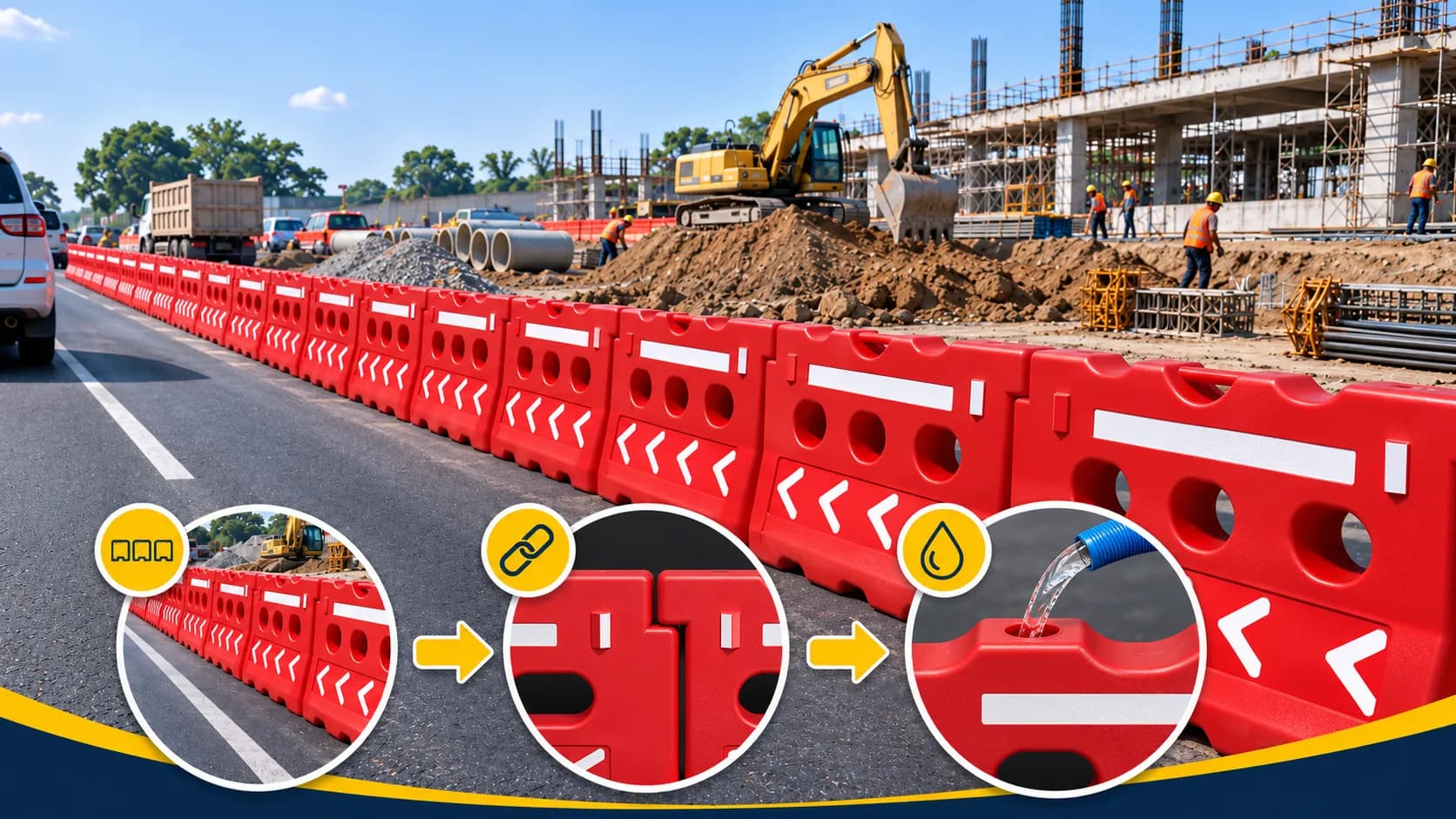
When road repair work is underway, some vehicle lanes usually need to be temporarily closed or diverted. To prevent motorists from entering the work area, workers install barriers that are easily visible from a distance. One commonly used type of barrier is the plastic road barrier.
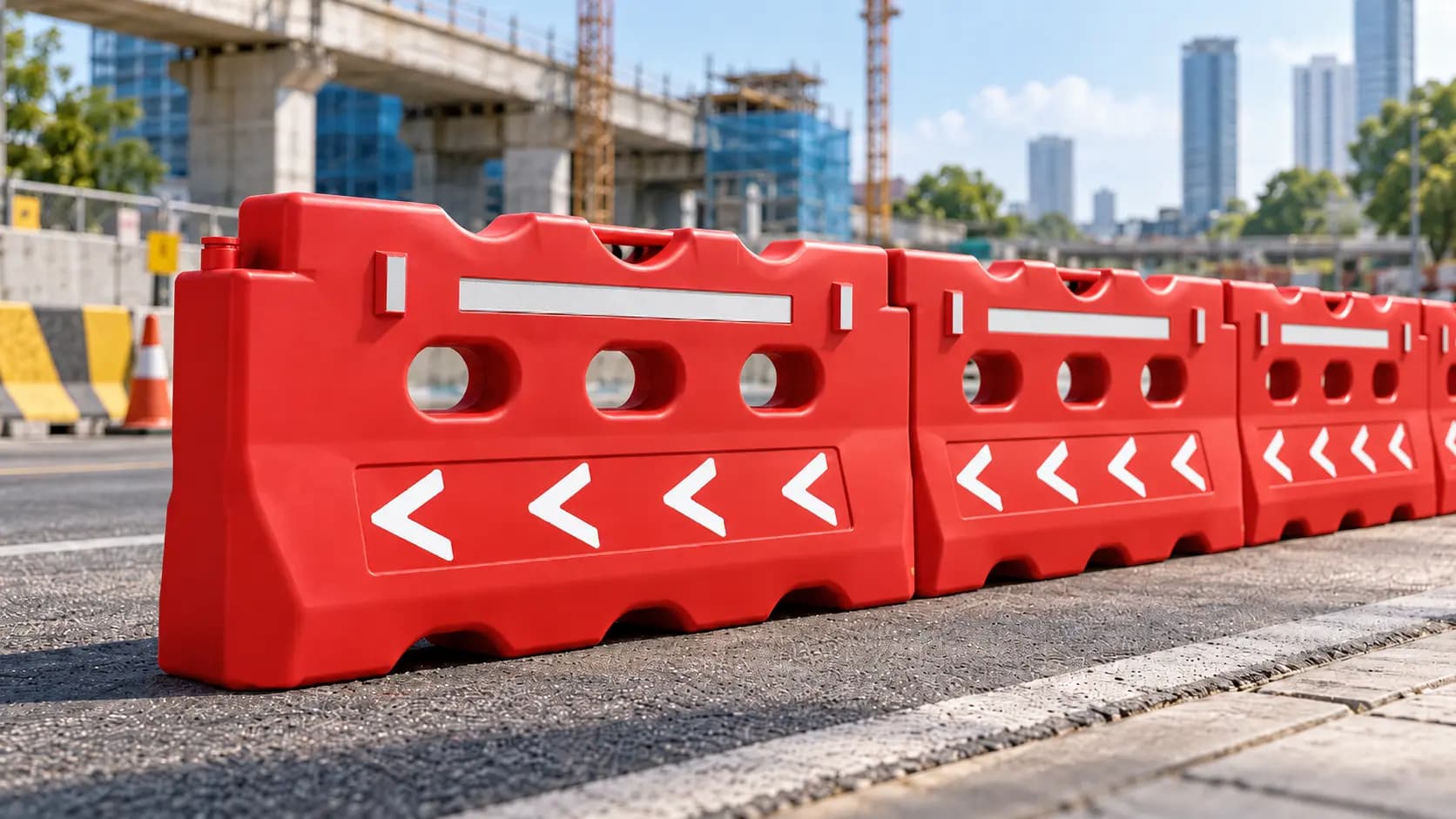
These barriers are generally red, orange, or yellow. They have an elongated shape, a hollow interior, and can be arranged in rows according to the needs of the area. Compared to concrete barriers, plastic road barriers are easier to move when the work location changes.
Many products today use High Density Polyethylene (HDPE), a type of plastic widely used for industrial applications and outdoor equipment.
So, what are the advantages of HDPE plastic road barriers, and what are their characteristics? Here is the explanation.
Understanding HDPE Plastic Road Barriers
Plastic road barriers are road dividers used to separate vehicle lanes, mark specific areas, or temporarily restrict access. These barriers can be found at road construction sites, construction projects, industrial areas, and parking facilities.
Unlike road barriers made from solid concrete, plastic road barriers generally have a hollow construction. Their interiors can be filled with water as ballast after the products have been placed in the required positions.
Road barriers that use water as ballast are also often referred to as plastic water barriers.
When empty, the barriers are relatively lightweight, making transportation and arrangement easier. Once water is added, their overall weight increases, making the barriers more stable.
Although their shapes and functions are almost the same, not all plastic road barriers have uniform specifications. Differences can be found in their materials, dimensions, body construction, filling capacity, and connection systems between units.

Why Do Road Barriers Use HDPE Material?
HDPE stands for High Density Polyethylene, a type of polyethylene plastic with high density.
This material has long been used for various industrial products, such as pipes, water tanks, drums, plastic pallets, and construction equipment. One reason for its use is that HDPE offers a fairly good combination of rigidity, toughness, and material weight.
In the manufacture of road barriers, this material provides several advantages.
First, HDPE has impact toughness. This material can deform when subjected to pressure without immediately breaking like more brittle materials. Nevertheless, the durability of each product still depends on material quality, wall thickness, and body design.
Second, HDPE does not rust. This property is useful because road barriers are often placed in open areas and exposed to rainwater. Unlike iron, HDPE surfaces do not require special protection to prevent metal corrosion.
Third, HDPE has low water absorption. This is one reason the material is used in products that come into contact with water or are placed in humid environments.
In addition, HDPE can be formed through plastic molding processes, including blow molding. This process allows the production of hollow bodies suitable for water-filled road barrier products.
However, it should be noted that HDPE can also experience degradation in its properties due to prolonged exposure to ultraviolet radiation. For outdoor use, attention should be paid to the quality of the material formulation and the use of UV stabilizers.
Therefore, the quality of HDPE road barriers is determined not only by the material itself but also by the production process and the overall product construction.
For further information about the material, readers can refer to the article Advantages of HDPE for Industrial Products.
Characteristics of Plastic Road Barriers You Should Know
In terms of their shape, plastic road barriers have several characteristics that distinguish them from permanent road barriers.
1. Have a Hollow Body
The interior of a road barrier is designed with space to hold ballast material, generally water.
This hollow construction makes transportation easier because the product does not have to be transported while filled. Filling is carried out after the barrier has been placed at the designated location.
The filling capacity of each model varies. The larger the storage space, the more water can be added according to the product's capacity limit.
2. Use a Modular Connection System
Most plastic road barriers have connecting parts at both ends. These parts are used to connect several units into a continuous barrier arrangement.
With this system, several units can be installed in rows to separate lanes or restrict access to an area.
The shape of the connections must be considered because each product has a different design. Some models are designed for straight installations, while certain systems have special installation configurations.
Therefore, road barrier arrangements should not follow curves if their connection design does not allow it.
3. Have Easily Recognizable Colors
Plastic road barriers are usually manufactured in fairly striking colors, such as orange, red, or yellow.
The choice of color is not merely for appearance. Colors that contrast with road conditions help motorists recognize the boundaries of areas where barriers have been installed.
Some products also feature reflective stickers that reflect light from vehicle headlights.
Even so, the use of road barriers at night still needs to be supported by lighting, signs, and other safety equipment according to site conditions.
4. Have a Supporting Base
The bottom section of a road barrier is designed to help support the body when placed on the road surface.
The width of the base, the shape of the feet, and the product's weight distribution affect its stability during use.
Therefore, two road barriers that look almost identical do not necessarily have the same installation characteristics.

Advantages of Plastic Road Barriers for Field Applications
The use of plastic road barriers offers several advantages, particularly for work that requires temporary area management.
Easier to Move
One of the main advantages of plastic road barriers is their relatively light weight when empty.
When a project enters the next stage of work, the positions of the barriers often need to be changed. With plastic barriers, rearrangement can be carried out without having to lift heavy concrete blocks.
This makes fieldwork more practical, especially at locations where vehicle routes change periodically.
Do Not Require Permanent Installation
Plastic road barriers can be placed in planned areas without the need to construct permanent concrete foundations for each unit.
After the work is completed, the ballast water can be drained, and the barriers can be moved to storage or the next location of use.
This advantage makes road barriers suitable for work with limited implementation periods.
Can Be Reused
As long as the body and connections remain in good condition, plastic road barriers can be used for other projects.
For example, barriers previously used for road maintenance work can be moved for parking area arrangements or subsequent construction work.
Repeated use can help reduce the need to purchase new units. However, the economic benefits still depend on the product's service life, frequency of relocation, and maintenance methods.
Relatively Practical for Shipping and Storage
HDPE road barriers can be shipped empty, so the load weight does not increase due to ballast water.
For projects requiring large quantities, this makes transportation planning easier. Nevertheless, the capacity of delivery vehicles must still be calculated based on the dimensions, product shapes, and arrangement methods.
Suitable for Various Locations
Plastic barriers are not only used on public roads. These products can also be used in locations that require temporary area separation.
Their use can be adjusted to the function and risk level of each location, provided that the barrier specifications meet those requirements.

Applications of Plastic Road Barriers in Various Areas
Plastic road barriers are commonly found in locations that require temporary barriers. The following are several examples of their applications.
Road Construction and Repair Projects
During asphalt paving, drainage repairs, or road infrastructure construction, certain areas need to be separated from vehicle lanes.
Plastic road barriers can be used to clearly mark work boundaries and direct vehicles away from closed zones.
For example, in December 2019, the South Jakarta Transportation Sub-Department installed plastic road barriers together with traffic cones on Jalan Casablanca to help regulate vehicle lanes.
This type of use demonstrates that road barriers can be part of traffic management equipment rather than the only safety devices being used.
Factory and Warehouse Areas
Industrial environments usually have operational vehicle routes, loading and unloading areas, and certain sections where work is being carried out.
Road barriers can be placed to mark maintenance work boundaries, temporarily close access, or help separate vehicle routes from other areas.
However, if there is a risk of heavy vehicles or forklifts colliding with the barriers, a safety assessment and an appropriate protection system are required.
Parking Areas
Building managers, shopping centers, and parking facilities can use plastic road barriers when they need to close certain sections of an area.
For example, during parking surface repairs, changes to entrance routes, or parking arrangements for particular activities.
Because the barriers can be moved, the area layout can be adjusted again after the activity is completed.
Events and Public Activities
At exhibitions, concerts, or sporting events, plastic road barriers can help mark the boundaries of operational vehicle routes and areas where vehicles are not permitted to enter.
These barriers can be part of temporary access management alongside signs and field personnel.
It is important to distinguish that road barriers designed for vehicles cannot automatically be used as fences to withstand crowd pressure.

Understanding Karpinus HDPE Road Barrier Specifications
PT Karya Pilar Nusantara provides HDPE road barriers for project needs, traffic management, and the separation of operational areas.
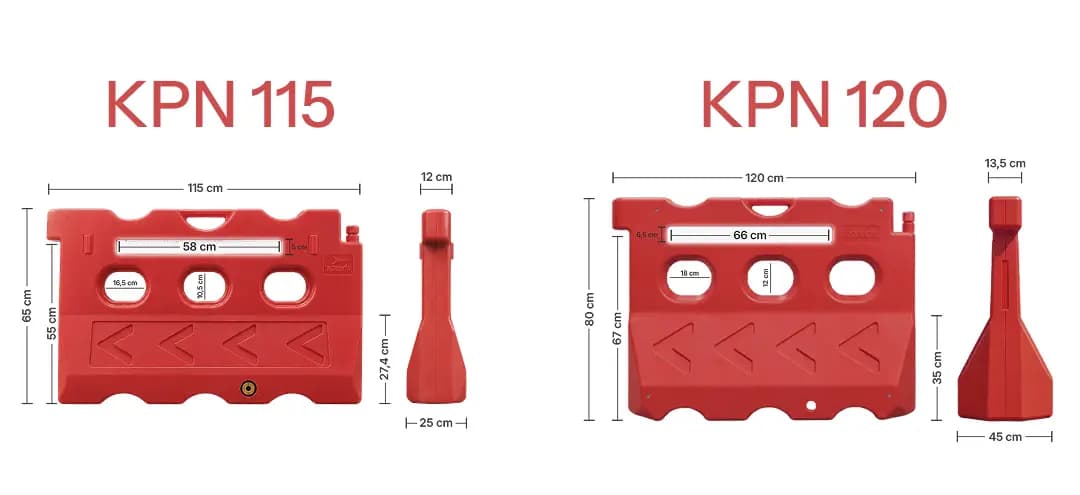
The products available in the Karpinus Road Barrier line include two models, namely KPN 115 and KPN 120.
The following is a comparison of the specifications listed on the KPN product page.
| Specification | KPN 115 | KPN 120 |
|---|---|---|
| Material | HDPE | HDPE |
| Length | 115 cm | 120 cm |
| Width | 25 cm | 45 cm |
| Height | 65 cm | 80 cm |
| Empty weight | 5.5 kg | 9.5 kg |
| Water capacity | 90 liters | 140 liters |
The KPN 115 has more compact dimensions with a water capacity of 90 liters. This model can be an option when site requirements prioritize barriers that are not too large.
Meanwhile, the KPN 120 has a taller and wider body, along with a greater water filling capacity.
These differences need to be considered based on site conditions, installation space, and operational requirements.
The listed weights refer to the products when empty, not their total weight after being filled with water.
To view model details and the latest product information, visit the Karpinus HDPE Road Barrier page.
Things to Consider Before Choosing a Road Barrier
Although plastic road barriers have relatively simple functions, product selection should not be based solely on color or price.
There are several things to check before deciding which model to use.
Match the Intended Installation Purpose
First, determine the function of the barrier, whether it is intended to mark work areas, regulate vehicle routes, close access, or serve other purposes.
If the installation is carried out on a public road, the location and type of equipment must follow the traffic management plan and the regulations of the relevant authorities.
Check the Dimensions and Water Capacity
The dimensions of the barrier affect the space required for installation. Meanwhile, the filling capacity is related to the product's weight after water is added.
Choose dimensions that suit the conditions of the area rather than simply assuming that a larger product is always better.
Pay Attention to the Material and Product Construction
In addition to confirming the material used, inspect the body, feet, filling holes, and connectors between units.
The product should have a construction suitable for its intended use and should not show cracks or damage to important parts.
Determine the Required Number of Units
The length of the installation area is one of the main factors in determining the number of road barriers required.
However, the calculation cannot be made simply by dividing the road length by the nominal length of the product. The connection design, unit arrangement, and conditions at the starting and ending points must also be considered.
For projects involving relatively long installations, it is advisable to check the layout beforehand so that the number of units prepared matches the requirements.
Usage Limitations and Maintenance of Plastic Road Barriers
Plastic road barriers offer many advantages, but this does not mean they can be used under all road conditions.
One important consideration is the difference between barriers that function to guide vehicles and safety systems designed to withstand vehicle impacts.
Water-filled HDPE road barriers can help improve barrier stability, but filling them with water does not automatically make them capable of stopping a vehicle that collides with them.
For locations that require protection against vehicle impacts, a barrier system with an appropriate design and supporting test evidence is necessary.
In addition to considering their function, the condition of the barriers must also be inspected regularly.
Parts that need attention include the condition of the plastic body, connections between units, water filling caps, and possible leaks.
Barriers that are cracked, excessively deformed, or damaged at the connections need to be inspected before being reused.
If the products are stored for long periods, they should be placed in areas that comply with the manufacturer's storage instructions. Cleanliness and material condition must also be maintained to ensure the products remain suitable for use.
With proper inspections, plastic road barriers can be reused as long as their condition and function continue to meet the requirements.
Conclusion: Choosing Road Barriers That Suit Your Needs
HDPE plastic road barriers are a practical type of barrier for traffic management and temporary area separation.
Their hollow construction, light weight when empty, ability to be filled with water, and modular design make these products easy to use for various field applications.
HDPE material also has several properties that support its use, such as toughness, low water absorption, and corrosion resistance.
Nevertheless, road barrier selection must still consider dimensions, water capacity, connection construction, installation conditions, and the level of risk at the location.
For project requirements or the procurement of plastic road barriers, information about available models and product specifications can be found in the PT Karya Pilar Nusantara HDPE Road Barrier catalog.