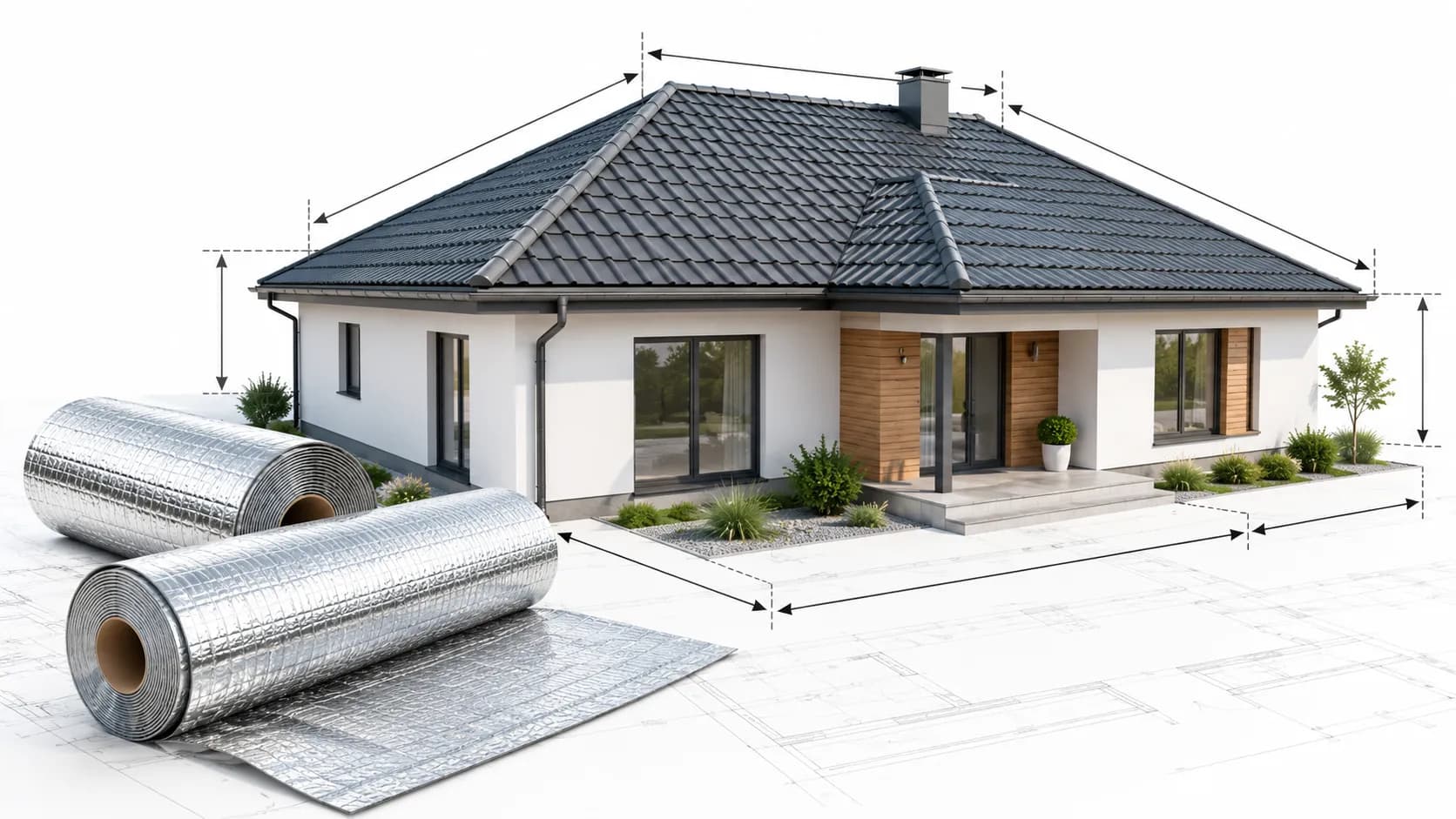
Behind the silver-colored layer found on some roof insulation products lies a foam material that plays an important role in reducing heat transfer. One of the materials used is XLPE foam, or Cross-Linked Polyethylene Foam.
This material has a closed-cell structure that differs from ordinary foam. This structure gives XLPE foam characteristics suitable for thermal insulation, especially when combined with an aluminum foil layer.
In the construction industry, XLPE foam is used as one of the materials for roof insulation to help reduce heat entering a building through the roof. It can be found in residential houses, warehouses, workshops, and industrial facilities.
So, what does the structure of XLPE foam actually look like? Why is this material used for roof insulation, and what characteristics should be considered?
Here is the explanation.
What Is XLPE Foam for Roof Insulation?
XLPE foam is a foam material made from polyethylene that has undergone a cross-linking process, which forms cross-links between its polymer chains.
Polyethylene itself is a type of polymer widely used for various industrial applications. When processed into foam, this material develops a porous structure with small cells distributed throughout it.
In XLPE, the cross-linking process creates connections between polymer chains, resulting in a more interconnected material network. This process helps improve several physical properties of the foam, including dimensional stability and its ability to resist deformation under pressure.
When used as roof insulation, XLPE foam acts as a layer that helps reduce heat transfer through the material.
XLPE foam can also be combined with aluminum foil. The combination of these two materials allows a single insulation product to provide both a thermal barrier and a reflective surface.
This is why XLPE foam has become one of the materials used in the development of building insulation products.
Understanding the Structure of XLPE Foam and Its Closed Cells
One of the important characteristics of XLPE foam lies in its internal structure.
Although it looks like a solid sheet of foam, the inside of this material actually consists of numerous small cells. In closed-cell foam, most of these cells have walls that separate one cavity from another.
This structure is one of the reasons XLPE foam can be used as an insulation material.
Closed-Cell Foam Structure
In foam with a closed-cell structure, gas is trapped inside small cavities separated by cell walls.
This arrangement helps reduce gas movement within the material and provides resistance to heat flow.
The closed-cell structure also means the material generally has lower water absorption compared to foam with interconnected open cavities.
However, its ability to resist water still depends on the material's quality, surface condition, and the form of the product being used.
The Role of the Cross-Linking Process
In addition to its cell structure, XLPE foam has cross-links within its polymer structure.
The cross-linking process helps improve the mechanical characteristics of polyethylene foam, including its ability to maintain its shape after being subjected to pressure.
As a result, XLPE foam can be manufactured into sheets that are lightweight and flexible while maintaining structural stability for certain applications.
However, not all XLPE foam products have the same level of strength or heat resistance. The final properties depend on the material composition, density, manufacturing process, and specifications of each product.

How Do XLPE Foam and Aluminum Foil Reduce Heat Transfer?
Heat absorbed by the roof surface can move into the interior of a building through several mechanisms.
On metal roofs, for example, the roof surface exposed to sunlight experiences an increase in temperature. Some of this heat is then transferred through the roofing material and radiated into the space beneath it.
Insulation helps reduce this heat transfer.
In a system combining XLPE foam and aluminum foil, each layer serves a different purpose.
XLPE Foam Helps Reduce Heat Conduction
XLPE foam has relatively low thermal conductivity, allowing it to function as a layer that resists heat flow.
In simple terms, heat takes time to travel through the material.
The greater the thermal resistance of an insulation layer, the less heat flows through it under the same temperature difference.
This performance is influenced by the thickness, thermal conductivity, and arrangement of the material.
Aluminum Foil Helps Reduce Radiant Heat
Unlike foam, aluminum foil works as a reflective surface.
A surface with low emissivity can help reduce heat transfer through radiation, particularly when facing an appropriate air space.
For this reason, aluminum foil is often combined with other insulation materials.
It is important to understand that aluminum foil and XLPE foam do not work in the same way. Foam provides thermal resistance through the thickness of the material, while foil helps control radiant heat transfer.
Both can complement each other when used in a properly designed and installed roofing system.

Benefits of XLPE Foam for Thermal Roof Insulation
The use of XLPE foam in thermal roof insulation systems is closely related to the physical characteristics of the material.
There are several benefits that make this material worth considering for various types of construction.
Provides Thermal Resistance
The foam structure, consisting of numerous small cells, helps slow down heat transfer.
This characteristic allows XLPE foam to be used as an insulation layer to help reduce heat passing through the roof structure.
However, the amount of heat reduction inside a building cannot be determined solely by the type of material. Thickness, ventilation, roof surface area, and installation methods also influence the final result.
Lightweight and Flexible
XLPE foam can be manufactured into relatively lightweight sheets or rolls.
This form makes the material easier to handle when moving, cutting, and adjusting it to the installation area.
Its flexibility also supports applications on structures that require the material to follow certain surface shapes.
Has Low Water Absorption
The closed-cell structure helps limit water from entering the foam's cavities.
This characteristic is beneficial for applications in environments with changing humidity levels.
Nevertheless, using XLPE foam does not automatically make the entire roof structure waterproof. Joints, penetrations, and edges still require attention.
Helps Reduce Certain Vibrations and Sounds
In addition to its thermal function, the foam structure can also absorb vibrations and contribute to sound control under certain conditions.
On metal roof structures, this can provide an additional benefit.
However, the level of sound reduction is not always the same for every product. Acoustic performance should be evaluated based on test results and the overall construction system, rather than simply the presence of a foam layer.
Material Characteristics to Consider
Before choosing XLPE foam for roof insulation, several characteristics need to be examined.
First, thermal conductivity. This value indicates a material's ability to conduct heat and is usually expressed in W/m·K. Under equivalent testing conditions, a lower value indicates a lower ability to conduct heat.
Second, material thickness. For materials with the same thermal conductivity, increasing thickness improves thermal resistance. However, thickness should not be used as the only indicator of quality.
Third, foam density. Density represents the mass of a material per unit volume. Differences in density can affect mechanical strength, flexibility, and other characteristics.
Fourth, dimensional stability. Insulation materials need to maintain their shape under their intended operating conditions. Changes in temperature or pressure can affect foam dimensions if the material is used outside its specifications.
Fifth, fire resistance. As a polymer-based material, XLPE foam must be evaluated according to the product's reaction-to-fire classification. Not all foam products have the same formulation or fire performance.
In addition, the quality of the aluminum foil lamination and the durability of the joints also need to be considered, particularly for insulation products that consist of multiple material layers.
By examining these characteristics, insulation can be selected based on technical data rather than simply the product's external appearance.
Applications of XLPE Foam in Different Types of Buildings
XLPE foam can be used in various building applications, particularly when a lightweight and flexible insulation layer is required.
In residential houses, this material can form part of a roof insulation system to help reduce heat entering from above. The selection should still take into account whether the building uses roof tiles, metal roofing, or another type of roof construction.
In warehouses and workshops, XLPE foam combined with aluminum foil is often considered to help control heat coming from large roof surfaces.
Meanwhile, in industrial facilities and factories, insulation requirements can be more complex because heat comes not only from sunlight but also from machinery and production activities.
Therefore, material selection for industrial buildings should also consider operating temperatures, ventilation, fire safety requirements, and working environment conditions.
XLPE foam is not the only type of roof insulation available. Other materials, such as glass wool, rock wool, and polyurethane, have their own characteristics.
To understand the differences between these materials, read Roof Insulation Guide: Types, Thickness, How It Works, and How to Choose.
Understanding XLPE Foam in Karpinux Roof Insulation
One product that uses XLPE foam as part of its insulation system is Karpinux Roof Insulation from PT Karya Pilar Nusantara.
Karpinux combines XLPE foam with an aluminum foil layer to help reduce heat transfer in building structures.
In its laminated structure, this product uses several materials with different functions, including XLPE as the insulation core, aluminum foil as the reflective layer, and additional supporting and protective layers.
According to the technical information published by Karpinux, this insulation material has a thermal conductivity value of 0.030 W/m·K.
This value is one of the material parameters that can be used to understand its heat conduction properties. However, the figure does not directly indicate how much the room temperature will decrease after installation.
Karpinux Roof Insulation is available in thickness options of 5 mm, 8 mm, and 10 mm.
The 5 mm thickness can be considered for renovations and lightweight buildings that require a relatively thin insulation layer.
The 8 mm thickness is an option for warehouses, workshops, and commercial buildings.
Meanwhile, the 10 mm thickness is intended for applications requiring a thicker foam layer, including industrial buildings and areas with higher heat loads.
This product is available in single-side and double-side configurations, with roll dimensions of 1 × 25 meters.
These options allow users to adjust the material specifications according to roof conditions, building requirements, and installation plans.

More detailed information about the material, thickness, and product specifications can be found on the Karpinux Roof Insulation page from PT Karya Pilar Nusantara.
Important Considerations During Installation
Material quality is one of the factors that determine roof insulation performance. However, the final result is also influenced by the installation method.
For insulation based on XLPE foam and aluminum foil, the position of each layer needs to be considered according to the roof construction.
Foil surfaces that function as radiant heat barriers generally require an appropriate air space for their reflective properties to work as intended.
If the foil comes into direct contact with a solid material, the heat transfer mechanism will be different.
In addition, joints between insulation rolls must be handled properly. Exposed sections or installation gaps can affect the continuity of the insulation layer.
Roof space ventilation should not be overlooked either. Insulation helps reduce heat flow, while ventilation regulates air movement inside the building.
Both serve different functions and need to be considered together.
For buildings with specific safety requirements, check the fire classification, operating temperature limits, and manufacturer's installation instructions before selecting the material.
Frequently Asked Questions About XLPE Foam
Is XLPE foam the same as ordinary polyethylene foam?
Both use polyethylene as their base material, but XLPE has undergone a cross-linking process that creates cross-links between its polymer chains. This process can improve several mechanical characteristics and the stability of the material.
Does XLPE foam have to be combined with aluminum foil?
No. XLPE foam can be used for various applications without a foil layer. However, in roof insulation applications, aluminum foil is often added to help reduce radiant heat transfer.
Is XLPE foam water-resistant?
XLPE foam with a closed-cell structure generally has low water absorption. Nevertheless, the water resistance of the overall system still depends on the condition of the material, joints, and installation method.
Can XLPE foam be used on spandek roofing?
XLPE foam can be one of the insulation options for spandek or metal roofing. The choice of thickness and installation configuration should be adjusted to the roof structure and the building's thermal requirements.
Is thicker XLPE foam always better?
For materials with the same characteristics, greater thickness generally provides higher thermal resistance. However, the best option still depends on the building's requirements, the material's thermal conductivity, installation space, and the overall roofing system.
Conclusion: Understanding the Material Before Choosing Insulation
XLPE foam is a closed-cell polyethylene material that has undergone a cross-linking process to achieve certain physical characteristics.
This structure provides several benefits, including thermal resistance, flexibility, low water absorption, and material stability suitable for various insulation applications.
When combined with aluminum foil, XLPE foam can become part of a roof insulation system that combines resistance to heat flow with radiant heat control.
However, using XLPE foam still requires consideration of thickness, material specifications, roof construction, building conditions, and installation methods.
PT Karya Pilar Nusantara provides Karpinux Roof Insulation made from XLPE foam and aluminum foil for various building needs, including residential houses, warehouses, workshops, and industrial facilities.
To determine the appropriate specifications, visit the Karpinux Roof Insulation page and consult the insulation requirements based on the roof type and building conditions.