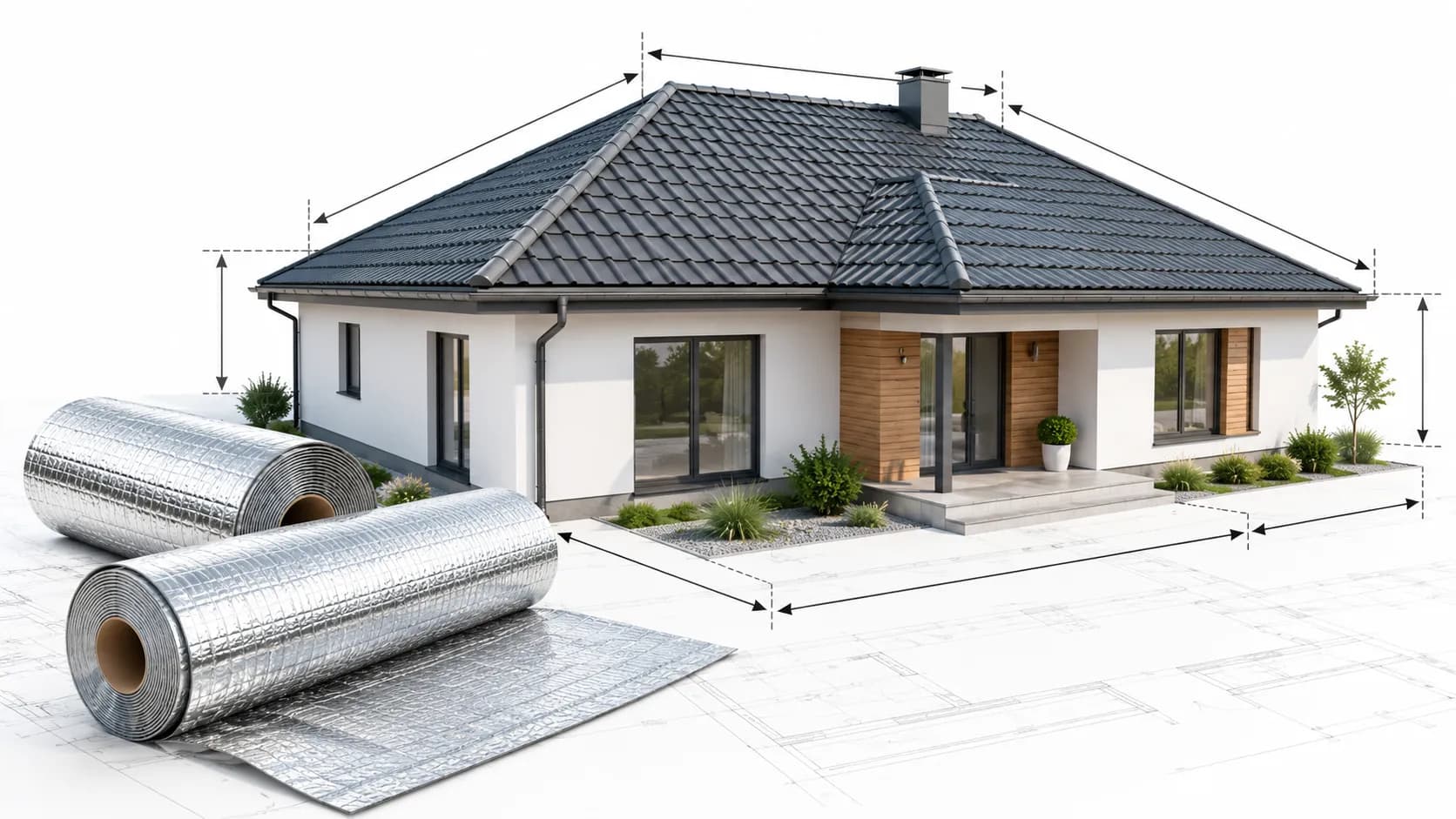
When looking for roof heat insulation materials, you may come across two commonly offered options: single side and double side. At first glance, both look almost identical. They come in the form of insulation sheets or rolls, with silver-colored aluminum foil surfaces.
The difference lies in the number of sides that have a reflective layer.
The single side type uses a reflective layer on one side, while the double side type has reflective layers on both sides. This difference affects how the material is used in a roof construction.
However, is double side necessarily better because both surfaces are covered with aluminum foil? Not necessarily.
The type of roof, installation position, and air space surrounding the insulation also determine the final results. Therefore, before choosing roof insulation, it is important to understand what distinguishes these two types.
Single Side and Double Side: What Is the Actual Difference?
In general, roof insulation is used to help reduce heat transfer from the roof to the room below.
In insulation that combines aluminum foil with foam material, the two materials have different functions. Aluminum foil helps reduce heat transfer through radiation, while foam serves as a layer that resists heat flow.
The terms single side and double side are derived from this material configuration.
Single Side Insulation
Single side insulation is an insulation material that has a reflective layer on one of its surfaces.
When using a foam core, one surface is covered with foil, while the other surface depends on the type of covering or product construction used.
The reflective layer helps reduce radiant heat transfer when facing an appropriate air space.
This type can be an option for roof constructions that require one active reflective surface. For example, when the installation position only provides an air space on one side of the insulation.
Because it has fewer reflective layers, single side insulation is also generally more affordable than double side insulation with equivalent basic specifications.
Double Side Insulation
Unlike single side insulation, double side insulation has reflective layers on both surfaces.
When the middle section uses foam, its structure simply consists of a reflective surface, a foam core, and another reflective surface.
This configuration allows both surfaces to help reduce radiant heat transfer when each faces an air space.
Double side insulation can be considered for roof constructions that have air spaces on both sides of the insulation, or when both reflective surfaces are required in the building design.
However, having more layers does not automatically double the heat insulation performance.
The final results still depend on the roof structure and installation conditions.

Why Can Aluminum Foil Layers Reduce Heat?
To understand the difference between single side and double side insulation, we first need to know how aluminum foil layers work.
When exposed to sunlight, the roof covering experiences an increase in temperature. This heat can then transfer to the underside of the roof and affect the room temperature.
Heat transfer occurs through several mechanisms, including conduction, convection, and radiation.
Conduction occurs when heat travels through materials that are in direct contact with each other. Meanwhile, convection involves the movement of air that carries heat from one place to another.
Radiation is different because heat can transfer in the form of electromagnetic waves without requiring direct contact.
This is where aluminum foil plays a role.
Aluminum foil surfaces with reflective properties and low emissivity can reduce heat exchange through radiation.
However, there is one aspect that is often overlooked when discussing aluminum foil: the presence of an air space or air gap.
Reflective surfaces work effectively when facing an air space. If the foil layer is pressed tightly against another solid material, heat transfer through direct contact can still occur.
That is why shiny foil is not the only factor determining insulation performance.
In products that use foam, the foam layer continues to help resist heat transfer through the material, even when one of the foil surfaces does not have an air space.
Comparison of Single Side vs Double Side Insulation
To make the differences easier to understand, the following comparison highlights several important aspects of these two types of roof insulation.
| Aspect | Single Side | Double Side |
|---|---|---|
| Reflective layer | One side | Two sides |
| Main function | Reduces radiant heat transfer on the side designed to function | Allows radiation control from both surfaces |
| Air space requirements | Air space on the reflective side being used | The benefits of both sides are most relevant when each faces an air space |
| Application | Simple constructions or applications requiring one reflective side | Constructions requiring two reflective surfaces |
| Price | Generally more economical | Generally higher with equivalent specifications |
| Installation considerations | The direction of the reflective side must be considered | Both reflective sides are available, but installation position remains important |
This comparison shows that the main difference lies in the layer configuration, rather than simply the type of building.
There is an assumption that single side insulation is only used for houses, while double side insulation must be used for factories. However, this distinction is not absolute.
A warehouse may use single side insulation if its roofing system only requires one reflective side. Conversely, a residential building may use double side insulation if its construction supports the use of both reflective surfaces.
Therefore, choosing insulation should begin with the condition of the roof, not merely the product name.
When Is Single Side Roof Insulation Sufficient?
Single side insulation can be a reasonable choice when the roof construction only requires one reflective surface.
For example, a building may have an air space beneath the insulation layer, while the other side is close to or in contact with a layer of the roof construction.
Under these conditions, the reflective surface facing the air space can help reduce radiant heat exchange.
Adding a reflective layer to the side without an air space may not necessarily provide benefits proportional to the additional cost.
Single side insulation is also worth considering for projects with limited material budgets, provided that the insulation characteristics and installation design still meet the building's requirements.
However, single side insulation does not mean that its insulation performance is always low.
When compared with double side insulation using a similar foam core, thickness, and material characteristics, its ability to resist conduction through the foam can remain comparable. The main difference lies in the contribution of the reflective surfaces and their conditions of use.
Therefore, single side insulation installed according to the design can be more beneficial than double side insulation installed without considering the roof structure.
When Should Double Side Insulation Be Used?
Double side roof insulation can be considered when a construction allows both reflective surfaces to function.
For example, insulation is installed with an air space between the roof covering and the upper surface of the insulation, as well as another air space between the underside of the insulation and the ceiling.
In this arrangement, both foil surfaces have the potential to help reduce radiant heat exchange in their respective air spaces.
However, the benefits cannot be assessed solely by the number of sides. The distance between layers, direction of heat transfer, surrounding materials, and surface conditions also affect the results.
Double side insulation can also be selected when project specifications specifically require a material with reflective layers on both sides.
In some exposed roof constructions, the underside of the insulation will be directly visible from inside the room. Foil layers on both sides can also provide a more uniform surface appearance, although the final result depends on the type of lamination and installation quality.
It is important to note that double side insulation is not automatically stronger, more waterproof, or more durable than single side insulation.
Tear resistance, moisture resistance, and service life must still be evaluated based on the constituent materials, reinforcement structure, type of lamination, and technical data of each product.

The Effect of Foil Position and Air Gap on Insulation Performance
One common mistake when choosing or installing aluminum foil is assuming that the shiny side must always face upward, toward the roof covering.
In fact, the installation direction needs to be adjusted to the construction.
To take advantage of the reflective function, the foil side must face an appropriate air space. If the air space is located beneath the insulation, the foil surface on that side can help reduce radiant heat exchange.
Conversely, if the foil is in direct contact with the roof covering or another solid layer, the reflective benefits of the surface in contact become limited.
This does not mean that all insulation functions are lost.
The foam material in the middle still retains its own thermal characteristics. However, the benefits of the reflective layer cannot be equated with conditions where the foil faces an air space.
In addition to positioning, installation quality must also be considered.
Material joints, unintended gaps, and compressed sections of insulation can affect the overall performance of the roofing system.
Moisture conditions must also not be overlooked. In certain buildings, differences in temperature and humidity can cause condensation if the layer arrangement, ventilation, and vapor control are not properly designed.
Therefore, both single side and double side insulation should be installed according to the manufacturer's instructions and the construction design being used.
Applications for Residential, Warehouse, and Factory Roofs
Every building has different insulation requirements. The following examples can be used as considerations before making a choice.
Residential Roofs
In houses with spandek or galvalum roofing, the conditions of the space beneath the roof should be considered first.
Is there a ceiling? Will the insulation be installed during roof construction or as part of a renovation? How much space is available between the roof covering and the layers beneath it?
If only one reflective surface will face an air space, single side insulation may be sufficient.
However, if there are air spaces on both sides and the installation design allows both to be utilized, double side insulation can be considered.
Warehouses and Workshops
Warehouses and workshops often have large roof areas, especially when using metal roofing.
In buildings like these, choosing insulation should not be based solely on the number of foil sides.
Roof height, ventilation, the presence of a ceiling, and the activities taking place inside the building must also be considered.
For example, a warehouse without a ceiling and one with a closed ceiling may have different air space configurations.
Therefore, both single side and double side insulation can be used, depending on how the material is installed.
Factories and Industrial Buildings
In industrial buildings, heat control requirements can be more complex due to production machinery, worker activities, mechanical ventilation, and large operational areas.
Double side insulation may be an option in certain designs that require reflective surfaces on both sides of the insulation.
However, using double side insulation alone does not guarantee that the room temperature will decrease to the desired target.
If the largest heat source comes from machinery or production processes, improvements to ventilation and heat control at the source should also be considered.
Thus, insulation selection for industrial buildings should be based on the overall building conditions.

Choosing Roof Insulation: Don't Just Look at the Number of Sides
Besides choosing between single side and double side insulation, there are several other factors that should be checked before purchasing the material.
First, examine the core material.
Not all aluminum foil insulation products use the same core material. Some use woven materials, bubble layers, and foam, each with different structures and characteristics.
The core material affects the insulation's ability to resist heat transfer through the layer.
Second, check the thickness.
For materials with the same thermal properties, thicker foam generally provides greater resistance to heat conduction.
However, thickness and the number of foil sides are two different specifications. Both need to be evaluated separately.
Third, pay attention to the type of reflective layer.
The term aluminum foil is sometimes used generally to describe various products with shiny surfaces.
However, aluminum foil and metallized film can have different structures and characteristics. Check the material information provided by the manufacturer, rather than relying solely on appearance.
Fourth, adjust the selection to the project budget.
For large roof areas, differences in price per square meter can affect the total material cost.
If single side insulation already meets the construction design requirements, using double side insulation may not be the most economical option.
Conversely, if both reflective surfaces are indeed required, choosing single side insulation simply because it is cheaper may not meet the project's needs.
Karpinux Roof Insulation Options
As one of the options for roof insulation needs, Karpinux from PT Karya Pilar Nusantara provides XLPE foam-based roof insulation in single side and double side variants.
Three thickness options are available:
| Thickness | Application Characteristics |
|---|---|
| 5 mm | For relatively thin layer requirements, renovations, and lightweight buildings |
| 8 mm | An option for warehouses, workshops, and commercial buildings |
| 10 mm | For projects requiring a thicker foam layer, including industrial buildings |
All three thicknesses are available in single side and double side options, with roll dimensions of 1 × 25 meters.
Karpinux combines foam material with a reflective layer system to help reduce heat transfer through the roof construction. The lamination options can be adjusted according to the product variant and project requirements.
To view the available materials and specifications, visit the Karpinux Roof Insulation page.
If you are still comparing thickness options, you can also read the article Roof Insulation Thickness: 5 mm, 8 mm, or 10 mm — Which Should You Choose?.
FAQ: Questions About Single Side and Double Side Insulation
Does double side roof insulation provide better cooling than single side insulation?
Not always. Double side insulation has two reflective surfaces, but its insulation performance is influenced by foil position, the presence of air spaces, the core material, and the roof construction.
Double side insulation cannot automatically be assumed to provide twice the heat reduction performance of single side insulation.
Is single side insulation suitable for spandek roofing?
Yes. Single side insulation can be used in spandek roof constructions if the material and installation arrangement meet the building's requirements.
The position of the foil surface, air spaces, and other surrounding layers must be considered.
Does double side aluminum foil require an air gap on both sides?
To take advantage of the reflective benefits of both surfaces, each side needs to face an appropriate air space.
If one side is in direct contact with a solid material, the reflective benefits on that side become limited. Nevertheless, the foam layer can still function as a barrier to heat conduction.
Is double side insulation thicker than single side insulation?
Not necessarily. The number of reflective sides and the thickness of the insulation core are two different things.
For example, roof insulation with a nominal thickness of 8 mm may be available in both single side and double side configurations.
Which is more suitable for factory roofs?
Both can be used, depending on the roof construction, thermal requirements, air spaces, and project specifications.
Factories do not necessarily have to use double side insulation. The selection should consider the overall roofing system.
Conclusion: Which Is More Suitable for Your Roof?
The main difference between single side and double side roof insulation lies in the number of reflective surfaces.
Single side insulation has one reflective surface and can be an economical option for constructions that require one active reflective side.
Meanwhile, double side insulation provides reflective layers on both surfaces and is more worth considering when the construction allows both sides to be utilized.
However, the number of foil layers is not the only measure of insulation quality. The core material, thickness, air spaces, ventilation, and installation method also play important roles.
Before purchasing, examine the roof structure and building requirements to ensure that the selected material is truly suitable for its intended use.
For residential buildings, warehouses, workshops, and industrial buildings, PT Karya Pilar Nusantara provides Karpinux Roof Insulation in single side and double side options.
Consult your roof specifications and material requirements to determine the most suitable Karpinux variant.