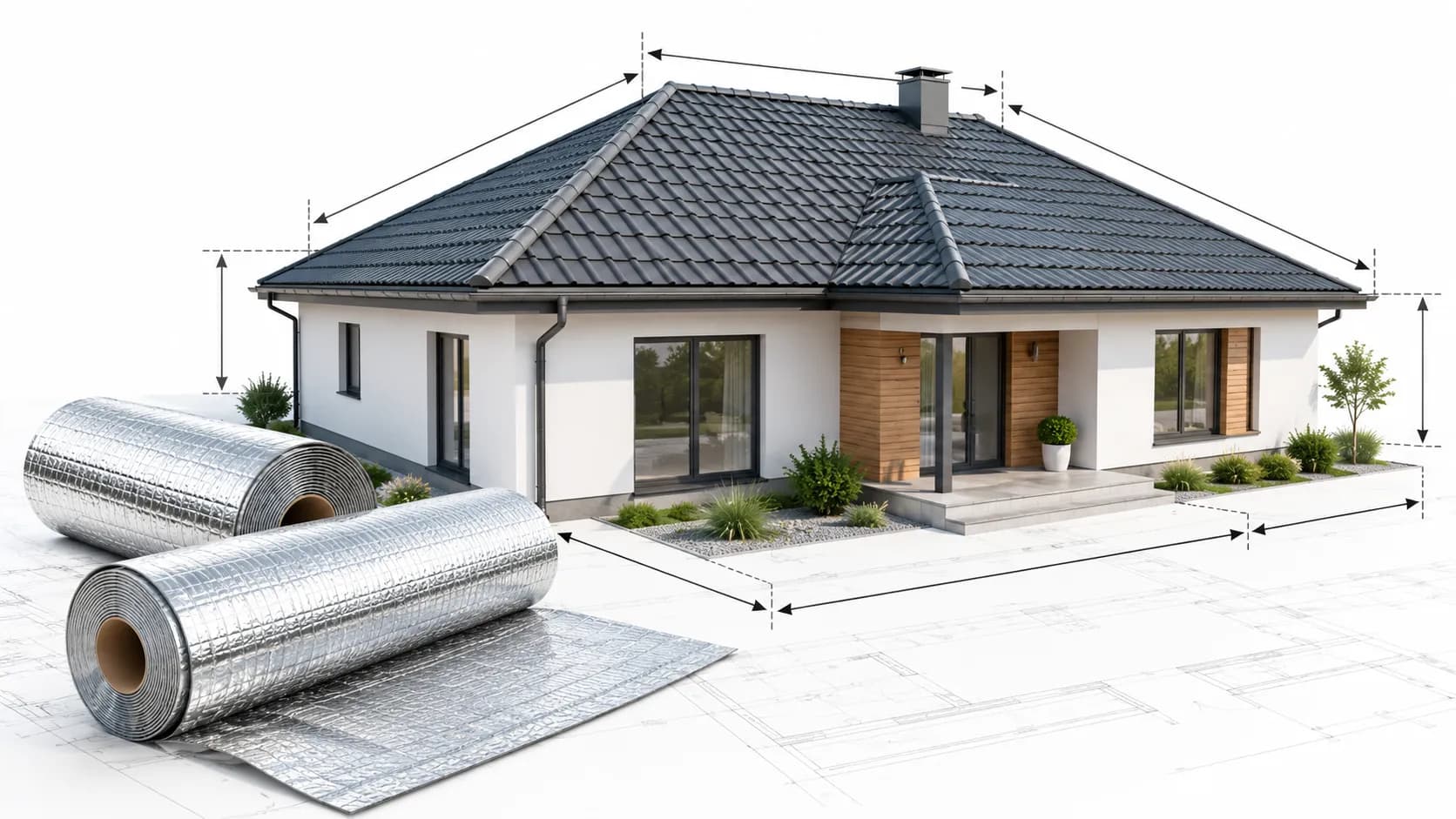
Spandek roofing is widely used in homes, warehouses, workshops, and industrial buildings.
In addition to being lightweight, this material is quite practical for covering large roof areas. However, one problem often arises after a building is put into use: the indoor space feels hot, especially when the sun is intense.
This condition is usually more noticeable in buildings where the metal roof is directly exposed to the occupied space, without a ceiling or adequate insulation.
One way to address it is to use roof heat insulation. Even so, installing insulation alone may not solve the entire problem. The condition of the roof, air circulation, and arrangement of materials also affect how much heat enters the room.
So, what makes a spandek roof feel hot, and how can the heat be reduced without replacing the entire roof?
Why Does a Spandek Roof Make a Room Feel Hot?
Spandek roofing is generally made from metal sheets formed into corrugated or trapezoidal profiles. This material is widely chosen because it is relatively lightweight and practical to install.
However, like other roofing materials, the spandek surface receives solar energy throughout the day.
Some of that energy is reflected, while the rest is absorbed, causing the roof surface to become hot. Because metal has high thermal conductivity, heat from the roof surface can be transferred to its underside.
In buildings without insulation, the hot underside of the roof can also radiate heat energy into the space below.
That is why rooms with metal roofing can sometimes feel stuffy even when doors or windows are open.
This condition does not necessarily mean the roof is of poor quality. Spandek is designed as a building covering material, not as the primary thermal insulation layer.
Therefore, additional heat-control measures are usually needed to make the indoor space more comfortable.

Identify the Causes of Heat Before Choosing a Solution
When a room feels hot, people often immediately look for spandek roof heat insulation materials. However, the source of the problem may differ from one building to another.
Some buildings become hot primarily because of sun exposure on the roof. Others have additional problems caused by poor ventilation or heat from activities inside the building.
Several conditions need to be considered.
The Roof Is Directly Exposed to the Room
In buildings without ceilings, the underside of the metal roof directly faces the activity area.
When the roof receives heat from the sun, thermal radiation from its underside can more easily affect the comfort of people inside.
This condition is quite common in warehouses, workshops, enclosed canopies, and semi-industrial buildings.
The Space Beneath the Roof Has Poor Ventilation
The air beneath the roof can increase in temperature during the day.
If there is no adequate air-exchange path, heat can remain in the upper part of the building for longer.
Opening doors may not be enough, especially if there is no effective path for hot air to escape.
There Is No Insulation Layer
Spandek sheets installed without an additional layer have relatively low thermal resistance.
As a result, heat transfer through the roofing system is not significantly reduced by the roof covering material itself.
Under these conditions, installing spandek roof insulation can be one of the steps worth considering.
Heat Also Comes from Inside the Building
Not all heat comes from the roof.
In workshops and factories, machinery, production activities, electrical equipment, and the number of people working can also add to the room's heat load.
If internal heat sources are substantial, roof insulation needs to be combined with ventilation adjustments or other heat-control systems.
By understanding the main causes, the chosen solution can better match the building's needs.
5 Ways to Reduce Heat from a Spandek Roof
There are several ways to help reduce heat from metal roofing. Some can be applied during initial construction, while other options may still be implemented in buildings already in use.
1. Installing Foam and Aluminium Foil Roof Heat Insulation
One solution commonly considered for metal roofs is insulation made from foam with an aluminium foil layer.
The two materials have different functions.
The foam layer helps slow heat flow through the material. Meanwhile, the aluminium foil surface is used to reduce heat transfer through radiation when installed in an appropriate configuration.
This combination is an option for various types of buildings because the material is available in rolls that can be adjusted to the roof area.
One type of foam used in insulation systems is Cross-Linked Polyethylene, or XLPE foam.
This material has a closed-cell structure that helps inhibit heat transfer.
For example, Karpinux Roof Insulation from PT Karya Pilar Nusantara uses XLPE foam with an aluminium foil layer. This product is available in several thicknesses, allowing it to be selected according to the building's characteristics.
However, insulation performance does not depend solely on the materials used. Installation position, air space, and the neatness of joints also affect the final result.

2. Paying Attention to Air Spaces or Air Gaps
When installing reflective insulation, air spaces or air gaps are often an important but overlooked component.
The aluminium foil surface works by reducing radiant heat exchange when it faces an air space.
If the foil is in direct contact with solid materials on both sides, its benefit as a reflective layer is not the same as when its surface faces an air space.
Therefore, the arrangement of the spandek sheets, insulation, and the interior of the building needs to be considered.
However, this does not mean that a larger air gap is always better.
An improperly designed air space can also allow heat transfer through air movement.
The size, position, and ventilation requirements of the gap should follow the roofing system design and the material's installation recommendations.
3. Improving Air Circulation Beneath the Roof
Insulation helps reduce heat transfer, while ventilation regulates air exchange.
The two do not replace each other.
In buildings with roof spaces or work areas with high ceilings, hot air can accumulate in the upper section.
If building conditions allow, ventilation in appropriate locations can help remove hot air and allow it to be exchanged with outdoor air.
Some buildings use upper-wall vents, roof vents, or mechanical exhaust systems.
These options still need to be adapted to environmental conditions.
In warehouses or factories, for example, ventilation systems must also consider dust, humidity, operational activities, and air-quality requirements.
Keep in mind that adding ventilation does not always make indoor air cooler than outdoor air. Its function is to help manage heat and air exchange according to existing conditions.
4. Using a More Reflective Roof Surface
In addition to limiting heat from below, heat can also be reduced by limiting the solar energy absorbed by the roof surface.
One approach is to use roof covering materials or coatings with good solar reflectance.
This system is often known as a cool roof.
Roof surfaces with high solar reflectance can absorb less energy than surfaces with low reflectance.
For new buildings, roof surface characteristics can be considered during material selection.
Meanwhile, in buildings that already use spandek roofing, special reflective coatings for metal roofs may be an option if they are compatible with the condition and type of protective coating already installed.
It should be noted that not all light-colored paints have the same performance. Reflective ability, heat emission, compatibility with metal surfaces, and coating durability need to be checked first.
5. Adding a Ceiling and a Suitable Insulation Layer
For buildings without ceilings, adding a ceiling can help create a separation between the roof surface and the room.
However, an ordinary ceiling is not a substitute for thermal insulation.
If the main objective is to reduce heat transfer, the ceiling system can be combined with insulation installed in an appropriate position.
In buildings with a space between the ceiling and roof, ventilation and moisture control also need to be considered.
This option is generally more relevant for homes, offices, shophouses, or rooms that require interior finishing.
Meanwhile, in warehouses and factories that intentionally use exposed roofs without ceilings, installing insulation beneath the roof covering may be a more practical approach, depending on the construction conditions.
Choosing the Right Heat Insulation for a Spandek Roof
After understanding the available solutions, the next step is to determine which material is suitable for the building.
Not all roof heat insulation products have the same characteristics. Even with the same material, differences in thickness and layer arrangement can result in different insulation properties.
Pay Attention to the Main Material
Aluminium foil, foam, and fibrous insulation materials work through mechanisms that are not entirely the same.
For metal roofs, a combination of foam and foil is one option because it combines the material's thermal resistance with a reflective surface.
However, the type of foam, thermal conductivity value, and installation configuration still need to be checked.
Match the Thickness to the Building's Needs
A small building used occasionally will naturally have different needs from a production facility that operates every day.
As an illustration, Karpinux Roof Insulation is available in three thickness options:
5 mm: For applications requiring a relatively thin layer, such as renovations and lightweight buildings.
8 mm: For applications such as warehouses, workshops, and commercial buildings.
10 mm: For projects requiring a thicker foam layer, including production areas and industrial buildings.
These categories are an initial guide for use, not a rule that every type of building must use a particular thickness.
The final choice still needs to consider roof conditions, material characteristics, and heat-control targets.
Check the Reflective Layer Configuration
Some products are available in single-side and double-side options.
Single-side insulation has a reflective layer on one side, while double-side insulation has reflective layers on both sides.
Even so, double-side insulation does not automatically provide twice the insulation performance.
The benefit of each foil surface is influenced by the direction it faces and its relationship with air spaces in the construction.
Therefore, the configuration should be chosen based on the installation design, not simply on the number of foil-covered sides.
Consider Size and Installation Method
On large roof areas, the dimensions of the material also affect the installation process.
Karpinux is available in rolls measuring 1 × 25 meters, with a nominal area of 25 m² per roll.
For project requirements, material quantities must still account for the shape of the roof area, cutting, joints, and possible installation waste.
Information about material structure, variants, and technical specifications can be found on the Roof Insulation Karpinux page.

What About Galvalum Roofing?
In addition to spandek, the term galvalum roofing also often comes up when discussing buildings with metal roof coverings.
In the market, the terms spandek and galvalum are sometimes related. Spandek often refers to the shape or profile of the roofing sheet, while galvalum is widely used to refer to aluminium-zinc-coated steel.
Because terminology and product specifications can vary between manufacturers, the actual material needs to be confirmed through the roofing product's technical information.
In terms of heat control, both face similar issues when used as metal roofing sheets.
The surface receives solar radiation, and heat can transfer to the underside of the structure.
Therefore, heat insulation for galvalum roofs can also use approaches involving insulation, reflective surfaces, air-space management, and ventilation.
Is a material suitable for spandek automatically suitable for galvalum?
Not necessarily, as the installation methods may not be identical in every respect. The sheet profile, frame structure, surface condition, and roofing system configuration still need to be checked.
When selecting insulation materials, the main focus should be on the characteristics of the roof construction, not just the trade name of the roof covering.
New Roof or Already Installed: What Needs to Be Considered?
The condition of the building plays a significant role in determining the insulation installation method.
If the Roof Is Still Under Construction
In new construction, the position of the insulation is usually easier to plan because the entire roof assembly has not yet been enclosed.
The material can be installed according to the roofing system design, taking into account the position of the framing, supports, air spaces, and direction of the reflective layer.
This stage also provides an opportunity to plan material joints more neatly and reduce unwanted gaps.
If the Spandek Roof Is Already Installed
In buildings that are already in use, the work requires additional inspection.
Access from below, spacing between framing members, ceiling condition, electrical installations, and the possibility of leaks need to be considered first.
Insulation may be installed from below without removing the entire roof covering, but whether this is feasible depends on the construction system and product instructions.
Do not attach the material haphazardly directly to the metal sheets or close off the entire roof space without considering moisture conditions.
An unsuitable method can reduce insulation performance or create new problems for the building.
For a basic discussion of material types and characteristics, also read the Roof Insulation Guide.
Mistakes That Make Roof Heat Insulation Less Effective
Using suitable insulation materials is an important step. However, the quality of the installation also plays a major role.
One fairly common mistake is leaving joints between sheets untidy.
Gaps in the insulation layer can make thermal protection uneven across the roof area.
Another mistake is assuming that aluminium foil always works at maximum effectiveness, regardless of how it is installed.
In fact, the reflective function of foil is influenced by the presence of an appropriate air space.
Some buildings also add insulation without checking ventilation problems and sources of heat inside the room.
As a result, heat from the roof may have been reduced, but the room can still feel stuffy because of other factors.
In addition, pay attention to moisture conditions and the possibility of condensation in metal roof construction. An unsuitable layer arrangement can cause water vapor to accumulate in certain areas.
Another thing to avoid is assuming that thicker material is always the most effective solution.
Thickness does affect the material's thermal resistance, but overall system performance is still influenced by the characteristics of the material and how it is installed.

Frequently Asked Questions About Metal Roof Heat Insulation
Does a spandek roof have to use heat insulation?
Not always. The need depends on the building's function, construction conditions, and desired level of comfort.
However, in buildings that experience heat problems from the roof, insulation can be one solution to help reduce heat transfer into the room.
Is aluminium foil alone enough for a spandek roof?
Aluminium foil can help reduce radiative heat transfer when installed in the correct configuration.
However, thin foil does not provide thermal resistance through material thickness in the way that foam does. For certain needs, a combination of both can be considered.
Can heat insulation be installed without removing the roof?
In some types of construction, installation from below is possible.
However, this method depends on installation access, framing conditions, the support system, and the type of insulation material.
Is heat insulation for galvalum roofs different from that for spandek roofs?
Not necessarily. Both can use the same type of insulation if the material specifications and installation methods are suitable for the construction.
What needs to be checked is the roof's characteristics and the arrangement of its layers.
Can spandek roof insulation help reduce rain noise?
Certain insulation materials can help reduce sound transmission through the roofing system.
However, the degree of sound reduction cannot be determined from foam thickness alone. The roof structure, joints, types of layers, and characteristics of the sound also affect the result.
Does installing insulation immediately make a room cool?
Not automatically.
Insulation works by helping reduce heat transfer. The condition of the room after installation is still influenced by ambient temperature, ventilation, activities inside the building, and the cooling system used.
Conclusion: Reducing Heat at Its Source
Heat from spandek roofs is a fairly common problem, especially in buildings with high sun exposure and spaces that lack adequate heat control.
To reduce it, several approaches can be taken, from installing roof heat insulation and paying attention to air spaces to improving ventilation, using a more reflective roof surface, and adding a ceiling with suitable insulation.
Not all buildings need the same combination of solutions.
In warehouses without ceilings, for example, insulation directly beneath the roof covering may be an option. Meanwhile, in homes with ceilings, inspecting the roof cavity and ventilation may be an important part of the solution.
Most importantly, identify the source of heat and the building's condition before choosing a material.
For insulation needs involving XLPE foam and aluminium foil, the specifications of Karpinux Roof Insulation from PT Karya Pilar Nusantara can serve as one reference when planning heat control for metal roofs.