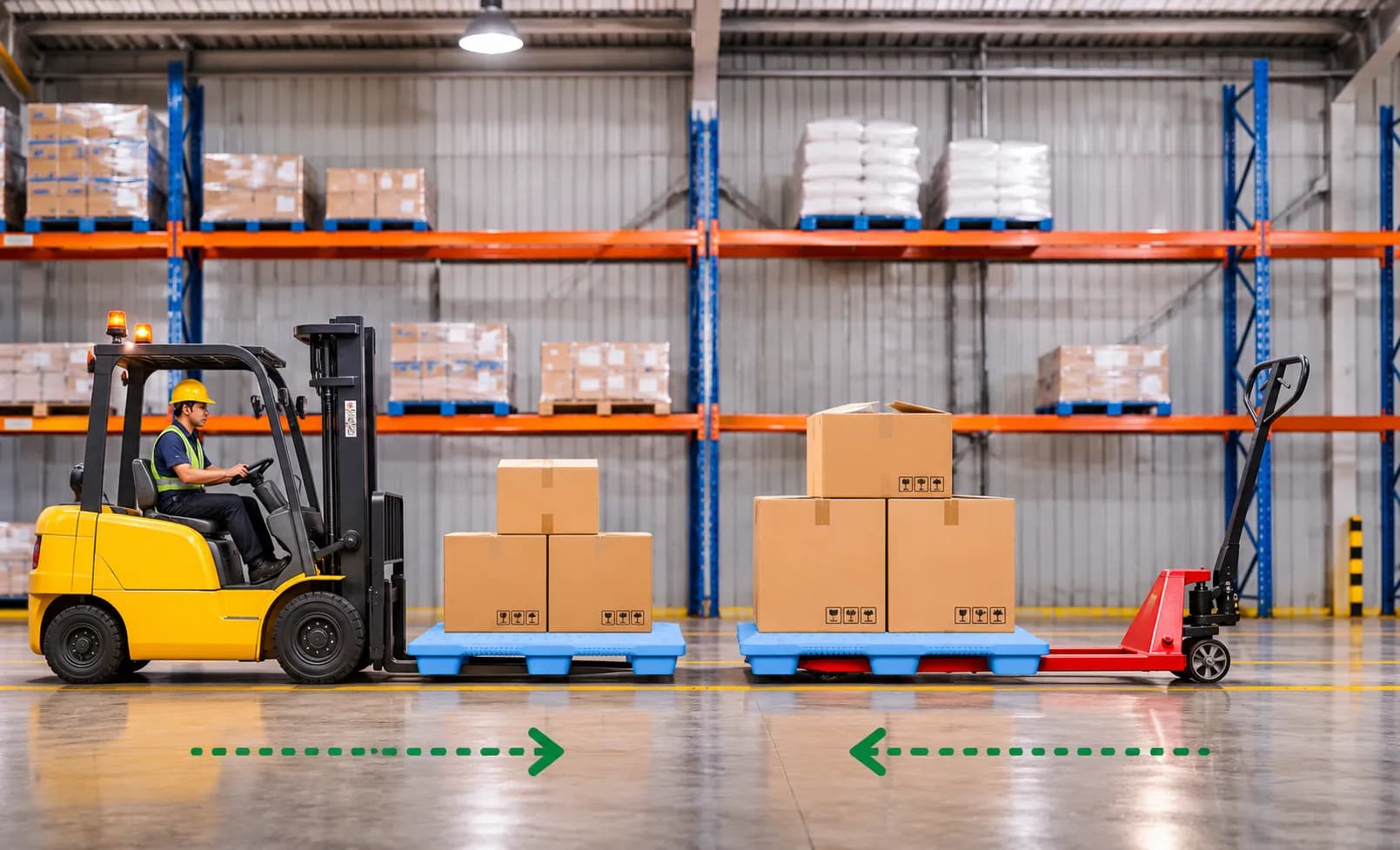
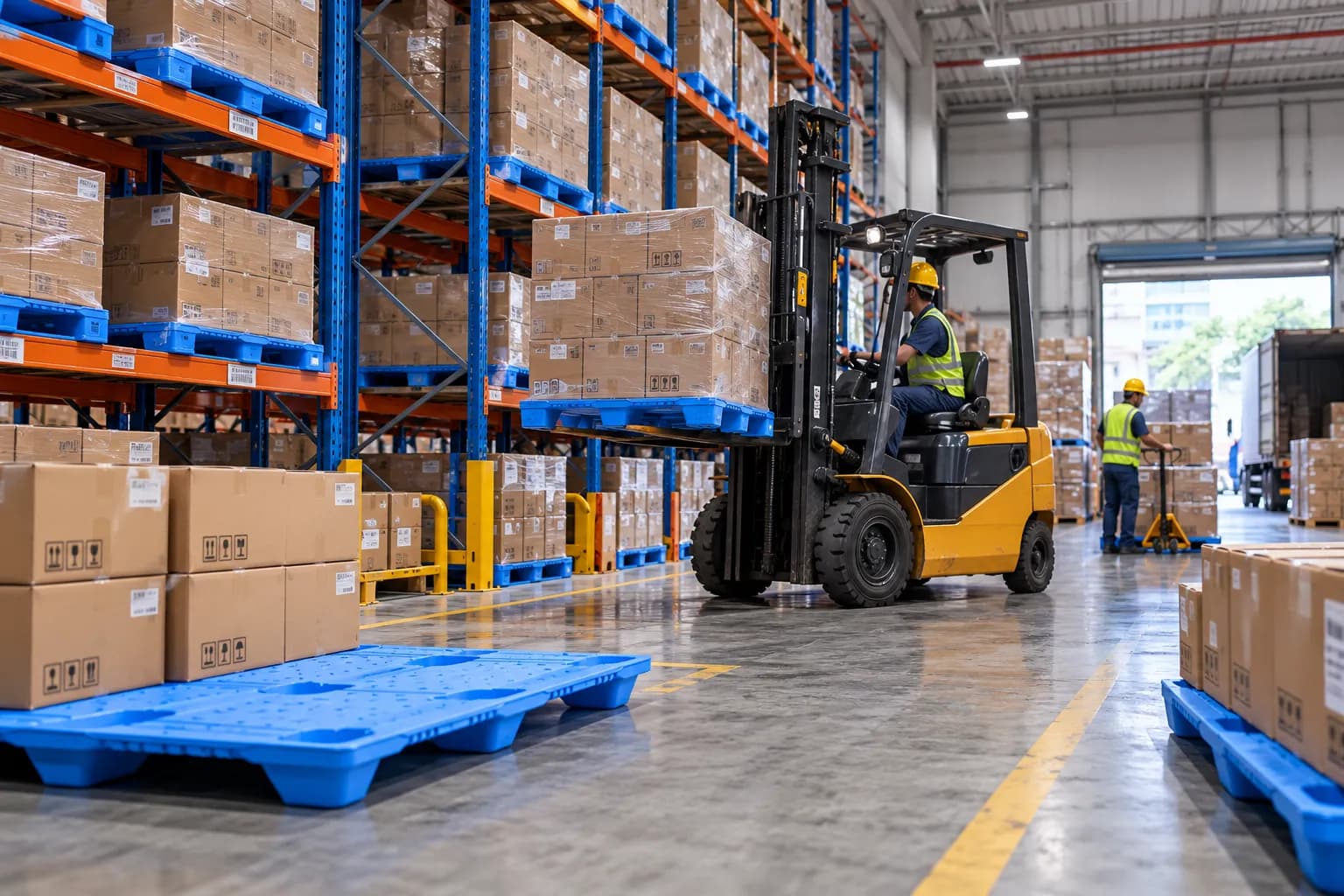
In warehouses or factories, pallets are often used to support goods weighing hundreds of kilograms to several tons. While the goods remain on the floor, the pallet may appear to be in good condition. However, the situation can change when the pallet is lifted by a forklift or moved onto a storage rack. That is why heavy loads generally require pallets with a suitable construction.
Heavy-duty plastic pallets are one option for warehousing and industrial operations that require high load capacities. These pallets are designed to handle specific working loads while taking structural strength, stability, and methods of moving goods into account.
Even so, not all pallets labeled heavy duty have the same capabilities. Some can support several tons when placed on the floor but have a lower load limit when lifted by a forklift.
So, what is the actual load capacity of a heavy-duty pallet? What distinguishes it from a standard pallet, and what kinds of work is it used for?
What Is a Heavy-Duty Plastic Pallet?
A heavy-duty plastic pallet is a pallet with a construction designed to support and handle heavy loads according to the working capacity specified by the manufacturer.
This type of pallet is widely used for storage, production, and the movement of goods in industrial environments.
Unlike lightweight pallets, which are generally chosen for distributing relatively light goods, heavy-duty pallets place greater emphasis on structural capability when handling heavy loads.
This strength comes not only from the material used but is also influenced by the construction design, the thickness of the supporting components, and how the load is distributed across the pallet's surface.
One material used to manufacture heavy-duty pallets is High Density Polyethylene (HDPE).
HDPE is resistant to moisture, does not rust, and can be formed into pallet structures with various configurations.
However, using HDPE does not automatically mean that every pallet can withstand heavy loads. The actual capacity must still be based on the specifications of each product.
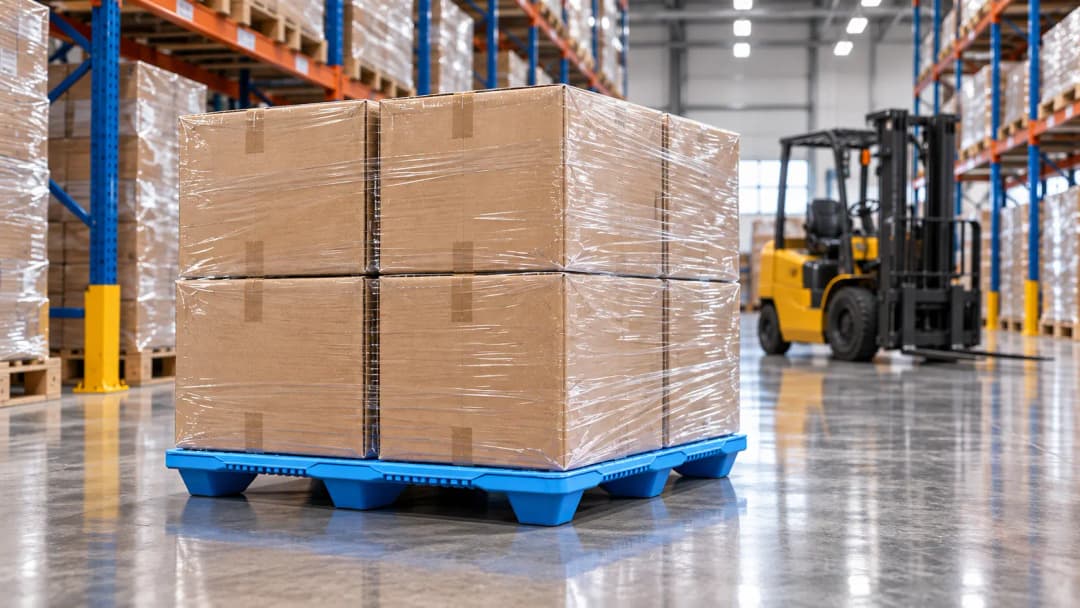
What Makes Heavy-Duty Pallets Stronger?
Two plastic pallets of the same size do not necessarily have the same load capacity.
The differences may come from several components that are not immediately visible once goods have been stacked on the pallet.
Pallet Structure and Thickness
Heavy-duty pallets generally have a construction designed to withstand pressure from heavy goods.
The top surface, or deck, serves as the area where goods are placed, while the underside helps transfer the load to the floor, forklift forks, or other supports.
Reinforcing structures such as ribs, legs, and runners can affect the pallet's rigidity and ability to withstand loads.
However, a thicker pallet is not necessarily always stronger. The placement of supporting structures also determines how the load is distributed.
Materials and Manufacturing Process
HDPE is widely chosen for industrial pallets because it does not absorb water like wood and does not corrode like metal.
HDPE pallets can also be used repeatedly as long as their physical condition and load capacity remain suitable for operational needs.
Nevertheless, material quality, the manufacturing process, and product design still influence the pallet's durability.
Underside Design
The underside of a pallet plays an important role when the pallet is lifted by a forklift or placed on a warehouse storage rack.
Single-side and double-side designs, supporting legs, and runners provide different support characteristics.
Therefore, before choosing a heavy-duty pallet, pay attention not only to its top surface but also to the underside construction that will come into contact with handling equipment and storage systems.
What Is the Load Capacity of a Heavy-Duty Pallet?
Load capacity is one of the most important pieces of information when choosing a heavy-duty pallet.
However, a capacity figure cannot be considered separately from the conditions in which the pallet will be used.
For example, a pallet with a static load capacity of 5 tons does not necessarily mean it can carry 5 tons of goods when lifted by a forklift.
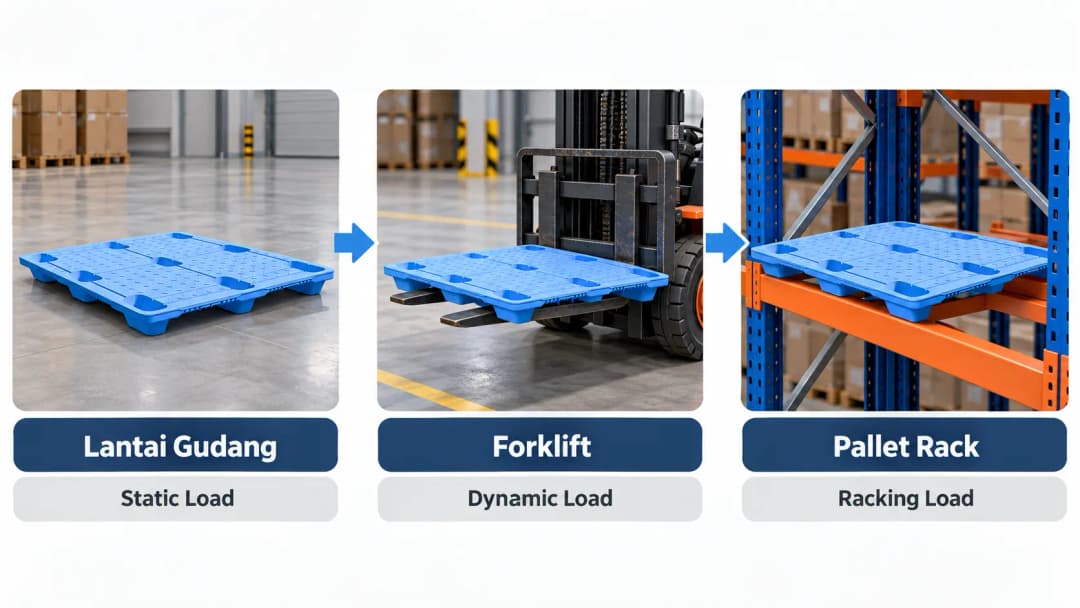
In industrial pallet specifications, there are three types of load capacity that need to be distinguished.
Static Load: Load When the Pallet Is Stationary
Static load indicates a pallet's ability to support goods when placed on a flat, stable surface, under its specified testing conditions.
For example, a pallet is placed on a warehouse floor with several stacks of sacks or cartons on top of it.
Because the underside of the pallet is supported by the floor, its static capacity is generally higher than its capacity when lifted.
Dynamic Load: Load When the Pallet Is Moved
Dynamic load indicates a pallet's ability to carry a load when lifted and moved using equipment such as a forklift.
In this situation, the pallet's support points change because the load is carried by specific sections that come into contact with the forklift forks.
Lifting, lowering, and moving goods also create loading conditions that differ from those when the pallet is stationary.
Therefore, dynamic load capacity needs to be checked specifically if the pallet is frequently used for loading and unloading activities.
Racking Load: Load When the Pallet Is on a Rack
Racking load refers to a pallet's load capacity when placed on a storage racking system with particular support points.
Unlike floor storage, a pallet in a racking system may be supported only by two beams or separate supporting structures.
The middle section of the pallet may bend under a load, especially if the goods are stored for a long period.
For this reason, racking capacity must be confirmed based on the specifications and configuration of the racking system being used.
These three load capacity ratings are not interchangeable.
| Load type | Pallet condition | Example of use |
|---|---|---|
| Static load | Stationary on the floor with adequate support | Goods storage |
| Dynamic load | Lifted and moved | Forklifts and material handling |
| Racking load | Supported by a specific rack structure | Multi-level warehouse racking |
Why Are Heavy Loads Not Necessarily Safe?
In everyday use, the total weight of goods is often treated as the only consideration when selecting a pallet.
In fact, two loads of the same weight can exert pressure differently.
Imagine a pallet carrying cartons with a total weight of 1,000 kg. The cartons are arranged evenly so that most of the pallet's surface bears the load.
Now compare this with an industrial machine weighing 1,000 kg that rests on only four small feet.
Although the total weight is the same, the pressure is not distributed across the pallet in the same way.
With the machine, pressure is concentrated at several points, so certain sections of the pallet may bear a greater load.
This condition is known as a point load, or concentrated load.
That is why the maximum capacity stated in the specifications cannot always be applied directly to every type of goods.
Factors to consider include the shape of the goods, the contact area, the position of the center of gravity, the stacking pattern, and the pallet's support conditions.

Heavy-Duty Pallet Applications in Warehouses and Industry
Heavy-duty pallets are used in various work environments that routinely handle heavy goods.
The type of goods, storage arrangement, and frequency of movement are factors that determine whether a pallet is suitable for use.
Goods Storage Warehouses
In warehouses with large quantities of stock, pallets serve as a base for storing goods while also helping with stock organization and retrieval.
Heavy-duty pallets can be used for heavy goods, especially when loads are stored as palletized units that are then moved together.
For storage directly on the floor, static load capacity is one of the main considerations.
However, if the pallet will also be moved periodically, its dynamic load capacity still needs to be checked.
Factories and Production Areas
In manufacturing environments, pallets are used to hold raw materials, production components, and finished goods.
Examples include transporting packaged raw materials, machine components, and industrial products that have completed the production process.
Plastic pallets can help prevent goods from coming into direct contact with the floor while making it easier to move them using material handling equipment.
For goods with irregular shapes or support points, it is necessary to ensure that the pallet structure can accommodate the resulting load distribution.
Distribution and Logistics
At distribution centers, goods typically pass through several stages, from receiving and storage to movement and shipping.
Heavy-duty pallets can be used to handle heavy loads that need to be lifted and moved repeatedly.
Under these conditions, dynamic load capacity, access for forklift forks, and the compatibility of pallet dimensions with transport vehicles are important considerations.
Industries Handling Heavy Goods
Industries handling bagged materials, liquid containers, metal components, or production equipment often need pallets with relatively high load capacities.
However, pallet use must be suited to the characteristics of the goods.
For example, storing drums creates a different load distribution from stacking sacks. Long items or machines with small supporting feet also require separate evaluation.
Therefore, industrial pallets should be selected based not only on the product category being handled, but also on the actual loading conditions.

Heavy-Duty Pallets for Forklifts and Racking Systems
Using forklifts and racking systems involves two conditions that require particular attention.
A pallet that is strong enough when placed on the floor may not have the same capability when its support points change.
When Lifted by a Forklift
A forklift supports a pallet through its forks, which enter designated openings.
When the pallet is lifted, part of its structure must carry the weight of the goods without direct support from the floor.
For this type of work, make sure the dynamic load capacity is suitable for the weight of the goods.
In addition, the opening dimensions, fork length, lifting position, and load balance must also be considered.
A pallet with a suitable dynamic load capacity must still be used with a forklift that has adequate lifting capacity.
When Stored in Racking
Storage on multi-level racks requires a different assessment.
The pallet must be able to maintain its shape and support the load while resting on the available rack supports.
During long-term use, continuous loading can cause deformation or bending, particularly if the support configuration is unsuitable.
Some pallet systems use additional supporting structures to help distribute loads.
For example, the Karpinus HDPE pallet range offers a Strip Pallet accessory that is used on the underside of the pallet to help improve stability in racking systems.
However, the presence of an accessory does not automatically establish a particular racking load capacity. The permitted load must still be confirmed based on the product and storage configuration.

Karpinus Heavy-Duty HDPE Pallet Options
PT Karya Pilar Nusantara offers several HDPE pallet options with different dimensions and capacities.
For heavy-load requirements, there are the KPN 1214 Heavy Duty and KPN 1212 Double Side series.
The following comparison is based on the product specifications.
| Specification | KPN 1214 Heavy Duty | KPN 1212 Double Side |
|---|---|---|
| Dimensions | 120 × 140 cm | 120 × 120 cm |
| Pallet weight | 12 / 14 / 16 kg | 16 / 18 / 20 kg |
| Static load | 2 / 2.5 / 3 tons | 2.5 / 3 / 3.5 tons |
| Dynamic load | 1.5 / 2 / 2.5 tons | 2 / 2.5 / 3 tons |
| Material | HDPE | HDPE |
| Construction | Single side | Double side |
Note: Each capacity figure corresponds to a specific product variant. Racking capacity is not stated in the catalog table and must be confirmed separately.
KPN 1412 Heavy Duty
The KPN 1214 pallet measures 120 × 140 cm and is available in several weight options.
Its highest-capacity variant has a static load capacity of 3 tons and a dynamic load capacity of 2.5 tons.
Its relatively large surface area can be considered for industrial goods with large dimensions or loads that require a wider supporting area.
Nevertheless, dimensional compatibility still needs to be checked against the warehouse layout, handling equipment, and distribution vehicles.
KPN 1212 Double Side
The KPN 1212 features a double-side construction and measures 120 × 120 cm.
Depending on the selected variant, this series offers a static load capacity of up to 3.5 tons and a dynamic load capacity of up to 3 tons.
Its construction may be a consideration for applications requiring a pallet with a more substantial underside structure.
However, for racking applications or handling goods with specific load points, the operational specifications must still be verified.
Information about the series, dimensions, and available capacities can be found on the Karpinus HDPE Pallets page.

What to Check Before Choosing a Pallet
Before purchasing pallets in large quantities, it is best to establish exactly how they will be used.
This helps avoid buying pallets that have a high capacity on paper but are less suitable for actual operating conditions.
Check the maximum weight of the goods. Use the heaviest load that may need to be handled, not just the average weight.
Pay attention to load distribution. Evenly distributed goods create different loading conditions from machines or materials that rest on only a few points.
Determine the storage method. If the pallet is used directly on the floor, evaluate its static load capacity. If it is placed on a rack, check its racking capacity according to the support configuration.
Match the pallet to handling equipment. Ensure that the pallet's dimensions and design are compatible with the forklifts, hand pallet trucks, or stackers being used.
Check environmental conditions. Temperature, chemical exposure, moisture, and storage duration can influence product selection.
Confirm the variant specifications. Even at the same dimensions, differences in pallet weight and construction can result in different capacities.
If pallets will be used continuously for heavy loads or in specialized storage systems, testing under actual operating conditions can help confirm their suitability before large-scale procurement.
FAQ: Frequently Asked Questions About Heavy-Duty Pallets
Can heavy-duty plastic pallets support a 5-ton load?
Yes, if the product has a capacity that matches the loading conditions. For example, the 16 kg variant of the KPN 1214 has a static load capacity of 3 tons, but its dynamic load capacity is 2.5 tons. Therefore, the 3-ton capacity does not apply to all conditions of use.
Are heavy-duty pallets suitable for use with forklifts?
Heavy-duty pallets can be used with forklifts if their dynamic load capacity, opening shape, and design are compatible with the lifting system. The forklift's lifting capacity and the stability of the load must also be taken into account.
Can all heavy-duty pallets be used on warehouse racks?
No. A high static load capacity does not automatically mean that a pallet is suitable for a racking system. This requirement must be assessed based on the racking capacity and the type of support used.
What is the difference between heavy-duty and standard pallets?
The main differences lie in their construction, load capacity options, and intended use. However, the term heavy duty does not represent a universal capacity rating. The most accurate comparison is still based on each product's specifications.
Are HDPE pallets suitable for industrial use?
HDPE pallets can be used in a variety of industrial activities, from raw material storage to finished goods distribution. Selection should take into account the load, type of goods, handling equipment, and working environment.
Conclusion: Match the Pallet to the Workload
Heavy-duty plastic pallets are an option for warehousing and industrial operations that require the handling of heavy loads.
However, choosing a pallet involves more than simply looking at the highest capacity rating or the heavy-duty label.
Static, dynamic, and racking capacities apply to different conditions of use. The same is true of the type of goods, load distribution, and equipment used during operations.
For floor storage, static load capacity is one of the main considerations. Meanwhile, operations involving forklifts require attention to dynamic load capacity. Use on warehouse racks needs to be supported by suitable racking capacity data.
By understanding these requirements from the outset, companies can choose pallets that are better suited to their storage, production, and distribution activities.
As a reference, PT Karya Pilar Nusantara offers a range of HDPE plastic pallets for warehouse and industrial needs in various dimensions and load capacities to suit operational requirements.