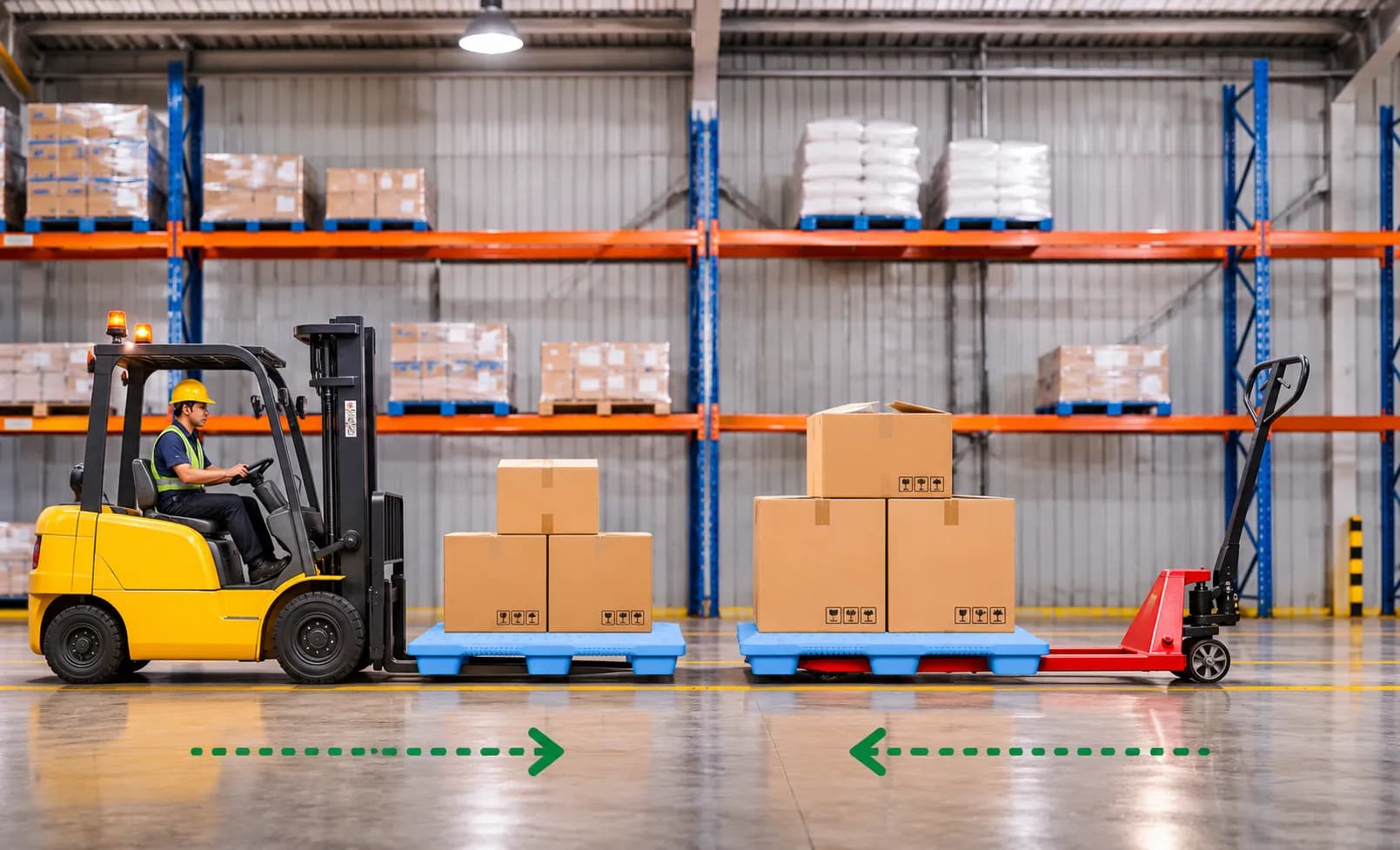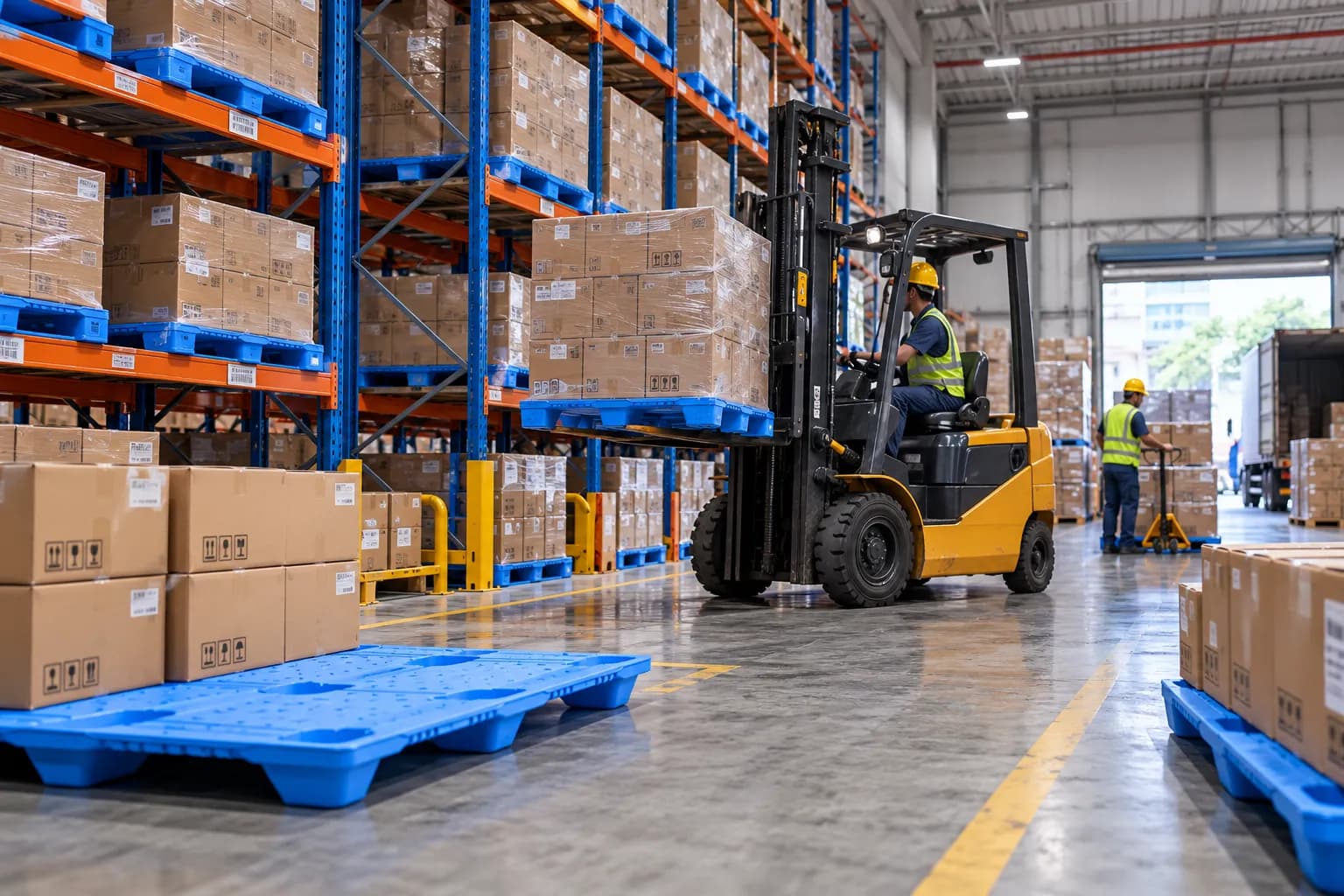
Pallets have become common equipment used in warehouses. From storing raw materials and organizing finished goods to moving loads using forklifts, all these activities can involve the use of pallets.
Although their design looks simple, not all pallets are suitable for the same tasks. Some pallets are used for light storage, others are designed for transporting goods, and some have stronger structures to support heavy loads.
These differences need to be considered before purchasing pallets in large quantities. Choosing the wrong size can make goods difficult to arrange, while an unsuitable load capacity can cause pallets to bend or become damaged during use.
To determine the right warehouse pallet, several factors should be checked first, including the type of pallet, the size of the goods, the handling method, and the storage system being used.
Why Should Warehouse Pallets Be Selected Carefully?
In a warehouse, pallets serve more than just a platform for goods. They help organize inventory while making it easier to move products from one place to another.
Goods that previously had to be moved individually can be arranged on pallets and then lifted using forklifts or other suitable material handling equipment.
Using pallets also helps prevent goods from coming into direct contact with the floor. This is particularly useful in warehouses storing products in cartons, sacks, or packaging that needs protection from moisture on the floor surface.
However, every warehouse has different requirements.
Distribution warehouses that carry out loading and unloading activities every day require pallets with different characteristics from raw material storage warehouses where goods are rarely moved.
The same applies to warehouses using multi-level racking systems. Pallets must be able to support goods according to how the racks provide support.
Therefore, pallet selection should begin with warehouse operations rather than simply considering appearance or price.
Understanding the Types of Plastic Pallets for Warehouse Needs
Plastic pallets are available in several types with different designs and capabilities. They can be categorized based on their duty class or the construction of the pallet itself.
Light Duty Pallets
Light duty pallets are generally used for applications involving relatively light loads.
This type can be considered for storing packaged products, retail goods, or distribution activities that do not require a particularly large load capacity.
Their construction tends to be lighter, making them easier to handle when empty. Nevertheless, their load-bearing capacity must still refer to the specifications of each product.
Lightweight pallets are not always suitable for storage on racks without additional support.
Standard or Medium Duty Pallets
Standard pallets are widely used for everyday warehouse operations.
They are commonly used for storing finished goods, raw materials, products in cartons, and distribution activities involving forklifts.
Compared to lightweight pallets, this category generally offers construction and capacity options that are more suitable for routine material handling activities.
However, the terms standard or medium duty do not indicate the same load capacity across all brands.
Heavy Duty Pallets
For heavier goods, heavy duty pallets are available with structures designed to accommodate greater loads.
This type can be considered for manufacturing industries, raw material warehouses, and storage facilities handling relatively heavy products.
Heavy duty plastic pallets for warehouses should not be evaluated solely by their material thickness. The shape of the supports, reinforcement structure, and load capacity when the pallet is lifted must also be examined.
A pallet that appears thicker does not necessarily have a higher load capacity than another pallet with a different structural design.
Single Side and Double Side Pallets
Apart from load classes, plastic pallets are also distinguished by their surface construction.
Single side pallets have one main surface used to support goods. Their underside is designed with legs or supports according to the product design.
Meanwhile, double side pallets have more substantial upper and lower structures. In certain designs, both sides can be used as surfaces to support goods.

The choice between these two types depends on storage requirements and the available handling equipment.
It is important to remember that the term double side is not the same as four way entry. Double side describes the pallet's surface construction, while four way entry indicates that forklift forks can access the pallet from four sides.
Determining Pallet Size Based on the Goods Being Stored
After understanding the different types of pallets, the next step is determining the appropriate size.
In Indonesia, plastic pallets are available in various sizes. Some commonly found options include 80 × 100 cm, 100 × 120 cm, and 120 × 120 cm.
Larger sizes are also available for certain types of goods.
So, how do you determine the right size?
Check the Dimensions of the Goods
The first thing to determine is the size of the goods that will be placed on the pallet.
For example, a warehouse stores goods in cartons with a base measuring 40 × 30 cm.
When using a 120 × 100 cm pallet, three cartons can simply be arranged along the 120 cm side and three cartons along the 100 cm side. This arrangement results in nine cartons in a single layer, with some remaining space on one side.
The actual quantity still needs to be adjusted according to the packaging shape, required spacing between cartons, and packing method.
This example shows that pallet size is directly related to how goods are arranged.
A pallet that is too small may cause parts of the packaging to extend beyond its edges. Conversely, an oversized pallet may leave unused space.
Adjust to the Storage Space
Pallet dimensions must also be considered in relation to the warehouse layout.
Pay attention to aisle width, rack dimensions, door access, and areas used for loading and unloading.
When forklifts are used, the vehicle's maneuvering space and the direction from which pallets are picked up also affect operational efficiency.
Avoid choosing a pallet that fits the goods but is difficult to move because it does not match the available space.
Consider the Transport Vehicle
Pallets used for distribution must be adjusted to the vehicle's loading space.
Check whether the pallet dimensions allow loads to be arranged efficiently inside trucks or containers.
For routine shipments, using consistent pallet sizes will make it easier to plan load arrangements and calculate transport capacity.

Understanding Load Capacity: When Stationary, Lifted, and Stored on Racks
One mistake to avoid when purchasing pallets is paying attention to only one load capacity figure.
For example, a pallet has a static load capacity of 2 tons. This figure does not mean that the pallet can be used to lift goods weighing 2 tons with a forklift.
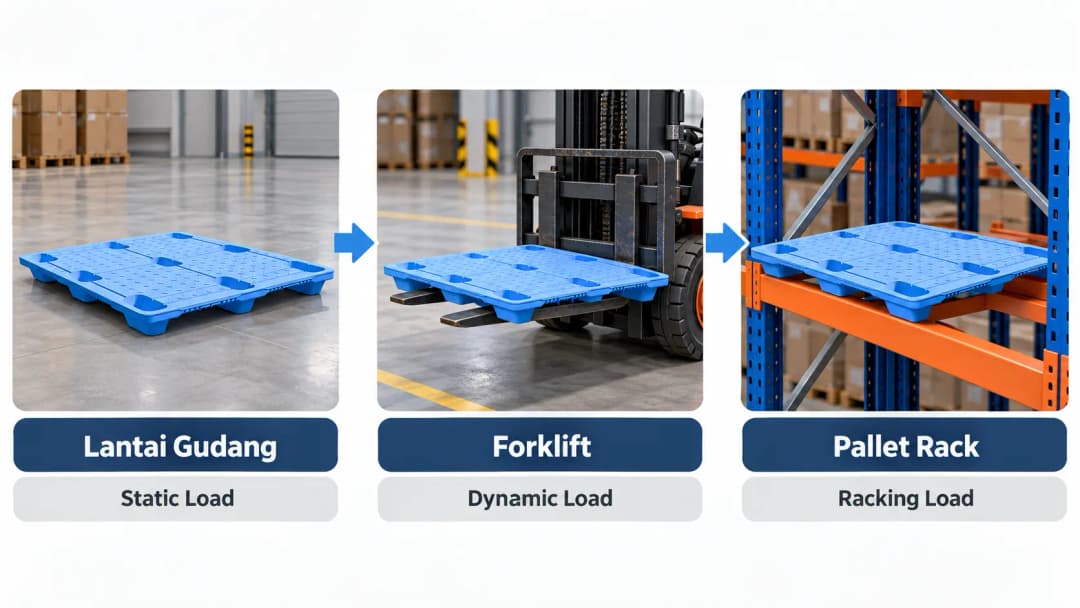
In pallet specifications, there are three types of load capacity that need to be understood.
Static Load: When the Pallet Is on the Floor
Static load refers to a pallet's ability to support weight while stationary with appropriate support, generally on a level floor surface.
For example, a pallet is placed on a warehouse floor and used to store several stacks of sacks or cartons.
Under these conditions, the underside of the pallet receives support from the floor surface.
The static load rating still depends on how the load is arranged and the product's testing conditions.
Dynamic Load: When the Pallet Is Lifted
Dynamic load is used as a reference for load capacity when a pallet carries goods and is moved using equipment such as a forklift.
When the pallet is lifted, its support conditions change. The load is supported through the parts of the pallet that come into contact with the forklift forks, rather than the entire underside.
This is why dynamic load capacity is generally lower than static load capacity.
If a warehouse frequently moves goods, dynamic load is one of the most important specifications to check.
Racking Load: When the Pallet Is Stored on Racks
Racking load refers to a pallet's ability to support weight when placed on a racking system with specific support points.
On racks that support pallets using only two beams, the middle section of the pallet may not receive direct support.
This condition differs from floor storage.
Therefore, a pallet with a high static load capacity is not necessarily suitable for racking applications.
Before placing pallets on multi-level racks, make sure the racking capacity and support configuration match the specifications of both the pallet and the racking system.
Choosing Plastic Pallets Suitable for Forklifts
Using forklifts helps speed up the movement of goods, especially in warehouses with frequent loading and unloading activities.
However, not all pallet designs have the same fork access and underside structure.
When selecting plastic pallets for forklifts, first check the direction of fork entry, the dimensions of the openings, and the pallet's ability to support loads during lifting.
Pay Attention to Fork Entry Direction
In general, pallets are available with fork access from two sides (two way entry) or four sides (four way entry).
Four-way access provides more options for picking up pallets, especially in warehouses with limited maneuvering space.
However, this design does not always mean that the pallet is compatible with every type of forklift or hand pallet truck.
Make Sure the Fork Dimensions Are Suitable
The width, thickness, and length of the forks must be considered in relation to the pallet openings.
Forks that do not enter properly risk striking the pallet's structural components.
In addition, fork length and the position of the load center must be appropriate to ensure the goods can be lifted stably.
The forklift's capacity must also meet the lifting requirements at the height and load center distance being used.
Inspect the Underside of the Pallet
The underside of a pallet is often overlooked because buyers tend to focus more on the upper surface.
In fact, this is the part directly involved in the lifting process.
Check the positions of the legs, runners, and reinforcement components. Make sure the design is compatible with the forklift forks and other handling equipment being used.
For hand pallet trucks, also pay attention to wheel clearance and the lifting mechanism. A pallet that can be lifted by a forklift is not necessarily compatible with every type of hand pallet truck.
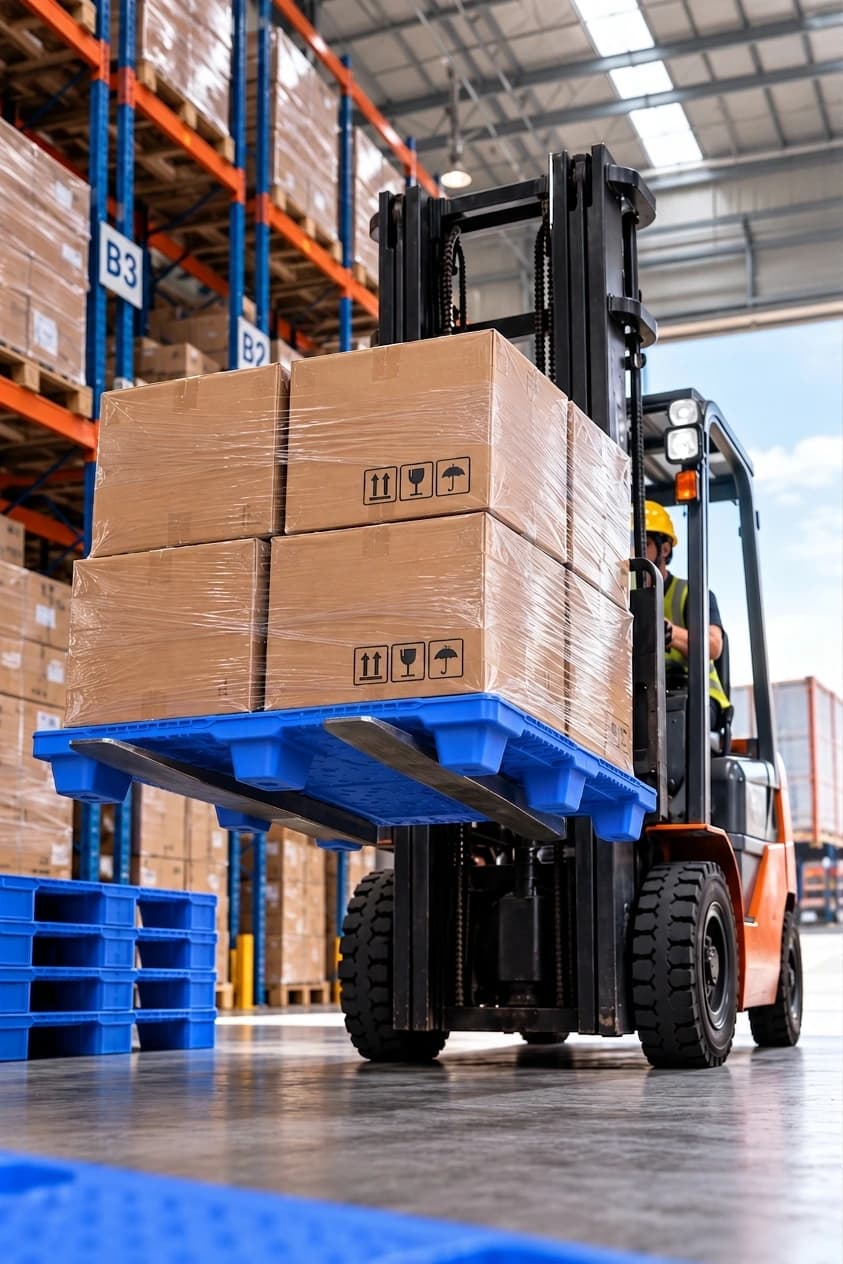
When Does a Warehouse Need Heavy Duty Pallets?
Not every warehouse needs to use heavy duty pallets.
If the goods being stored are relatively light and the frequency of movement is low, pallets with smaller load capacities may already meet the requirements.
Conversely, warehouses handling heavy goods need to consider stronger pallet categories.
Examples include storing large quantities of raw material sacks, machine components, or industrial goods with concentrated loads.
Apart from load weight, several other conditions need to be considered.
First, the frequency of moving goods. Pallets used repeatedly during loading and unloading activities experience different operating conditions from pallets that remain stationary on the floor most of the time.
Second, the way loads are arranged. Goods with evenly distributed weight produce different pressure patterns compared to machines supported by several individual legs.
Third, the storage system. If pallets will be placed on racks, the required racking capacity must be checked separately.
Heavy duty pallets are also not automatically suitable for every racking system. Their compatibility must be evaluated based on the pallet design and support conditions.
Therefore, selecting a pallet with a large load capacity is not simply about finding the highest tonnage rating. What matters more is ensuring that the capacity matches how the pallet will be used.
Examples of Choosing Pallets Based on Warehouse Conditions
To make this easier to understand, here are several warehouse conditions that can be used as references.
Carton Storage Warehouse
A warehouse stores finished products in cartons. The goods are placed on pallets and mostly stored directly on the floor.
Under these conditions, pallet size needs to match the carton dimensions and stacking arrangement.
Static load capacity becomes one of the main considerations. However, if the pallets are also moved using forklifts, their dynamic load capacity must be sufficient to support the weight of the goods.
Raw Material Warehouse with a 900 Kg Load
For example, a company stores 60 sacks of raw materials, each weighing 15 kg.
The total weight of the goods reaches 900 kg, excluding additional packaging or load-securing equipment.
If the entire load is moved using a forklift, the pallet's dynamic load capacity must be able to support that weight under the appropriate operating configuration.
A pallet with a static load capacity of 2 tons but a dynamic load capacity of only 750 kg is not suitable for lifting this 900 kg load.
In this case, the company needs to look for a variant with a higher dynamic load capacity and an adequate capacity margin.
Warehouse with Multi-Level Racking
The situation is different in warehouses that use selective pallet racking.
In addition to considering the weight of the goods, companies need to check beam spacing, pallet placement direction, and the ability of the pallet's underside to receive support.
Static or dynamic load capacity alone is not sufficient to ensure safe storage on racks.
Request racking load information that matches the rack configuration before deciding on a pallet model.
Karpinus HDPE Pallet Size and Capacity Options
PT Karya Pilar Nusantara supplies plastic pallets made from HDPE for warehousing, logistics, goods storage, and industrial applications.
Karpinus pallets are available in several sizes and load capacity classes.
| Pallet Series | Size | Static Load | Dynamic Load |
|---|---|---|---|
| KPN 1080 Light | 80 × 100 cm | 1–2 tons | 0.5–1 ton |
| KPN 1210 Standard | 100 × 120 cm | 1.5–2.5 tons | 0.7–1.5 tons |
| KPN 1214 Heavy Duty | 120 × 140 cm | 3–5 tons | 1–2 tons |
| KPN 1212 Double Side | 120 × 120 cm | 4–6 tons | 1.5–2.5 tons |
Note: The capacity figures indicate the range across different variants within the same series, not the capacity applicable to every variant. Racking capacity compatibility must be confirmed separately.
KPN 1080 Pallets for Lighter Applications
The KPN 1080 series, measuring 80 × 100 cm, can be considered for warehouses that require pallets with more compact dimensions.
The available load capacities vary by variant, so users need to select the appropriate option based on the weight of the goods and the handling method.
KPN 1210 Pallets for Warehouse Operations
The KPN 1210 series measures 100 × 120 cm and is available in several pallet weight and load capacity options.
This size can be considered for storing products in cartons, raw materials, and everyday logistics activities, provided its specifications meet the requirements.
KPN 1214 Pallets for Heavier Loads
For companies requiring heavy duty plastic pallets for warehouses, the KPN 1214 is one of the available options.
This series measures 120 × 140 cm, with static load capacity options of up to 5 tons and dynamic load capacity of up to 2 tons, depending on the variant.
KPN 1212 Double Side Pallets
The KPN 1212 measures 120 × 120 cm and features a double side construction.
This variant is available with static load capacities of 4–6 tons and dynamic load capacities of 1.5–2.5 tons.
Its selection must still consider the type of goods, handling equipment, and storage method being used.
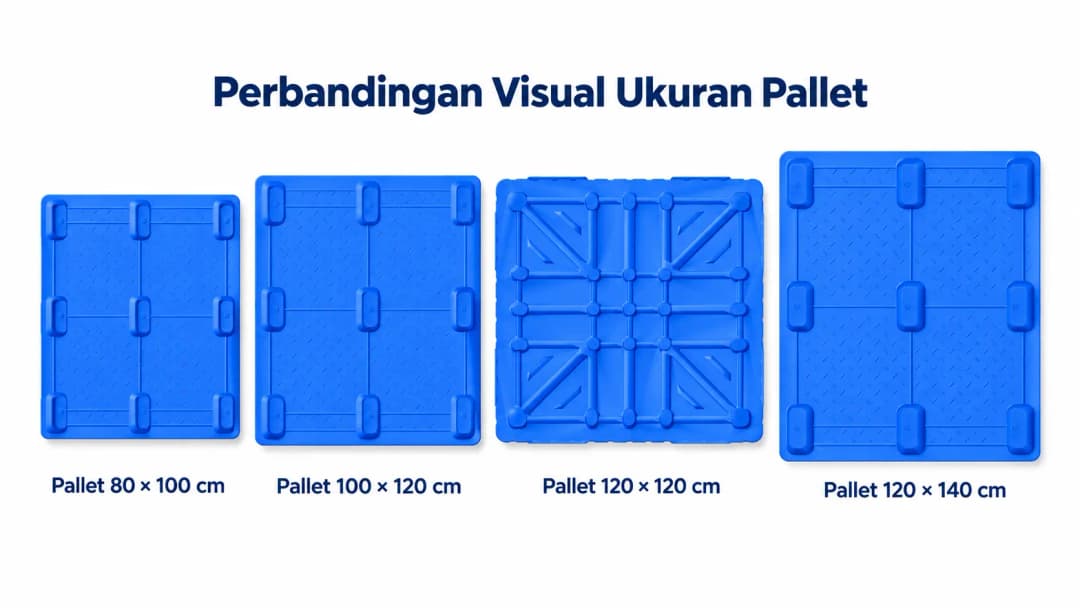
Karpinus HDPE pallets are manufactured directly by PT Karya Pilar Nusantara. For procurement needs, companies can consult regarding the required pallet sizes, load capacities, and quantities.
More information is available on the PT Karya Pilar Nusantara HDPE Plastic Pallets page.
Things to Check Before Buying Warehouse Pallets
Before making a purchase decision, it is advisable to conduct a simple assessment of operational requirements.
Some information that should be prepared includes:
Type of goods. Will the pallets be used for cartons, sacks, machines, drums, or other products?
Load weight. What is the maximum weight of the goods placed on each pallet?
Goods dimensions. Does the entire underside of the goods receive sufficient support?
Storage location. Will the pallets be placed on the floor, stacked, or stored on racking systems?
Handling equipment. Will forklifts, hand pallet trucks, or stackers be used?
Frequency of use. How often will the pallets be moved each day?
Warehouse conditions. Will the pallets be used at normal temperatures, in humid environments, or in cold storage?
Required quantity. How many pallet units are needed to meet operational capacity?
For large-volume purchases, it is advisable to test samples under actual operating conditions.
Check whether the pallet dimensions match the goods, whether the handling equipment can be used properly, and whether the pallet construction meets the load requirements.
Also document the specifications of the approved variants so that future purchases use products with consistent characteristics.
This step can help reduce selection errors before pallets are widely used in the warehouse.
Frequently Asked Questions About Warehouse Plastic Pallets
Can all plastic pallets be used with forklifts?
Not all pallets have the same fork entry design. Check the opening dimensions, underside structure, and dynamic load capacity before using them with forklifts.
Are 100 × 120 cm plastic pallets suitable for warehouses?
The 100 × 120 cm size can be used for various warehousing needs. However, suitability still depends on the dimensions of the goods, warehouse layout, and available handling equipment.
Are heavy duty pallets always stronger?
Heavy duty pallets are generally designed for higher load classes. However, their actual capacity must still be evaluated based on the specifications of each product, including loading conditions.
Can plastic pallets be stored on multi-level racks?
Yes, provided the pallet design and racking capacity are compatible with the racking system being used. Not all pallets that are strong when placed on the floor can be positioned directly on two rack beams.
Are HDPE plastic pallets resistant to water?
HDPE material is resistant to water and does not decay like wood due to moisture. Nevertheless, pallets still need to be inspected and maintained according to their operating conditions.
Conclusion: Choose Pallets That Match Warehouse Operations
Pallet selection should begin with understanding the goods to be stored and how those goods will be moved.
Pallet dimensions must match the size of the load and the available storage space. Meanwhile, load capacity must be evaluated based on operating conditions, whether the pallet is placed on the floor, lifted by a forklift, or positioned on racks.
Light duty, standard, and heavy duty pallets each have their own applications. The same applies to single side and double side constructions, which need to be selected according to operational requirements.
For companies requiring HDPE plastic pallets, PT Karya Pilar Nusantara provides several size and capacity options that can be adjusted to warehouse requirements and industrial procurement needs.
By determining the right specifications from the beginning, pallet use can help make goods storage and handling operations more organized.
Explore the available HDPE plastic pallet options and consult your procurement requirements through PT Karya Pilar Nusantara.