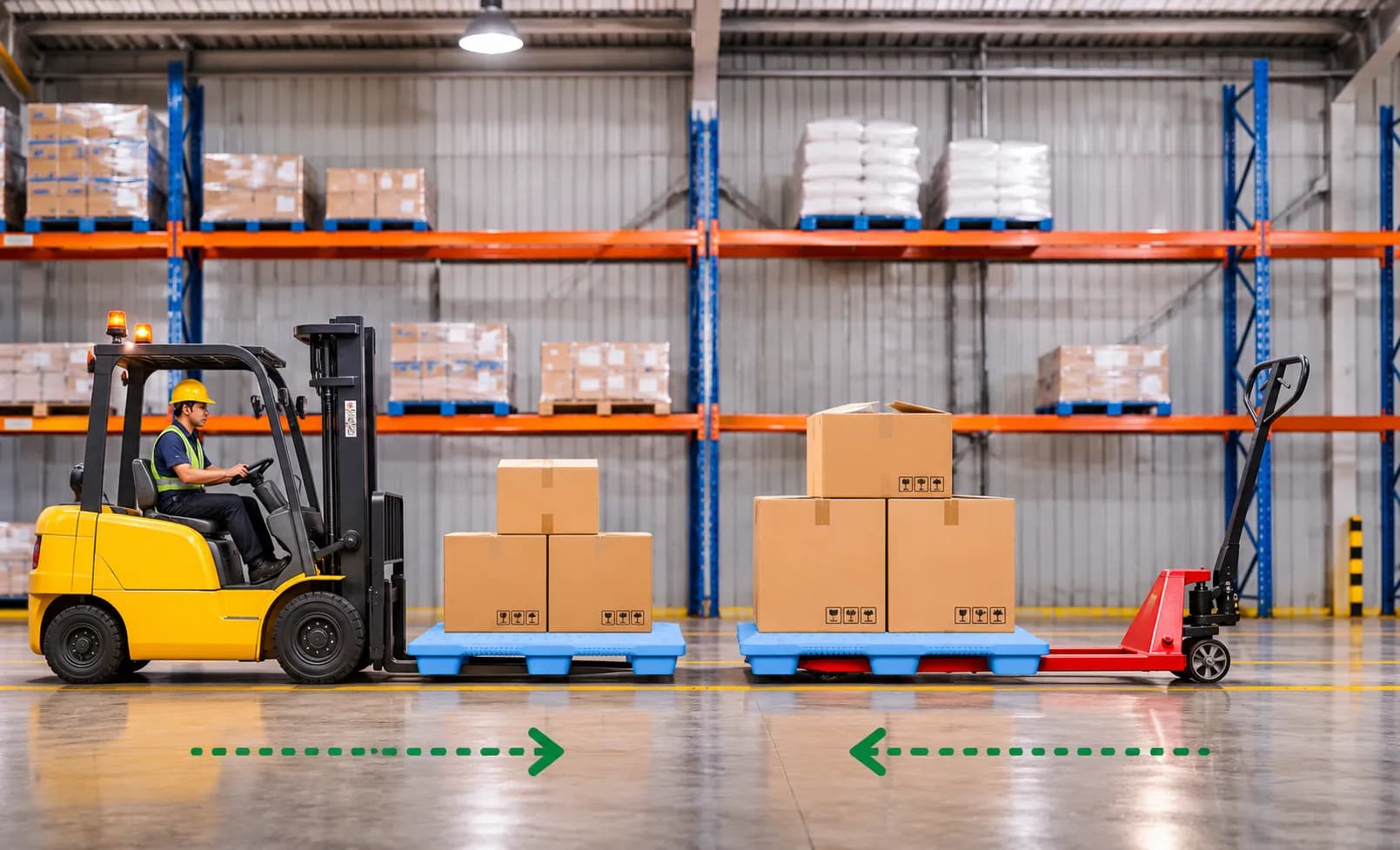
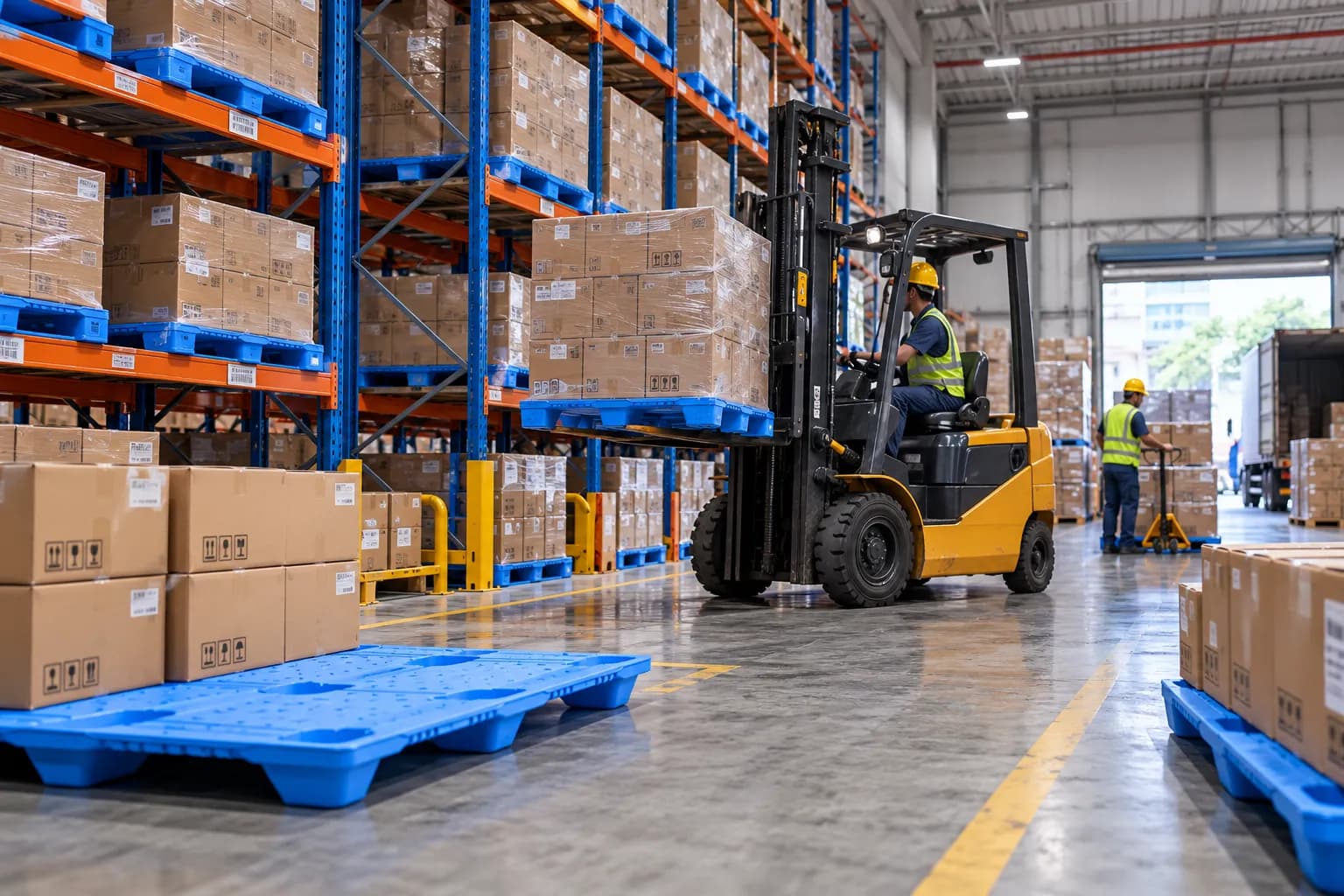
When choosing pallets for warehouse needs, price is usually one of the main considerations. Wooden pallets are known to be more affordable, while plastic pallets offer resistance to moisture and ease of maintenance.
However, does a pallet with a lower purchase price always provide greater savings?
In warehouse operations, pallets are used to support goods, assist with loading and unloading, and facilitate movement using forklifts. If they are used frequently, pallet maintenance and replacement costs also need to be taken into account.
Therefore, comparing plastic pallets vs. wooden pallets cannot be based solely on unit price. The type of goods, warehouse conditions, frequency of use, and service life also determine which option is more economical.
So, which one should be used for warehouse and industrial needs?
What Is the Difference Between Plastic Pallets and Wooden Pallets?
A pallet is a platform used to store, stack, and move goods. It helps with material handling by preventing goods from coming into direct contact with the floor and making them easier to lift using material handling equipment.
Among the various types of pallets used in industry, plastic pallets and wooden pallets are two commonly found options.
Wooden pallets are made from an arrangement of wooden boards and beams assembled into a single structure. This material has long been used in goods transportation because it is relatively easy to obtain and can be manufactured according to specific size requirements.
Meanwhile, plastic pallets are made from polymer materials molded into a single structure. One of the materials used is High Density Polyethylene, or HDPE.
HDPE pallets have low water absorption, do not deteriorate like wood, and can be cleaned after use. These characteristics make them a popular consideration for repeated storage and material handling needs.
Nevertheless, both types of pallets have their own advantages. Wooden pallets are still widely chosen for certain shipping needs, while plastic pallets are often used in warehouse systems that require consistent dimensions and easy maintenance.
Plastic Pallets vs. Wooden Pallets: A Comparison for Warehouses
Before making a choice, there are several differences worth considering.
| Aspect | Plastic Pallets | Wooden Pallets |
|---|---|---|
| Initial price | Generally higher | Generally more affordable |
| Water resistance | Do not absorb water like wood | Can absorb moisture |
| Maintenance | Relatively easy to clean | Require inspection of boards and nails |
| Cleanliness | Do not produce wood splinters | May produce splinters |
| Resistance to wood pests | Not a food source for termites | At risk of termite infestation |
| Repairs | Depends on the design, generally more difficult to repair | Certain types of damage can be repaired |
| Load capacity | Depends on the type and construction | Depends on the wood type and construction |
| Repeated use | Suitable for repeated use if specifications are appropriate | Can be reused with condition inspections |
The table shows that neither type of pallet is always superior under all conditions.
Resistance to Warehouse Conditions
In warehouses with high humidity levels, wooden pallets require more attention. Wood can absorb water, so proper storage and maintenance are necessary to reduce the risk of damage.
HDPE plastic pallets have different characteristics. The material does not absorb moisture like wood, making it more practical for environments that require regular cleaning.
However, plastic pallets still need to be cleaned and inspected. Water-resistant materials do not mean that all surfaces are automatically free from dirt or contamination.
Ease of Operational Handling
The shape of a pallet also affects warehouse operations.
Pallets with uniform dimensions make it easier to arrange goods, especially when a company uses a fixed storage layout system.
Molded plastic pallets generally have consistent dimensions between units. Meanwhile, the quality of wooden pallets is strongly influenced by the manufacturing process, material condition, and assembly accuracy.
For forklift operations, both can be used as long as they have suitable construction, load capacity, and fork entry clearance.
Maintenance and Replacement Costs
Another equally important difference is their maintenance requirements.
Wooden pallets can experience damage to boards, joints, or nails. Certain minor damage can still be repaired, but the process requires time and money.
Plastic pallets do not have nails or boards that need replacing. Nevertheless, cracked or deformed sections must still be inspected because they can affect the pallet's ability to support goods.
Plastic Pallets Have a Higher Price, but Are They Really More Expensive?
If you only look at the purchase price, wooden pallets often appear more economical.
For the same quantity, the initial procurement cost of wooden pallets is generally lower than that of plastic pallets with comparable specifications.
However, in warehouse operations, purchasing costs are not the only expense.
Other costs may arise during pallet use, such as repairs, cleaning, replacement of units that are no longer suitable for use, and goods handling costs when operational disruptions occur.
Therefore, companies should calculate the total cost of ownership (TCO).
The calculation can be simplified as follows:
Total pallet cost = purchase cost + replacement cost + maintenance cost during the period of use.
If necessary, companies can also include labor costs, storage costs, and losses resulting from actual recorded goods damage.
With this approach, the higher price of plastic pallets does not necessarily mean higher operational costs.
Conversely, plastic pallets are not automatically the most economical choice if they are only used once or rarely moved.
Simulation of Pallet Usage Costs Over Three Years
To make this easier to understand, let's use a simple example.
A warehouse needs 100 pallets to support goods storage and handling activities over three years.
The company is considering two options with the following assumptions.
| Cost Component | Wooden Pallets | Plastic Pallets |
|---|---|---|
| Purchase price per unit | Rp120,000 | Rp300,000 |
| Initial purchase of 100 units | Rp12,000,000 | Rp30,000,000 |
| Replacements over 3 years | 150 units | 5 units |
| Replacement costs | Rp18,000,000 | Rp1,500,000 |
| Total maintenance costs | Rp3,000,000 | Rp500,000 |
| Total cost over 3 years | Rp33,000,000 | Rp32,000,000 |
Note: All figures are illustrative assumptions, not official KPN prices, the latest market price survey, or actual damage rate data. The replacement quantities are intentionally different to illustrate one possible operational scenario.
Based on this example, the initial cost of wooden pallets is much lower. However, after replacement and maintenance costs are added, the total expenditure for plastic pallets becomes approximately Rp1,000,000 lower.
Of course, the results may vary.
If a warehouse uses high-quality wooden pallets with a low damage rate, expenses over three years could be significantly lower than in the simulation above.
Conversely, if pallets are used intensively and require periodic replacement, long-term costs become an increasingly important consideration.
Therefore, to determine which option is truly more economical, companies need to use data from their own operational conditions.
When Are Wooden Pallets More Cost-Effective?
Although plastic pallets have several advantages, wooden pallets remain a reasonable choice for many industrial needs.
One example is one-way shipping.
In this system, pallets are shipped together with products and may not return to the original warehouse. Companies usually pay more attention to initial procurement costs because the pallets are not always reused in their operations.
Wooden pallets can also be considered when a company needs custom sizes that are not available among standard pallet options.
Wooden structures are relatively easy to adjust to the dimensions of the goods, provided that the design still meets load and handling requirements.
In addition, wooden pallets can be an option when:
The initial purchasing budget is limited.
The goods do not require storage conditions with special cleanliness requirements.
The frequency of pallet movement is relatively low.
The company has facilities for inspecting and repairing wooden pallets.
Under these conditions, using wooden pallets does not mean that a company is choosing an inferior material.
Instead, it can be an economical decision when it matches operational needs.
When Are Plastic Pallets More Beneficial?
Plastic pallets become an attractive option when a company uses pallets repeatedly over the long term.
For example, in distribution warehouses that handle goods receiving, storage, stock picking, and outbound shipping every day.
Under these conditions, pallets become part of the operational equipment used continuously.
HDPE plastic pallets can help reduce certain maintenance tasks commonly associated with wooden structures, such as inspecting protruding nails or replacing damaged boards.
The material also does not easily absorb water, making it an option for warehouses with stricter cleanliness requirements.
Plastic pallets can be considered for the following applications.
Warehousing and Distribution Centers
Pallets are repeatedly used to move goods with forklifts or other material handling equipment.
Food and Beverage Industry
Plastic pallets can make cleaning easier. However, their suitability for specific hygiene standards must still be verified based on product specifications.
Cold Storage
HDPE material can be used in low-temperature applications if the pallet type is specifically designed and confirmed to be suitable for those operating temperatures.
Export Shipping
Plastic pallets are not included in the category of raw wood packaging regulated under ISPM 15. Meanwhile, wooden pallets that fall within the scope of this standard require appropriate treatment and marking in accordance with the regulations.
Nevertheless, the requirements of destination countries and importers must still be considered.
From these examples, plastic pallets become an attractive choice when companies prioritize repeated use, ease of cleaning, and compatibility with warehouse operational systems.
KPN HDPE Pallet Options for Warehouses and Industry
For companies that need plastic pallets for warehouse operations, PT Karya Pilar Nusantara provides various HDPE pallet options with different dimensions and load capacities.
KPN plastic pallet products are intended for goods storage, logistics, distribution, and industrial activities.
Available options include single side and double side pallets.
Single Side Pallets
Single side pallets have one main surface for placing goods, with a supporting structure underneath.
This type is available in several sizes, allowing it to be adjusted to storage and goods handling requirements.
Double Side Pallets
Double side pallets have a structure with surfaces on both sides. In designs specifically intended for reversible use, both sides can be used as supporting surfaces.
This option can be considered for applications requiring a more substantial structure, provided that handling and loading methods comply with product specifications.
KPN HDPE Pallet Series Options
| Series | Dimensions | Static Load | Dynamic Load |
|---|---|---|---|
| KPN 1080 Light | 80 × 100 cm | 2–3 tons | 1.5–2.5 tons |
| KPN 1210 Standard | 100 × 120 cm | 1.3–3 tons | 0.8–2.5 tons |
| KPN 1214 Heavy Duty | 120 × 140 cm | 2–3 tons | 1.5–2.5 tons |
| KPN 1212 Double Side | 120 × 120 cm | 2.5–3.5 tons | 2–3 tons |
Capacities depend on each variant. Static and dynamic load capacities do not apply to all usage conditions. For racking systems, load capacity must be confirmed separately.
These differences in dimensions and capacities give companies options to match pallets with the weight of their goods and the handling systems used.
For example, warehouses that need to store relatively small goods can consider the KPN 1080 series. Meanwhile, applications with larger dimensions and heavier loads can be evaluated using other series.
Complete information about dimensions, materials, and product options can be found on the Karya Pilar Nusantara HDPE Plastic Pallet page.
What to Check Before Buying Warehouse Pallets
After understanding the differences between materials, the next step is to match the pallets with the company's needs.
There are several things that should be checked before procurement.
1. Weight and Dimensions of Goods
Make sure the pallet dimensions match the packaging dimensions and the weight of the goods that will be placed on them.
Goods should not extend excessively beyond the pallet surface, as this can interfere with stacking and handling processes.
2. Load Capacity
Check whether the pallet's load capacity matches the conditions of use.
The load capacity when a pallet is stationary on the floor is not the same as its capacity when lifted using a forklift.
If used on racks, the pallet's capacity in a racking system must be specifically checked.
3. Frequency of Movement
Pallets used only for temporary storage have different requirements from pallets that are moved every day.
The more intensive the handling activities, the more important it becomes to consider the pallet's structure and durability under repeated use.
4. Warehouse Environmental Conditions
Consider whether the warehouse has high humidity levels, low temperatures, or specific cleanliness requirements.
The pallet material and design should be adjusted to these conditions.
5. Quantity and Duration of Use
For large-scale procurement, unit price calculations should be supplemented with projected usage costs.
Avoid a situation where pallets that appear inexpensive at the time of purchase actually require replacement more frequently than initially expected.
Likewise, pallets with high specifications may not be necessary if the stored goods are relatively lightweight and rarely moved.
A more complete guide to choosing dimensions and capacities can be found in the Guide to Choosing HDPE Pallets article.
Frequently Asked Questions About Plastic and Wooden Pallets
Are plastic pallets stronger than wooden pallets?
Not necessarily. Pallet strength is influenced by design, material, supporting structure, and loading conditions. Both types of pallets are available in various load capacity classes.
Are plastic pallets more durable?
HDPE plastic pallets offer advantages in moisture resistance and do not deteriorate like wood. However, their actual service life still depends on product quality and how they are used.
How much do plastic pallets for warehouses cost?
Plastic pallet prices depend on dimensions, weight, material, construction, load capacity, and purchase quantity. For company needs, it is advisable to request a quotation based on the required specifications to ensure an accurate comparison.
Do plastic pallets require no maintenance?
Plastic pallets still require cleaning and condition inspections. The difference is that there are no wooden boards or nails to inspect, as with wooden pallets.
Are wooden pallets still suitable for industrial use?
Yes. Wooden pallets can be used for various industrial needs, including storage and distribution, as long as their construction, condition, and load capacity are suitable.
Conclusion: Choose Pallets Based on Operational Needs
The comparison of plastic pallets vs. wooden pallets shows that both materials have different advantages.
Wooden pallets are generally more economical in terms of initial purchase price, relatively easy to obtain, and can be an option for one-way shipping or specific needs requiring custom dimensions.
Meanwhile, HDPE plastic pallets offer moisture resistance, ease of cleaning, and dimensional consistency that can support warehouse operations involving repeated use.
To determine which is more cost-effective, companies need to consider purchase costs, maintenance, replacement, and how long the pallets will be used.
Therefore, the decision should not be based solely on unit price, but also on the costs incurred throughout the pallets' operational use.
For companies considering HDPE plastic pallets, PT Karya Pilar Nusantara provides various size and capacity options for warehouse, logistics, and industrial needs.
Information about specifications, product options, and procurement consultation can be obtained through the Karya Pilar Nusantara HDPE Pallet page.