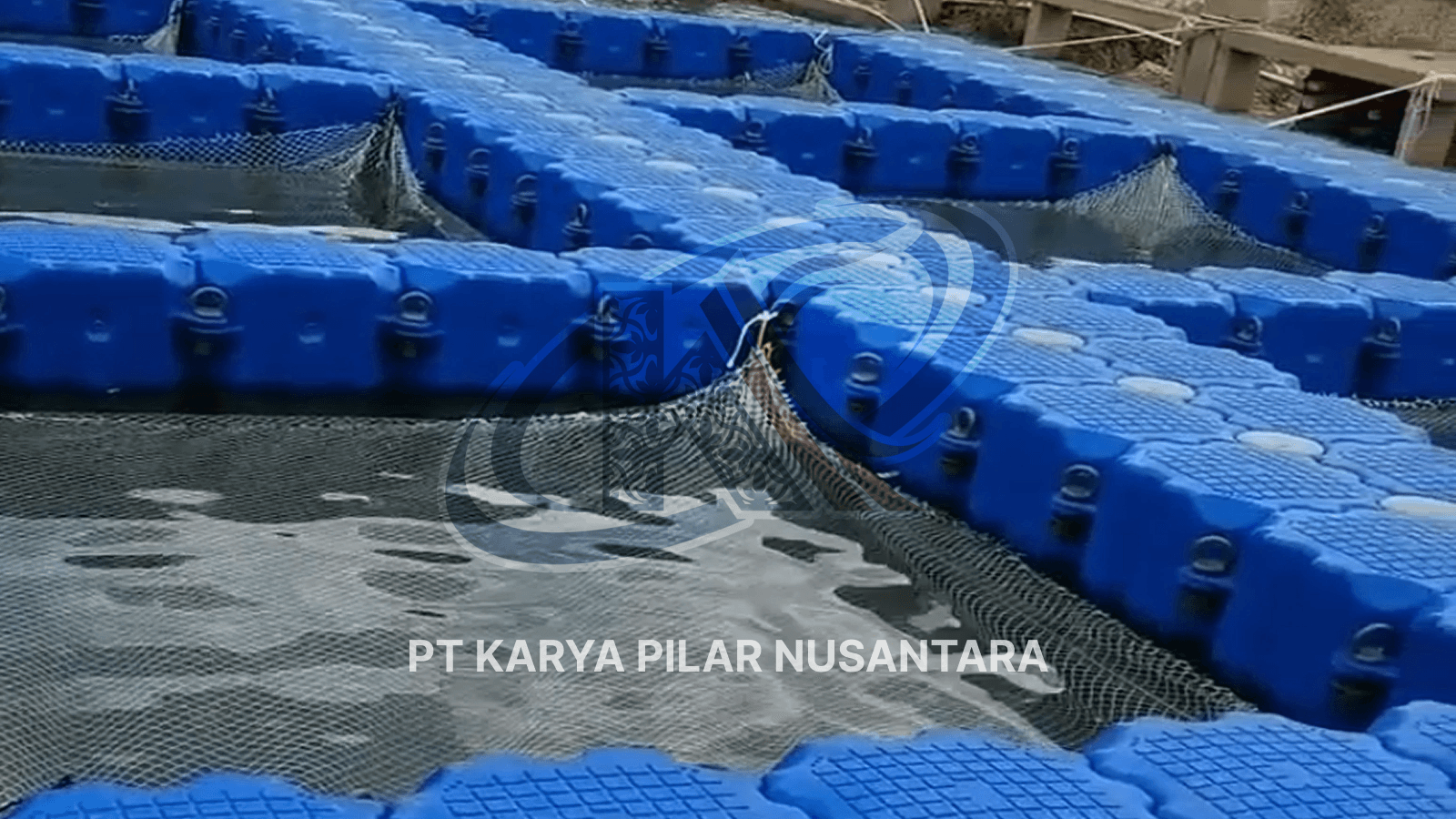
Floating fish cages have long been used by fish farmers in various regions of Indonesia. In reservoirs, lakes, rivers, and coastal areas, fish cages have become one of the ways to raise fish by utilizing available waters.
If you look closely, the fish cages used do not always have the same shape. Some still use bamboo frames and drum floats, while others use plastic pipes or arrangements of floating cubes made of HDPE.
These differences are not only about the materials used. The construction of a fish cage affects how nets are installed, how easily workers can move around, maintenance requirements, and the structure's ability to withstand water conditions.
Therefore, before building a fish cage, it is advisable to understand the components of its construction first. This is especially important if you plan to use a modular floating system that can be arranged according to the size and needs of fish farming.
What Is a Floating Fish Cage and How Does It Work?
A floating fish cage is a fish farming facility that uses a floating frame to support a fish-rearing enclosure in the water. In floating net cages, or KJA, the enclosure consists of a net bag suspended from a structure on the water's surface.
The net serves as the place where fish are raised, while the frame and floats keep the upper part of the cage at the surface.
Through the openings in the net, water can flow in and out according to water conditions. This water exchange is important for helping supply dissolved oxygen and carrying fish metabolic waste out of the farming enclosure.
However, natural water exchange does not always mean that water quality will maintain itself. The number of fish, feeding practices, net cleanliness, and water conditions must still be considered.
In daily operations, the upper part of the cage is also used as a walking surface when workers feed the fish, inspect their condition, clean the nets, or harvest them.
This is why fish cages require a sufficiently stable structure. The frame not only supports the net but must also be capable of carrying operational loads according to its intended design.
Types of Floating Fish Cages Based on Their Construction
Types of floating fish cages can be distinguished based on the materials and shapes of their supporting structures. Each has characteristics that need to be adapted to the farming location.
1. Bamboo or Wooden Floating Fish Cages
Fish cages with bamboo or wooden frames are among the structures that have long been used in fish farming.
Typically, bamboo poles or wooden beams are arranged into a square frame. Floats, such as plastic drums, are installed underneath to keep the frame afloat. The net bag is then suspended in the middle.
This type of construction is still used because the materials and construction process are relatively accessible in several regions.
However, bamboo and wood that are continuously exposed to water and weather require inspections and replacement of parts that begin to deteriorate. Frame connections also need attention, especially in locations that frequently experience changes in currents or waves.
2. Floating Fish Cages Using HDPE Pipes
The next type uses polyethylene pipes, including HDPE, as part of the frame or flotation system.
In some systems, hollow pipes assembled into circular or square structures function as flotation devices. This type of cage is widely known in marine aquaculture activities.
The use of pipes allows fish cages to be constructed in various sizes. However, these structures require connections, net supports, mooring systems, and operational walkways according to their design.
3. HDPE Floating Fish Cages with a Modular Cube System
Unlike pipe-based structures, this system uses several floating cube modules connected into one assembly.
The cubes are usually arranged to form walkways around the net compartments. This allows workers to access every part of the fish cage.
One advantage of modular arrangements is that their configuration can be planned based on the number and size of the farming compartments.
If additional walkways or changes to the arrangement are required, the configuration can be adjusted as long as the design, connections, buoyancy, and mooring system meet the requirements.

Understanding the Main Components of a Floating Fish Cage Structure
A fish cage that looks simple from the surface actually consists of several components with different functions.
If one component is unsuitable, fish farming activities may be disrupted. For example, a frame that is still in good condition is not necessarily safe to use if the net begins to tear or the mooring system weakens.
The following are the main components that need to be understood.
Frame and Walkways
The frame serves as the support for the upper structure and as a place to install the net's supporting components.
In certain fish cages, the frame also provides walkways for workers to move around the farming compartments.
The width of the walkway needs to account for the activities performed. A walkway used for light inspections certainly has different requirements from an area used for lifting nets, carrying feed, or placing equipment.
Floats or Floating Platforms
Floats are responsible for maintaining the structure's position on the water's surface.
In traditional fish cages, these components may consist of drums or other flotation materials installed beneath the frame. Meanwhile, in modular systems, arrangements of HDPE cubes can function as both walking surfaces and flotation supports.
Buoyancy requirements must be calculated based on the total structural load, including workers, equipment, net components, and changes in load during operations.
Net Bag
The net bag is the enclosure where fish are raised during the farming process.
The mesh size needs to be adjusted to the size of the fish to prevent them from escaping easily while still allowing proper water circulation.
The net depth also needs to be adjusted to the depth of the location and the requirements of the fish species. The bottom of the net should not be allowed to touch the waterbed if doing so interferes with its farming function.
Net Weights
Weights are installed to help maintain the shape of the net bag underwater.
Without suitable weights, the net may change shape due to currents, reducing the space available for fish to move.
The weight and installation position need to follow the size and design of the net.
Anchors and Mooring Ropes
Anchors help maintain the position of the fish cage so that it does not drift away due to currents or wind.
A mooring system usually involves ropes and attachment points that connect the structure to anchors or other restraints.
The number, size, and position of anchors cannot be standardized for all fish cages. Waterbed conditions, depth, structural dimensions, currents, waves, and changes in water levels will influence their planning.

Using HDPE Floating Cubes for Fish Cages
When constructing floating fish cages, selecting the flotation system is often a consideration from the planning stage. The floats must be capable of supporting the structure used on the water while accommodating the operational requirements around the farming compartments.
One material used for this purpose is floating cubes for fish cages made of High Density Polyethylene, or HDPE.
HDPE is a plastic material that does not corrode like iron. With the appropriate formulation, this material can be used in products exposed to water and outdoor conditions.
Unlike drums installed beneath a frame, modular floating cubes have surfaces that can be arranged into walking areas.
Creating Walkways Around the Nets
In fish cages with several compartments, workers need to move from one area to another to feed the fish or inspect their condition.
HDPE cubes can be assembled along the sides of net compartments to form walkways.
This arrangement helps provide access to several compartments from interconnected platforms, without always having to use a boat to reach each side of the cage.
The width and number of platform layers must still be determined based on operational requirements and load calculations.
Making Fish Cage Configurations Easier to Adjust
Modular systems use locking components to connect one cube to another.
Because each module is manufactured in a specific size, the cubes can be arranged into straight walkways, square platforms, or structures surrounding net compartments.
Configuration changes are also possible when farming requirements expand, provided that the connections and mooring system are rechecked.
Using Textured Surfaces
On certain floating cubes, the upper surface is equipped with patterns or textures to help improve foot grip during use.
This characteristic is useful in fish cage operations because walkways are often exposed to water splashes.
Nevertheless, textured surfaces still need to be cleaned of algae, mud, and other dirt that can make them slippery.
Karpinus HDPE Floating Cubes
PT Karya Pilar Nusantara provides Karpinus HDPE Floating Cubes for floating construction needs, including floating fish cage platforms.
The cube modules displayed on its product page measure 50 × 50 × 40 cm and are made of HDPE material.
The system is equipped with connecting components such as pins and locking bolts, which are used to join several modules according to the planned arrangement.
Karpinus floating cubes can be considered for creating access walkways and working platforms around fish cage compartments.
However, floating cubes alone do not form a complete fish cage. The construction still requires net support and attachment systems, weights, anchors, and other components that comply with the fish farming design.

Designing Floating Fish Cage Platforms According to Requirements
The size of a fish cage should be determined based on the fish species, planned farming activities, and site conditions.
For example, a net compartment measuring 4 × 4 meters requires a walkway arrangement that allows workers to reach the sides of the net.
If floating cubes measuring 50 × 50 cm are used, a walkway one cube wide can be planned around the compartment.
For a simple geometric illustration, an empty compartment measuring 4 × 4 meters surrounded by a 0.5-meter-wide walkway will result in overall dimensions of 5 × 5 meters.
The walkway area is calculated as follows:
Outer area: 5 × 5 = 25 m²
Compartment opening area: 4 × 4 = 16 m²
Walkway area: 25 − 16 = 9 m²
Each cube measuring 50 × 50 cm covers an area of 0.25 m². Therefore, the initial requirement for this walkway is:
9 ÷ 0.25 = 36 floating cubes.
This figure is only an example of a single-layer arrangement calculation based on area. It does not include layout changes, additional access, net frames or hangers, structural reinforcement, and other technical requirements.
A walkway width of 0.5 meters also does not automatically meet operational access requirements. If the walkway is used to carry feed, equipment, or conduct harvesting activities, a more appropriate assessment of width and capacity is required.
For fish cages consisting of several compartments, the platforms can be arranged to connect with each other so that access routes to one compartment can be shared.
In addition to the number of cubes, the design must consider connection positions, net suspension points, mooring points, operational loads, and worker movement space.
Do not rely solely on the number of cubes per square meter. Theoretical buoyancy differs from the safe working load when the structure is actually in use.
Floating Fish Cages for Freshwater and Marine Fish Farming
Floating net cages can be used to raise various species of fish. However, the selection of location and construction type must follow the requirements of the species being farmed.
Floating Fish Cages in Lakes and Reservoirs
Lakes and reservoirs are among the locations widely used for freshwater fish farming with floating net cages.
Fish species raised include tilapia and carp, depending on water conditions and local farming activities.
In these locations, changes in water levels, currents, and water quality require attention. Reservoir conditions that appear calm on the surface do not necessarily have good oxygen levels and water quality at all times.
Fish cage placement must also follow permitted zones to avoid interfering with other uses of the reservoir.
Floating Fish Cages in Rivers
Rivers can also be used for fish cage farming in locations that meet the requirements.
The most important considerations are changes in currents and water levels, especially during the rainy season.
The structure used must be designed so that it does not easily shift, obstruct river flow, or become caught on materials carried by currents.
In rivers that frequently carry waste or logs, the risks of impact and materials becoming caught on the structure need to be considered from the beginning.
Floating Fish Cages at Sea
Marine fish farming using floating net cages can be applied to species such as grouper and snapper.
Marine waters have conditions that differ from reservoirs. In addition to currents and waves, structures also face the effects of tides, wind, and exposure to saltwater.
The selection of frame design and mooring system is important because not all modular structures are suitable for every marine condition.
For areas with large waves or strong currents, more specialized designs and technical verification are required.
Things to Consider Before Installing Fish Cages
Building a fish cage involves more than determining the frame size and purchasing flotation materials. The placement location will affect the sustainability of farming activities and maintenance costs.
First, examine the water conditions. Depth, currents, waves, water quality, and changes in water levels must be suitable for both the fish and the structure. Locations that frequently experience low oxygen levels or pollution can cause problems even when the fish cage itself remains in good condition.
Second, determine walkway requirements. Consider the number of people who will be working, how feed will be transported, equipment placement, and activities carried out during harvesting. All of these factors will affect the area and structural capacity required.
Third, plan the mooring system. Anchors and mooring ropes must be adapted to site conditions. Floating structures still require position restraints to prevent them from drifting or colliding with other facilities.
Fourth, pay attention to regulations governing water use. Fish cage installation must comply with applicable zoning regulations, permits or approvals, and environmental carrying capacity requirements. This is particularly important for the use of lakes, reservoirs, rivers, and coastal areas.
Finally, consider ease of maintenance. Fish cages that are difficult to access can complicate net inspections, component replacement, and fish harvesting.
For larger fish cage projects, the design should be reviewed by technical personnel who understand floating structures and aquaculture activities.
Maintaining Floating Fish Cages to Keep Them Suitable for Use
The condition of fish cages needs to be inspected regularly, not only when problems are discovered.
The net is one component that requires attention. Nets covered with algae or attached organisms can obstruct water exchange. In addition, damage to the net may cause fish to escape from the farming enclosure.
Frame connections and floats also need to be inspected, especially after strong currents, large waves, or changes in the cage's position.
In HDPE floating cube systems, inspections can be carried out on the module surfaces, the physical condition of the cubes, and the pins and locking bolts.
If components are found to be cracked, loose, or deformed, their use needs to be evaluated before the fish cage is operated again.
Walkways should be cleaned of algae and dirt to prevent workers from slipping easily.
Anchors and mooring ropes also need regular inspections. Worn ropes or damaged attachment points can affect the cage's ability to maintain its position.
Maintenance carried out from the beginning helps identify damage before it disrupts farming activities. In addition, timely component replacement can reduce the risk of damage to other parts.
Frequently Asked Questions About Floating Fish Cages
What is the difference between floating fish cages and floating net cages?
The term floating fish cage is often used to refer to fish-rearing facilities placed on floating structures. Floating net cages, or KJA, refer more specifically to systems that use net bags as fish-rearing enclosures.
Can HDPE floating cubes be used for tilapia fish cages?
They can be considered as part of a tilapia cage platform structure. However, compartment size, nets, buoyancy, and the mooring system must be designed according to farming requirements and water conditions.
Can floating cubes replace fish cage nets?
No. Floating cubes function as supporting modules or walking surfaces on floating structures. Fish still require a rearing enclosure in the form of nets or another specially designed containment system.
How many floating cubes are needed for one fish cage?
The number depends on the compartment size, walkway width, number of compartments, and the arrangement used. For cubes measuring 50 × 50 cm, each square meter of a fully covered surface requires four cubes in a single-layer geometric calculation.
Calculations for fish cages with net openings must use the actual area of the installed platform, not the total area of the compartment.
Can HDPE floating fish cages be used at sea?
HDPE material can be used in marine environments if its material specifications are suitable. However, the suitability of the entire cage system depends on the frame design, current and wave conditions, connection strength, and mooring system.
Conclusion: Choosing the Right Fish Cage Structure
Floating fish cages are one of the facilities used for fish farming in various types of waters. Their structures can be made using bamboo, wood, polyethylene pipes, or modular systems made of HDPE.
Each option has different installation and maintenance requirements.
In fish cage systems using HDPE floating cubes, the modules can be used to create walkways and working areas around farming compartments. Their arrangement can be planned according to the number of compartments and the requirements of activities carried out on the water.
Nevertheless, the success of fish cage operations is not determined solely by the flotation material. Water quality, net design, mooring systems, structural capacity, and fish farming management must still be taken into account.
For fish farm operators planning to build or replace fish cage platforms, PT Karya Pilar Nusantara provides Karpinus Floating Cubes made of HDPE with a modular system.
The required number of cubes and supporting components can be discussed based on the size and planned arrangement of the fish cage before procurement takes place.


