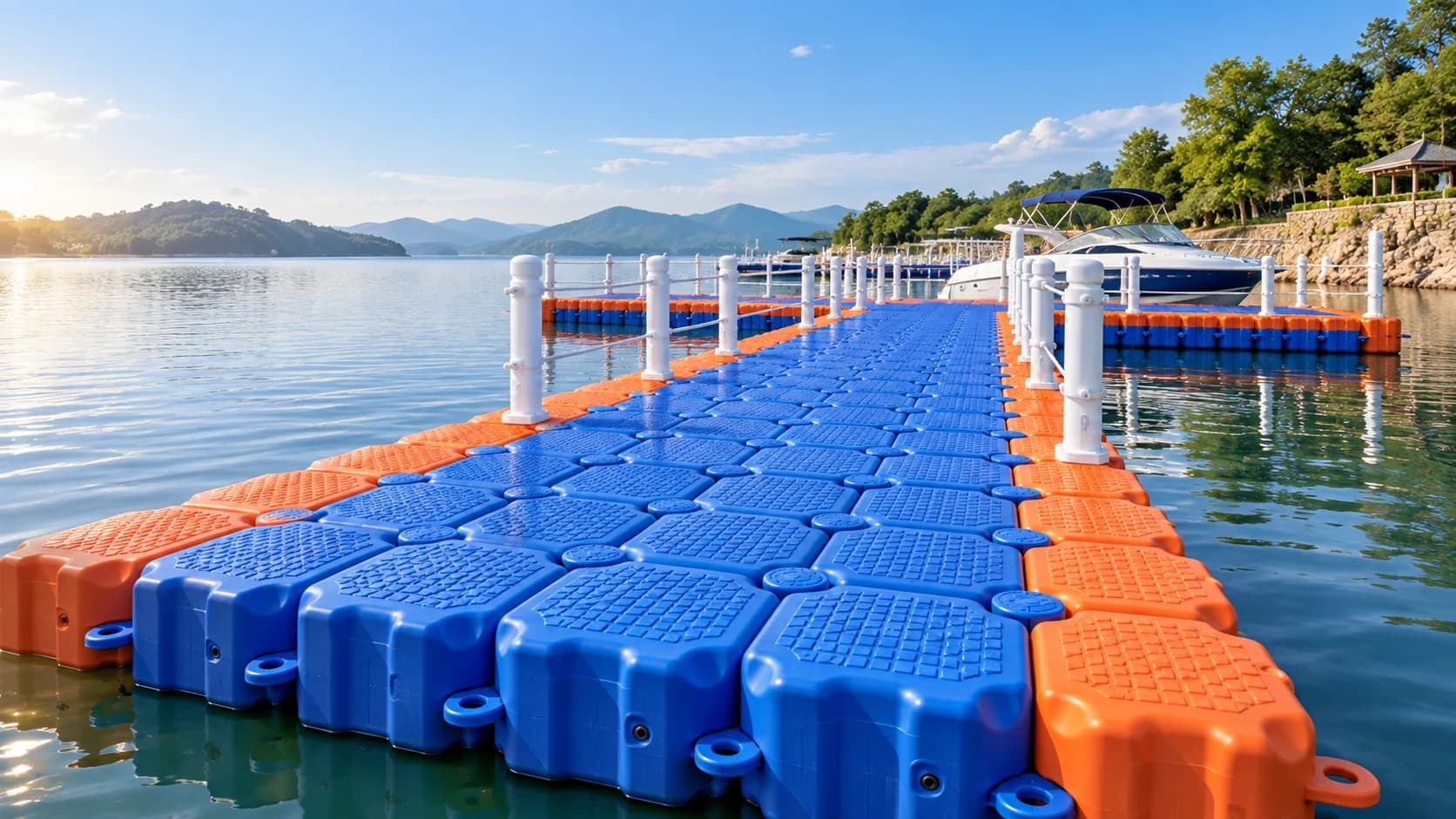
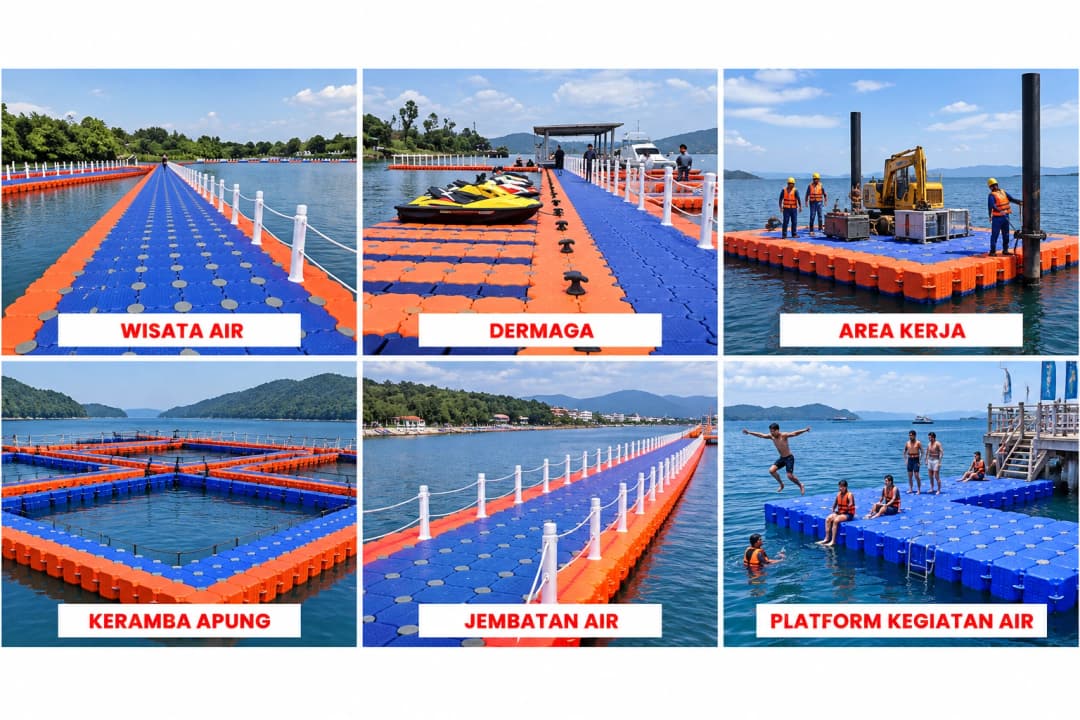
HDPE floating cubes are widely used to construct various floating facilities such as floating docks, floating bridges, fish cages, floating platforms, and water tourism facilities.
Unlike permanent structures such as concrete, floating cubes use a modular system. Each unit can be connected to other units, allowing the shape, length, and total platform area to be adjusted according to project requirements.
However, determining the number of floating cubes required should not be based solely on surface area. Cube dimensions, buoyancy, applied loads, water conditions, and installation systems must also be taken into account.
This article explains HDPE floating cubes, including their functions, dimensions, quantity calculations, and various applications.
What Are HDPE Floating Cubes?
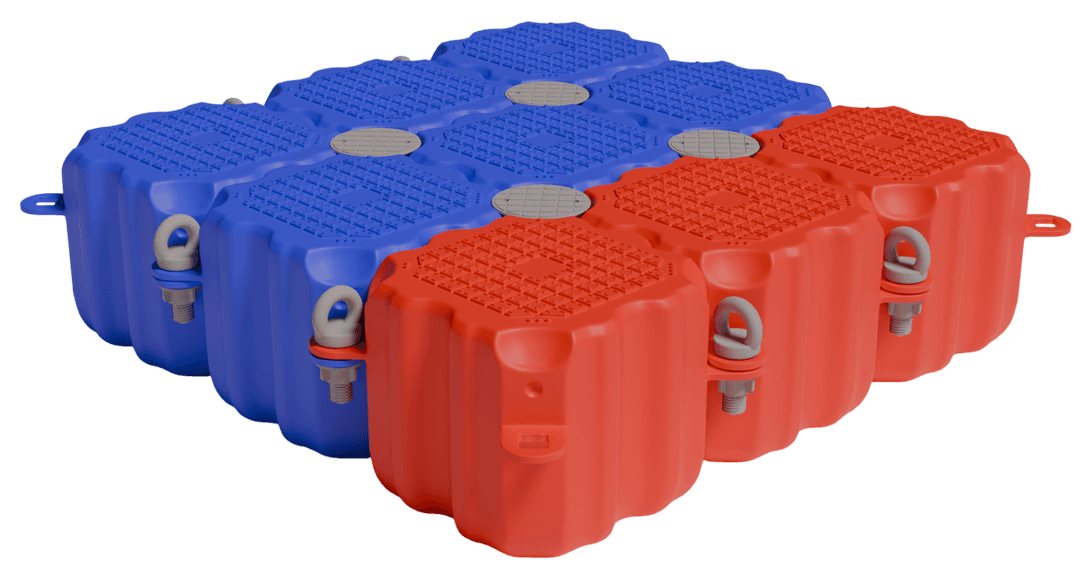
HDPE floating cubes are hollow modular units made from High Density Polyethylene (HDPE) and designed to generate buoyancy when placed in water.
Multiple cubes can then be connected using pins and locking systems to form a floating surface of a specific size.
Thanks to their modular system, floating cubes can be configured in straight layouts, wider platforms, L-shapes, T-shapes, or other configurations depending on site requirements.
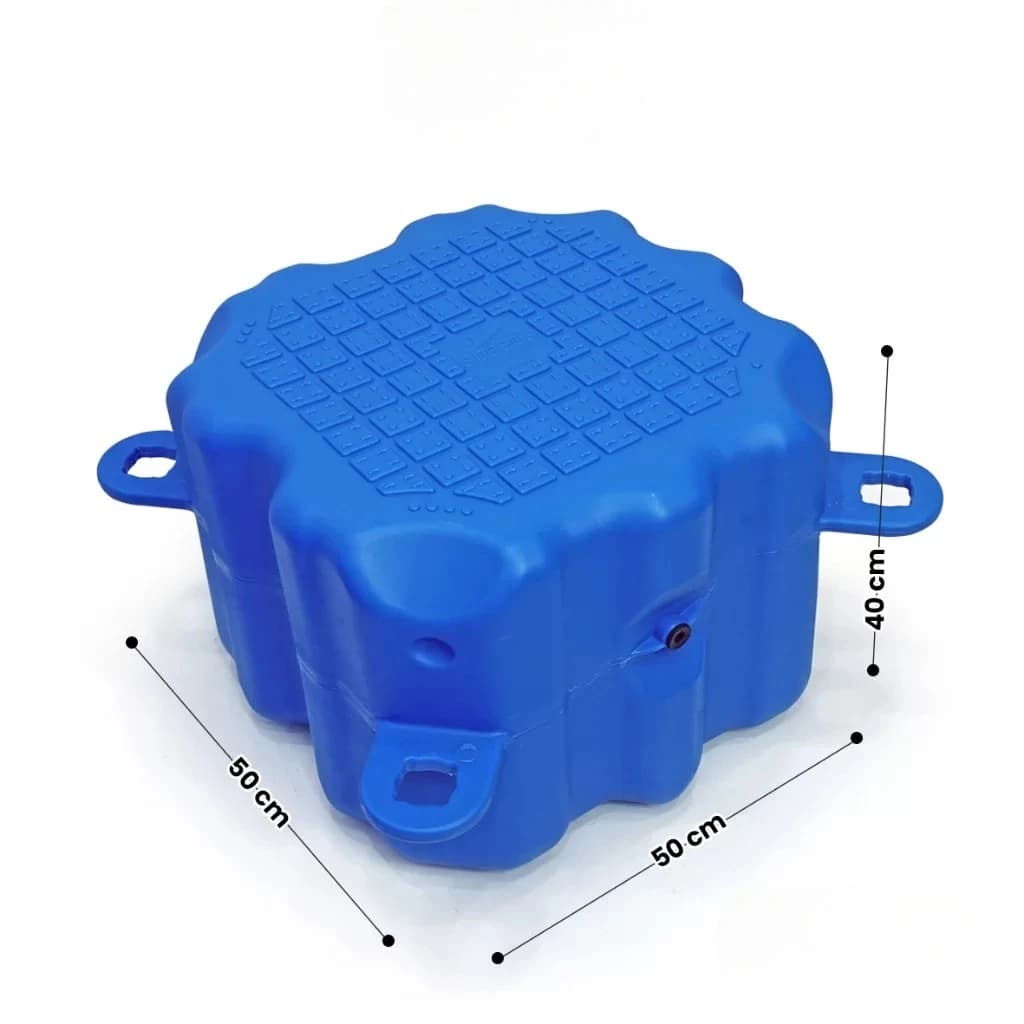
The HDPE Floating Cubes supplied by PT Karya Pilar Nusantara have the following dimensions:
50 × 50 × 40 cm
with an approximate weight of:
±7.2 kg per unit.
These dimensions provide each cube with a surface area of approximately 0.25 m².
HDPE Floating Cube Specifications
Below is an overview of the specifications of HDPE Floating Cubes from Karya Pilar Nusantara:
| Specification | Description |
|---|---|
| Material | High Density Polyethylene (HDPE) |
| Length | 50 cm |
| Width | 50 cm |
| Height | 40 cm |
| Weight | ±7.2 kg/unit |
| Surface area | ±0.25 m²/unit |
| Requirement per 1 m² | ±4 units |
| Geometric volume | ±0.10 m³ |
| Stated maximum load | 100 kg/unit |
HDPE is widely used for products exposed to outdoor and aquatic environments because it does not corrode like metal materials.
For long-term outdoor use, material quality, manufacturing processes, and protection against environmental exposure remain important factors.
How Do Floating Cubes Stay Afloat?
The way floating cubes work can be explained using the Archimedes' Principle.
When an object is placed in water, it experiences an upward buoyant force equal to the weight of the water displaced by the object.
A cube measuring:
0.50 m × 0.50 m × 0.40 m
has a geometric volume of approximately:
0.10 m³
or approximately:
100 liters.
In freshwater, a volume of 0.10 m³ can theoretically displace approximately 100 kg of water when the cube is almost fully submerged.
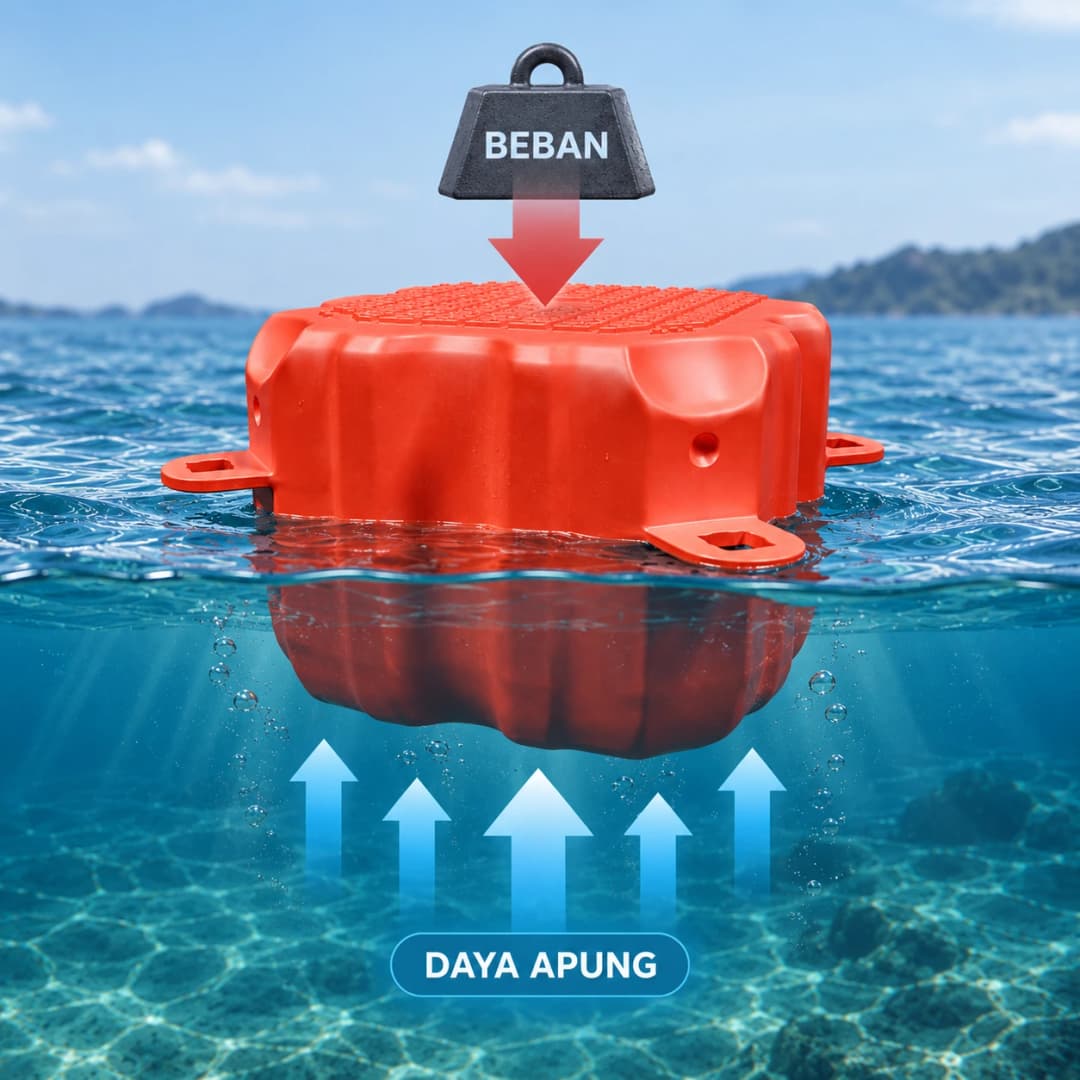
However, this figure should not automatically be considered a safe working load.
A floating structure must also support the weight of the cubes themselves, users, additional frames, railings, accessories, equipment, as well as dynamic forces caused by people moving, waves, currents, and vessel activity.
Therefore, floating cube projects should distinguish between:
theoretical buoyancy, maximum capacity, and recommended working load.
Operational loads should be determined based on the structure configuration and the conditions of the installation site.
How Many Floating Cubes Are Needed for 1 m²?
Each cube has a top surface measuring:
50 cm × 50 cm = 0.25 m²
This means approximately 4 floating cubes are required to create a 1 m² surface area.
The calculation is:
1 m² ÷ 0.25 m² = 4 cubes
As a simple estimate, the number of cubes required can be calculated using the following formula:
Number of cubes = platform area × 4
For example, if a dock measuring:
6 m × 6 m = 36 m²
is required, the initial geometric requirement would be:
36 × 4 = 144 cubes.
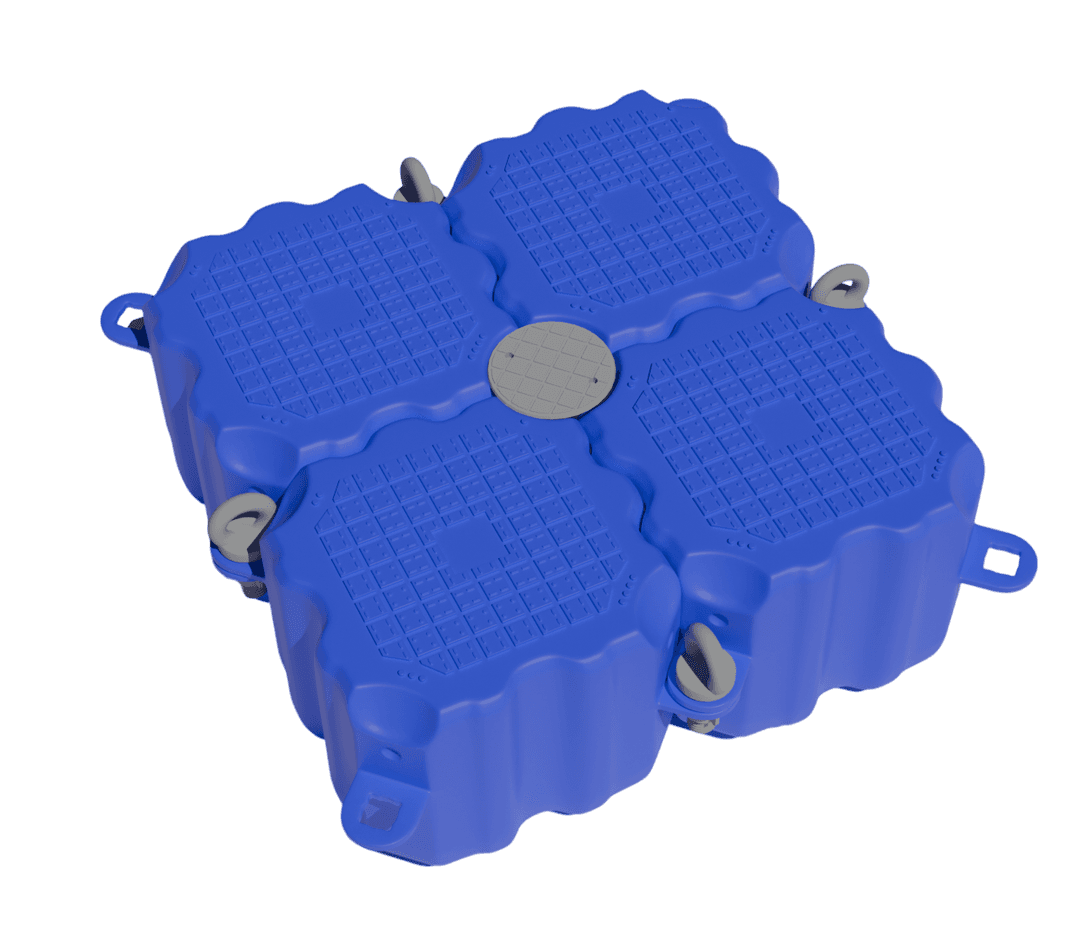
This calculation is based only on surface area.
The final quantity may change if the design includes a specific shape, double-layer construction, additional areas, vessel access lanes, fenders, or other special configurations.
Single Layer and Double Layer
Floating cubes can be used in single-layer or double-layer configurations.
Single Layer
A single-layer configuration means that the structure uses one layer of floating cubes.
This configuration is commonly used for:
- floating docks,
- walkways,
- tourism platforms,
- access routes to fish cages,
- and other floating applications.
Double Layer
A double-layer configuration uses two layers of floating cubes, increasing the overall height of the structure and producing different buoyancy characteristics.

However, using two layers does not automatically mean that the structure can safely support twice the load.
Load distribution, connections between units, stability, wave conditions, and the anchoring system must still be carefully considered.
Functions of HDPE Floating Cubes
The primary function of floating cubes is to create a modular floating surface.
Multiple units can be assembled into small structures or larger floating areas.
This modular system offers several advantages, including flexible configurations, relatively practical installation, and the ability to adapt the layout according to site requirements.
Under certain conditions, the structure can also be dismantled or rearranged when requirements change.
Applications of HDPE Floating Cubes
1. Floating Docks
One of the most common applications is as a floating dock.
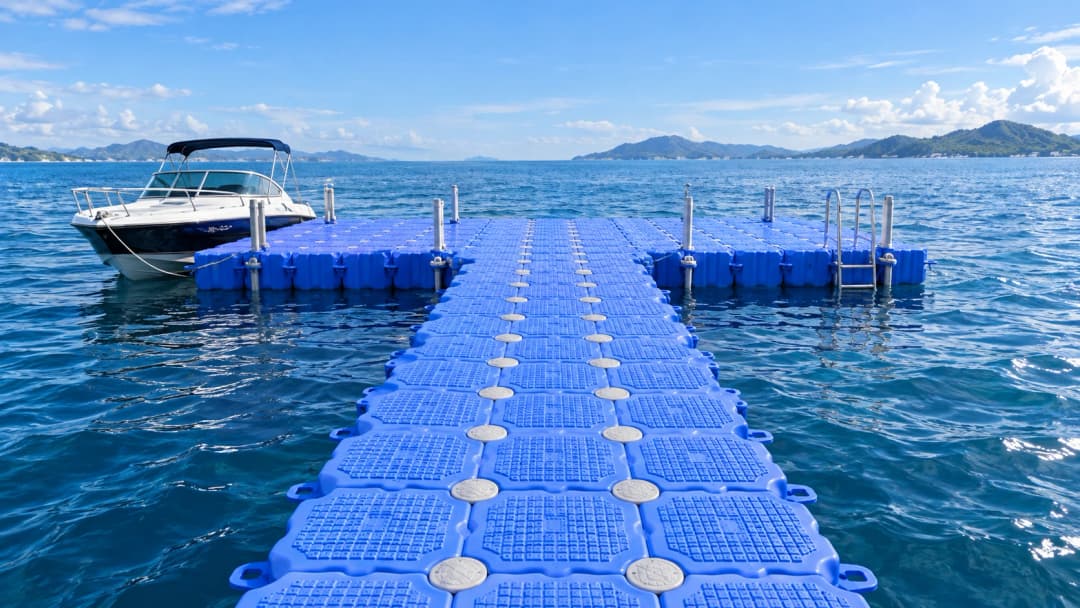
A floating dock moves along with changes in water levels, making it suitable for certain areas such as lakes, reservoirs, rivers, and coastal locations.
The structure can be used as access to boats or expanded into a larger berthing area.
For a more complete system, the dock can be combined with gangways, railings, fenders, bollards, and anchoring systems.
2. Floating Bridges
Floating cubes can also be arranged lengthwise to create a floating bridge or floating walkway.
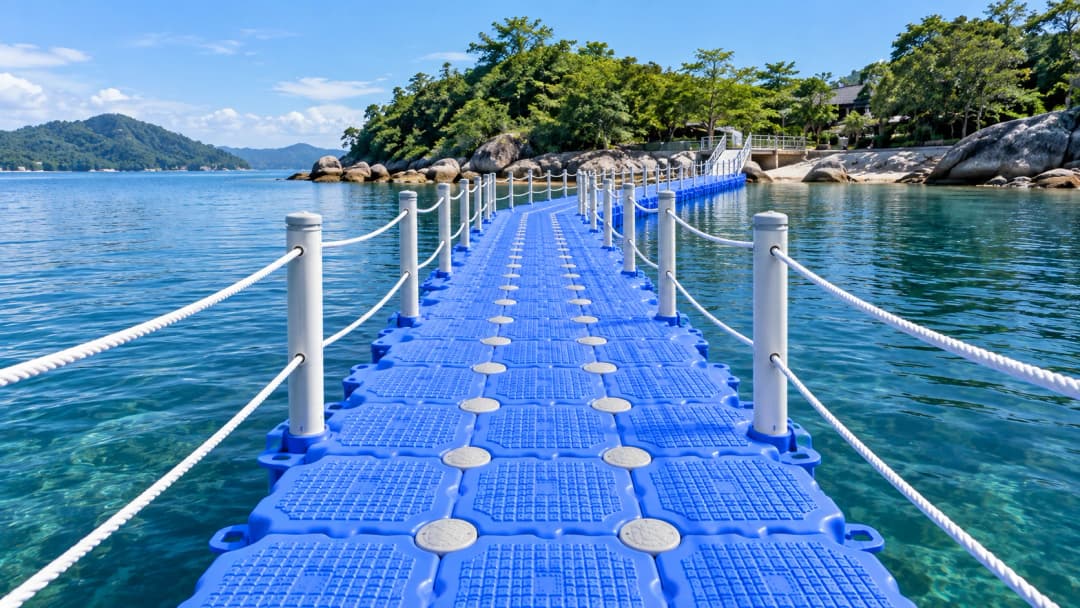
This application can be used as an access route in tourism areas, water facilities, or certain project sites.
The width and configuration of the bridge should be adjusted according to the number of users, the intended function of the walkway, and water conditions.
3. Floating Fish Cages
In the aquaculture sector, floating cubes can be used to create working walkways around fish farming areas.
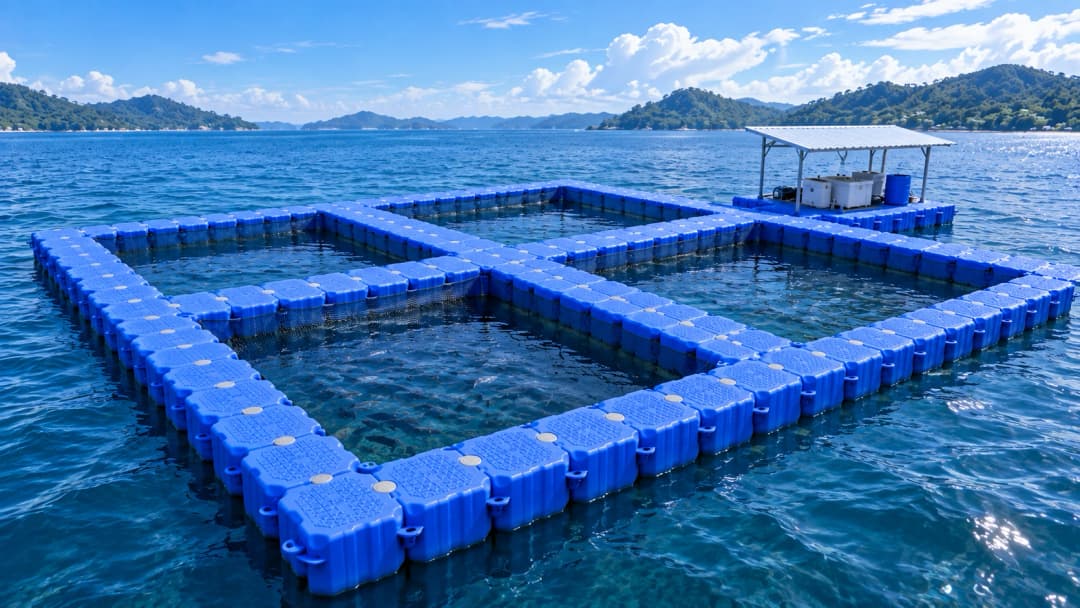
These platforms can assist operators with feeding, net inspection, maintenance, and other operational activities.
4. Floating Platforms
Floating cubes can be assembled into floating platforms of various sizes.
Applications may include:
work areas, equipment platforms, water activity platforms, and supporting structures for various projects.
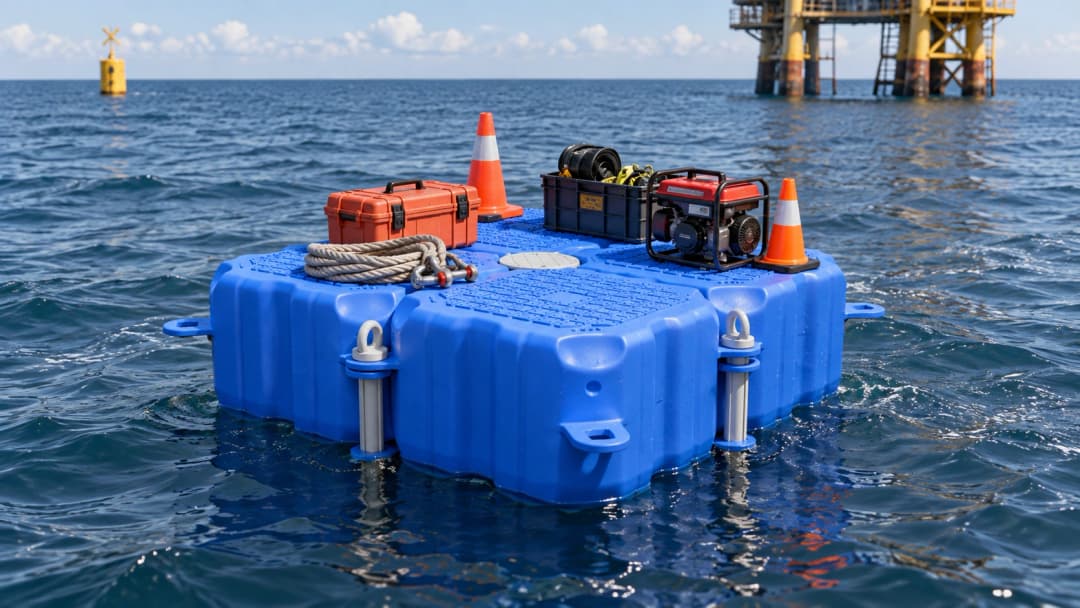
For platforms supporting heavy or concentrated loads, more detailed structural calculations are required.
5. Water Tourism Facilities
Floating cubes can also be used in tourism areas such as lakes, reservoirs, rivers, and beaches.
Some applications include:
visitor walkways, access to attractions, water activity platforms, and boat docking areas.
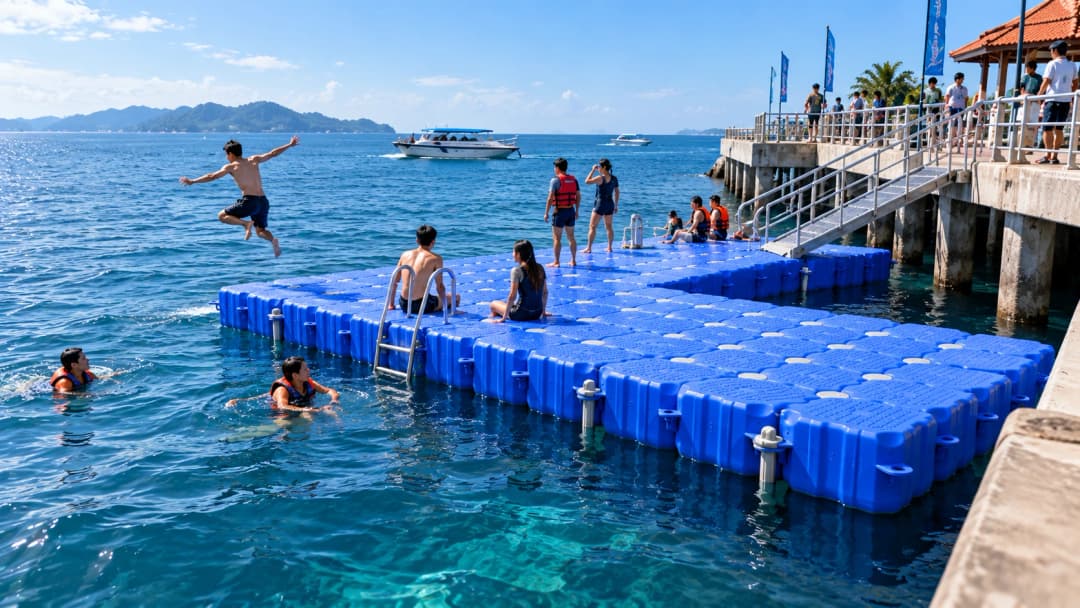
For public facilities, safety factors such as stability, railings, walking surfaces, and user accessibility should receive particular attention.
Supporting Components for Floating Cubes
In actual projects, a floating structure consists of more than just floating cubes.
Several supporting components may be used, including:
Locking pins, used to connect multiple cubes at their joining points.
Nuts or bolt nuts, used to help secure specific connections.
Handrails, used as barriers and handholds along the sides of the platform.
Fenders, used to help protect the side of the dock when it is near or in contact with vessels.
Bollards, used as one of the mooring points for vessels.
Pile guides, which can help keep the dock positioned relative to piles while still allowing the structure to move vertically with changing water levels.
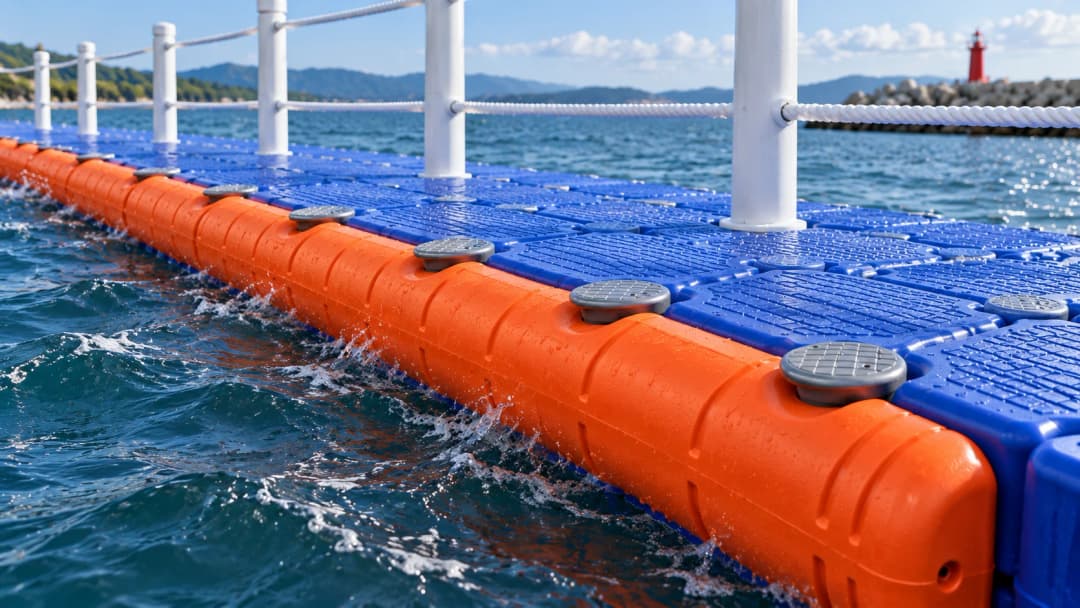
Therefore, project calculations should not be based only on the number of cubes but should also consider the connection system and other supporting components.
How to Determine Floating Cube Requirements
The simplest way to determine the number of floating cubes is based on the surface area.
However, to create the correct configuration, several additional factors should also be considered:
- platform dimensions,
- intended function of the structure,
- number of users,
- type and distribution of loads,
- wave and current conditions,
- changes in water levels,
- water depth,
- type of vessel that will berth,
- and the anchoring system.
For example, two docks with the same area of 20 m² may not necessarily require the same configuration.
A tourism dock on a relatively calm lake has different operating conditions compared with a vessel dock in a coastal area exposed to waves, currents, tides, and forces from vessels.
Therefore:
the platform area determines the basic number of cubes, while site conditions determine the overall system design.
Can Floating Cubes Be Used at Sea?
From a material perspective, HDPE can be used in various aquatic environments.
However, use at sea should not be determined solely by whether the floating cube material can remain in water.
Marine environments may involve:
waves, currents, wind, tides, and forces generated by vessels.
Therefore, it is important to ensure that the structure configuration, connections, fenders, and anchoring system are suitable for the conditions at the installation site.
In other words, not only must the cubes be suitable, but the entire floating dock system must also be appropriately designed.
Are Floating Cubes Slippery?
Floating cube surfaces are generally designed with raised textures to help improve grip when walked on.
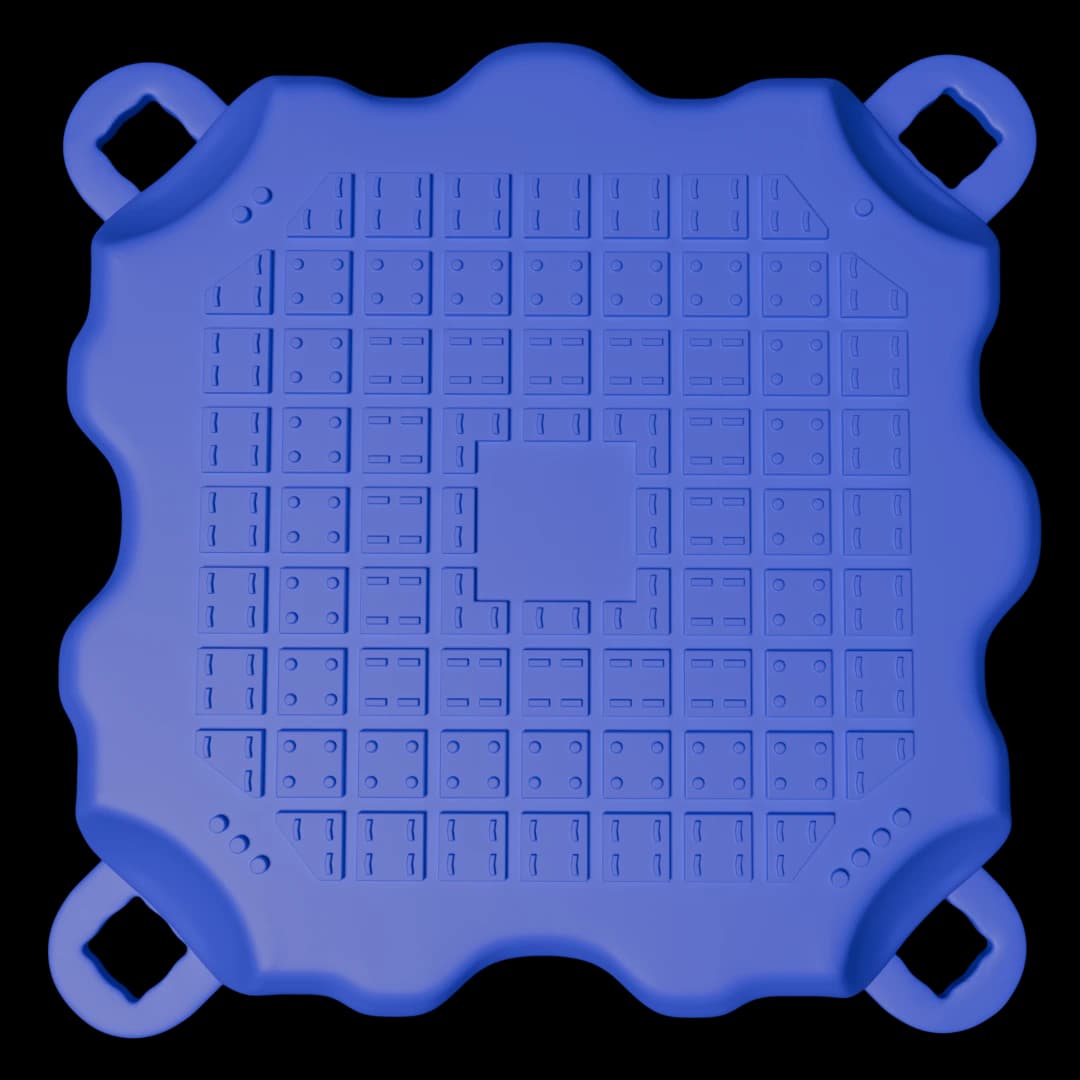
However, the surface may still become more slippery if it is covered with mud, algae, oil, or excessive dirt.
Therefore, structures used as walkways should still be cleaned and inspected regularly.
How to Maintain Floating Cubes
Floating cube maintenance is relatively simple.
Several components should be inspected regularly, including:
the condition of the cube surfaces, connections between units, locking pins and nuts, railings, fenders, pile guides, and anchoring points.
Areas affected by algae growth or dirt should be cleaned to keep the surface comfortable and safe to use.
For docks used by vessels, the sides of the structure and mooring points require additional attention because they are exposed to greater forces.
Mistakes to Avoid
One common mistake is calculating project requirements based only on the price of a single cube.
In reality, project cost and safety are also influenced by the configuration, number of accessories, anchoring system, and site conditions.
Another common mistake is treating theoretical buoyancy as a safe working load.
For more complex projects, the planning process should ideally follow these stages:
determine the function → determine the layout → calculate the number of cubes → calculate loads → determine accessories and anchoring → installation.
Conclusion
HDPE floating cubes provide a modular solution for building various floating structures such as floating docks, floating bridges, fish cages, floating platforms, and water tourism facilities.
With dimensions of 50 × 50 × 40 cm, four cubes can form an area of approximately 1 m², allowing initial quantity estimates to be calculated based on the required platform area.
However, the number of cubes is not the only factor that determines the success of a project.
Loads, wave conditions, currents, changes in water levels, anchoring systems, connections, and accessories must also be adapted to site conditions.
For floating docks, floating bridges, fish cages, floating platforms, and other water-based projects, PT Karya Pilar Nusantara can assist in determining the appropriate number of cubes and configuration based on the required dimensions and intended application.
Consult the required dimensions and project area in advance so that the number of cubes, accessories, and installation system can be planned more accurately.