When choosing pallets for a warehouse, size and load capacity are usually the two factors that receive the most attention. However, there is another equally important aspect: the construction of the pallet itself.
Take a 120x120 plastic pallet, for example. On the market, this size is available in several construction types, including single side and double side. Although their length and width are the same, they are not necessarily suitable for the same tasks. Double side pallets are generally chosen when users need a more comprehensive upper and lower structure. This type can be used for various storage and material handling activities, provided that its capacity and design are suitable. However, does every warehouse need to use double side pallets? To answer this question, we need to examine how the pallets are used, the types of goods being handled, and the equipment available.
120x120 Plastic Pallets: Why Is This Size Chosen?
A 120x120 plastic pallet is a square-shaped pallet with a length and width of 120 cm each. This size is equivalent to 1,200 × 1,200 mm.
Compared to a 120×100 cm pallet, the difference in dimensions may not seem significant. However, this difference can be noticeable when arranging goods with certain packaging dimensions.
A 120×120 pallet has a surface area of 1.44 square meters, while a 120×100 pallet has a surface area of 1.2 square meters. Therefore, the base area of a 120×120 pallet is approximately 20% larger.
For example, a warehouse stores cartons with a base dimension of 60×60 cm. On a 120×120 pallet, four cartons can be arranged side by side in a single layer. Meanwhile, a 120×100 pallet can only accommodate two cartons in that arrangement without extending beyond the surface edges.
This example shows that pallet dimensions can affect how goods are arranged.
Nevertheless, a larger pallet is not necessarily more efficient. If most goods are relatively small, the additional surface area may actually make storage space less optimal.
That is why pallet dimensions should be determined based on packaging dimensions, stacking patterns, warehouse area, and the vehicles used for distribution.
In the Karpinus HDPE pallet product line, the 120×120 cm size is available through the KPN 1212 model, featuring a double side construction and a height of 15 cm.

What Is a Double Side Pallet?
A double side pallet is a type of pallet that has deck structures on both the upper and lower sections. The upper section is used to support goods, while the lower structure forms part of the pallet's support system when carrying loads.
In plastic pallets, this construction may consist of decks with specific reinforcement arrangements. The design varies depending on the requirements and specifications of each manufacturer.
Simply put, a single side pallet has one main surface for placing goods, with legs or supports underneath. Meanwhile, a double side pallet has a more comprehensive lower structure.
These structural differences affect pallet weight, support points, and suitability for different storage methods.
There is also the term reversible pallet, which is often associated with double side pallets.
A reversible pallet is specifically designed so that both sides can be used as load-bearing surfaces. However, not every product labeled as double side automatically has this capability.
If a product is only described as double side, its ability to be used on both sides must still be confirmed based on the manufacturer's design and specifications.
Differences Between Single Side and Double Side Pallets
At first glance, these two types of pallets serve the same purpose. Both are used as platforms for storing and moving goods.
The differences become apparent when we examine their lower structures and how the pallets are used.
Single side pallets generally have one main surface supported by legs or runners. This design is available in various sizes and load capacity classes.
Meanwhile, double side pallets have both upper and lower decks. This construction can be considered for specific load-support requirements, particularly when a two-deck design is needed for operations.
The following table shows their general differences.
| Aspect | Single Side | Double Side |
|---|---|---|
| Construction | One main deck | Upper and lower decks |
| Lower section | Legs or runners | Lower deck structure |
| Weight | Can be lighter | Generally heavier within the same class |
| Material handling | Depends on openings and design | Depends on openings and design |
| Load capacity | According to variant specifications | According to variant specifications |
| Reversible use | Not always available | Must be confirmed whether reversible |
It is important to understand that double side pallets are not automatically stronger than all single side pallets.
For example, a single side pallet with a heavy duty design may have a higher static load capacity than a double side pallet with a different construction.
This is because pallet strength does not depend solely on the number of decks. It is also influenced by the material, thickness, reinforcement structure, and load distribution.
Therefore, choosing a pallet type based only on its appearance is not appropriate. Load capacity specifications and intended use must remain the primary considerations.

When Should You Use Double Side Pallets?
Double side pallets can be an option for several warehouse conditions. However, their use must still be adjusted to the characteristics of the goods and the handling methods.
1. When a Warehouse Stores Heavy Goods
Heavy goods require pallets with adequate construction and load capacity.
Examples include factory raw materials, industrial components, bagged products, or finished goods stacked in large quantities.
Under these conditions, the pallet must be able to support the weight of the goods without excessive deformation.
Double side construction can be one option because its lower section has a more comprehensive support structure.
However, the ability to withstand loads still depends on each pallet's specifications.
For example, the KPN 1212 is available with static load capacities ranging from 2.5 to 3.5 tons, depending on the selected variant.
These figures can serve as an initial reference when selecting pallets for floor storage requirements.
2. When Goods Are Frequently Moved Using Forklifts
In warehouses with high levels of activity, pallets do not always remain in one location.
Newly arrived goods are usually moved to storage areas. Afterward, the goods may be lifted again and transported to production or shipping areas.
This process can occur repeatedly throughout the day.
For such activities, the pallet's dynamic load capacity requires special attention.
Double side pallets designed for forklift use can be considered as long as their opening design, support points, and load capacity are compatible with the equipment being used.
For the KPN 1212, the available dynamic load capacities range from 2 to 3 tons.
This means the variant should be selected based on the actual load being transported, rather than simply its capacity when placed on the floor.
3. When a Wide Base Surface Is Required
Some goods are not particularly heavy but have relatively large packaging dimensions.
Examples include products packed in wide cartons, machine components, or raw materials arranged in specific types of packaging.
Such goods sometimes require square-shaped pallets to achieve a more suitable arrangement.
A 120×120 pallet can be an option if its dimensions allow goods to be placed without excessive overhang beyond the edges.
However, this advantage comes from the pallet's dimensions, not solely from its double side construction.
If the goods require both a 120×120 size and a two-deck structure, then a double side pallet becomes a relevant option.
4. When Pallets Are Used in a Repeated Storage System
In some companies, pallets are used in the same operational cycle for years.
Pallets move from production areas to warehouses and are then reused after the goods have been removed.
This requirement differs from one-way shipping, where pallets may not be returned to the sender.
For repeated use, it is important to choose pallets with structures suitable for the load, handling frequency, and environmental conditions.
HDPE pallets have the characteristic of not absorbing water like wood and can be cleaned according to operational needs.
This makes them worth considering for various warehouse and industrial activities.
Nevertheless, service life is not determined by material alone.
Forklift impacts, overloading, and storage methods can also affect pallet conditions.
Does Every Warehouse Need Double Side Pallets?
Not every warehouse needs double side pallets.
If storage activities only involve relatively light goods, single side pallets may already be sufficient, provided their load capacity meets the requirements.
The same applies to distribution activities that prioritize lighter pallet weight.
For example, a company shipping goods in cartons with a load weight of approximately 500 kg per pallet does not necessarily need double side construction.
If the dimensions and load capacity of a single side pallet are already suitable, using a double side pallet may not provide significant additional benefits.
Another factor to consider is warehouse equipment.
Double side pallets have a different lower structure compared to pallets with legs. In certain models, this construction may limit the use of manual pallet jacks.
If a warehouse uses pallet jacks more frequently than forklifts, the compatibility of the openings and wheel clearance should be checked first.
Otherwise, the pallets that have already been purchased may turn out to be incompatible with the available material handling equipment.
The best choice is not always the heaviest or thickest-looking pallet, but the one that suits daily operations.
Understanding the Load Capacity of 120x120 Plastic Pallets
One common mistake when purchasing industrial pallets is focusing only on the highest load capacity figure.
For example, a pallet may be described as capable of supporting a 3-ton load.
However, this figure does not explain whether the pallet can carry 3 tons when lifted by a forklift or only when resting on the floor.
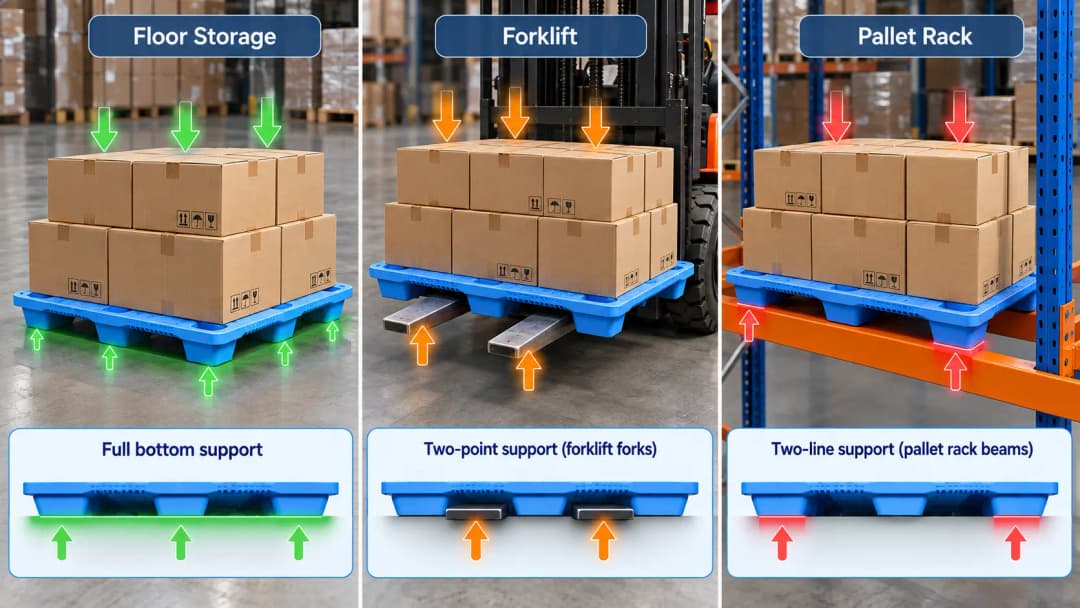
In pallet specifications, there are three terms that need to be distinguished.
Static Load: When the Pallet Is on the Floor
Static load refers to the pallet's capacity to support a load while stationary, under the specified support conditions.
For example, a pallet is placed on a warehouse floor and loaded with several layers of cartons containing products.
Under these conditions, the bottom of the pallet is supported by the floor surface.
For the KPN 1212, static load capacities are available in three options: 2.5 tons, 3 tons, and 3.5 tons.
These figures do not mean that goods can be placed in any arrangement.
A load concentrated at one point can create different pressure compared to a load that is evenly distributed.
Dynamic Load: When the Pallet Is Being Moved
Dynamic load indicates the pallet's capacity to carry goods while being moved using suitable equipment.
When a pallet is lifted by a forklift, its support points change.
The load is no longer supported by the floor but by the parts of the pallet that come into contact with the forklift forks.
Therefore, dynamic load capacity is generally lower than static load capacity.
For example, the 18 kg variant of the KPN 1212 has a static load capacity of 3 tons and a dynamic load capacity of 2.5 tons.
If the pallet is intended to lift goods weighing 2.8 tons, its 3-ton static load capacity cannot be used as a reference to declare that lifting operation safe.
Its dynamic load capacity is only 2.5 tons, so this variant does not meet the load requirements for that lifting operation.
Racking Load: When the Pallet Is Placed on a Rack
Racking load refers to the pallet's load capacity when placed on a racking system with specific support points.
For example, a pallet is placed on two support beams of a warehouse rack.
Under these conditions, not every part of the pallet's bottom receives support as it would when placed on the floor.
As a result, the pallet structure may experience different levels of stress and deflection.
That is why a high static load capacity does not necessarily indicate that a pallet is suitable for racking systems.
For the KPN 1212, the currently available data lists static load and dynamic load capacities.
The racking load capacity has not been specifically stated, so it must be confirmed before the pallet is used on racks.
Using Double Side Pallets with Forklifts and Racking Systems
In warehouse operations, forklifts and racking systems are often used together.
However, each provides different support conditions for pallets.
When a forklift lifts a pallet, the load is supported by the forks inserted underneath the pallet.
Meanwhile, when a pallet is placed on a rack, the load is transferred to the rack's supporting structure.
This difference explains why one type of pallet may not be suitable for every storage method.
Use with Forklifts
Before using double side pallets with forklifts, pay attention to the fork width, distance between the forks, and available entry directions on the pallet.
Make sure the forks can enter properly and support the pallet at the points intended by its design.
Also consider the forklift's load capacity and the condition of the goods being lifted.
Even pallets with adequate dynamic load capacity still require proper handling to prevent damage from impacts or incorrect lifting positions.
Use in Racking Systems
For warehouses using multi-level racks, checking pallet dimensions alone is not sufficient.
The distance between rack beams, weight of the goods, pallet position, and support surface area must also be considered.
PT Karya Pilar Nusantara also provides a Strip Pallet accessory, which is used as an additional supporting component underneath pallets for certain racking system requirements.
However, using this accessory does not automatically make every pallet safe for all rack configurations.
Compatibility between the pallet, accessory, load, and racking system must still be confirmed.
KPN 1212 Double Side Pallet Specifications
One of the available 120x120 plastic pallet options is the KPN 1212 Double Side from PT Karya Pilar Nusantara.
This product is made from High Density Polyethylene, or HDPE, and has dimensions of 120 × 120 × 15 cm.
The KPN 1212 is available in three weight variants, each with a different load capacity.
KPN 1212 Variant Options
| Specification | Variant 1 | Variant 2 | Variant 3 |
|---|---|---|---|
| Pallet weight | 16 kg | 18 kg | 20 kg |
| Static load | 2.5 tons | 3 tons | 3.5 tons |
| Dynamic load | 2 tons | 2.5 tons | 3 tons |
| Dimensions | 120×120×15 cm | 120×120×15 cm | 120×120×15 cm |
| Material | HDPE | HDPE | HDPE |
All variants feature double side construction with a stated TKDN (Domestic Component Level) value of 52.77%.
These differences in load capacity provide options for companies that need pallets suited to the weight of their goods and operational activities.
For example, if a warehouse handles loads of approximately 1.5 tons per pallet and moves them using forklifts, a variant with a dynamic load capacity of 2 tons can be considered.
However, if the load weight approaches 2.5 tons or more, a variant with a higher dynamic load capacity may be required.
The final selection must still consider working load limits, load distribution, forklift conditions, and an appropriate capacity margin.
For large-volume procurement, specifications should be confirmed according to the type of goods and intended handling methods.
Information about the product and other available pallet options can be found on the Karpinus HDPE Pallet page.

KPN Pallet Options for Different Requirements
In addition to the KPN 1212 Double Side, PT Karya Pilar Nusantara offers several warehouse plastic pallet options with different dimensions and construction types.
Each is available for requirements that are not necessarily the same.
KPN 1080 Light
The KPN 1080 pallet measures 100 × 80 × 15 cm and features single side construction.
This product is available in weight options of 5 kg, 7 kg, and 8 kg.
Its static load capacity ranges from 2 to 3 tons, while its dynamic load capacity ranges from 1.5 to 2.5 tons, depending on the variant.
Its more compact size can be considered when the dimensions of the goods do not require a larger pallet.
KPN 1210 Standard
The KPN 1210 measures 120 × 100 × 15 cm and features single side construction.
Its weight variants range from 8 kg to 12 kg.
Its static load capacity ranges from 1.3 to 3 tons, while its dynamic load capacity ranges from 0.8 to 2.5 tons.
This size can be selected for various warehousing and distribution activities, provided that it suits the dimensions of the goods.
KPN 1412 Heavy Duty
For requirements involving a longer base surface, the KPN 1412 is available with dimensions of 140 × 120 × 15 cm.
This single side product comes in weight options of 12 kg, 14 kg, and 16 kg, with static load capacities of 2 to 3 tons and dynamic load capacities of 1.5 to 2.5 tons.
The KPN 1412 can be considered for goods with dimensions that require a longer surface.
This comparison shows that pallet selection cannot be determined solely by whether a pallet is single side or double side.
Even smaller pallets may have suitable load capacities for certain tasks.
Conversely, larger pallets are not necessarily required if the dimensions of the goods do not demand them.
Tips for Choosing Pallets Before Procurement
Before purchasing pallets in large quantities, it is advisable to collect several pieces of information from the warehouse or operations department.
Calculate the Weight of Goods per Pallet
Determine the maximum weight of goods that will be stored on a single pallet.
Do not rely only on the average weight, as the quantity of goods placed on a pallet may change according to production needs.
If the pallet is used to move goods, make sure its dynamic load capacity is suitable.
Check Goods Dimensions and Warehouse Space
Pallets that are too small may cause goods to extend beyond their edges.
Conversely, pallets that are too large may occupy more storage space than necessary.
Pallet dimensions must also be compatible with the width of operational aisles, racks, and transport vehicles.
Confirm the Equipment Being Used
Check whether the warehouse uses forklifts, pallet jacks, or stackers.
Each type of equipment has a different lifting mechanism.
Therefore, the design of the pallet's lower section must be compatible with the equipment that will be used.
Consider the Storage Method
Determine whether pallets will only be stored on the floor, used in a goods stacking system, or placed on racks.
These three conditions have different support requirements.
For racking applications, pallet capacity and configuration must be specifically confirmed.
Conduct Testing Before Large-Scale Purchases
If pallets will be used for heavy-load applications or special conditions, testing under actual operating conditions can help ensure their suitability.
This method is also useful for determining whether the pallets can be handled properly using the available equipment.
Frequently Asked Questions About Double Side Pallets
Are 120x120 plastic pallets always double side?
No. The 120×120 cm size indicates the pallet's dimensions, not its construction type.
Pallets with the same dimensions may have either single side or double side construction, depending on the model produced.
Are double side pallets stronger than single side pallets?
Not necessarily. Pallet strength is determined by the material, design, reinforcement structure, and loading conditions.
To determine load capacity, check the static load and dynamic load specifications of each variant.
What is the load capacity of the KPN 1212 double side pallet?
The KPN 1212 is available in three variants.
The 16 kg variant has a static load capacity of 2.5 tons and a dynamic load capacity of 2 tons.
The 18 kg variant has a static load capacity of 3 tons and a dynamic load capacity of 2.5 tons.
Meanwhile, the 20 kg variant has a static load capacity of 3.5 tons and a dynamic load capacity of 3 tons.
Can double side pallets be used with pallet jacks?
It depends on the design of the pallet's lower section and the dimensions of the equipment being used.
Not all double side constructions provide sufficient clearance for pallet jack wheels.
Therefore, compatibility must be checked before purchasing.
Are double side pallets suitable for racking systems?
Yes, provided that the product has specifications suitable for use on racks.
Racking load capacity cannot be determined solely from static or dynamic load capacity.
Can HDPE pallets be reused?
HDPE pallets can be reused as long as their physical condition and load capacity continue to meet operational requirements.
Regular inspections are still necessary, particularly if the pallets are frequently lifted, exposed to impacts, or used to carry heavy goods.
Conclusion: Match the Pallet to Your Requirements
Double side 120x120 plastic pallets can be an option when companies require a square-shaped base surface with a two-deck construction.
This type is worth considering for warehousing and industrial activities involving heavy goods, forklift operations, or pallets intended for repeated use.
However, not every warehouse needs double side construction.
In some conditions, single side pallets with suitable dimensions and load capacities may actually be more practical.
For the KPN 1212, three weight options are available, with static load capacities of up to 3.5 tons and dynamic load capacities of up to 3 tons.
Each variant has different capabilities, so the selection must be adjusted to operational requirements.
Before choosing a pallet, make sure the dimensions of the goods, load capacity, handling methods, and storage system have been identified.
Available models and more detailed information can be found in the Karya Pilar Nusantara HDPE Plastic Pallet catalog.