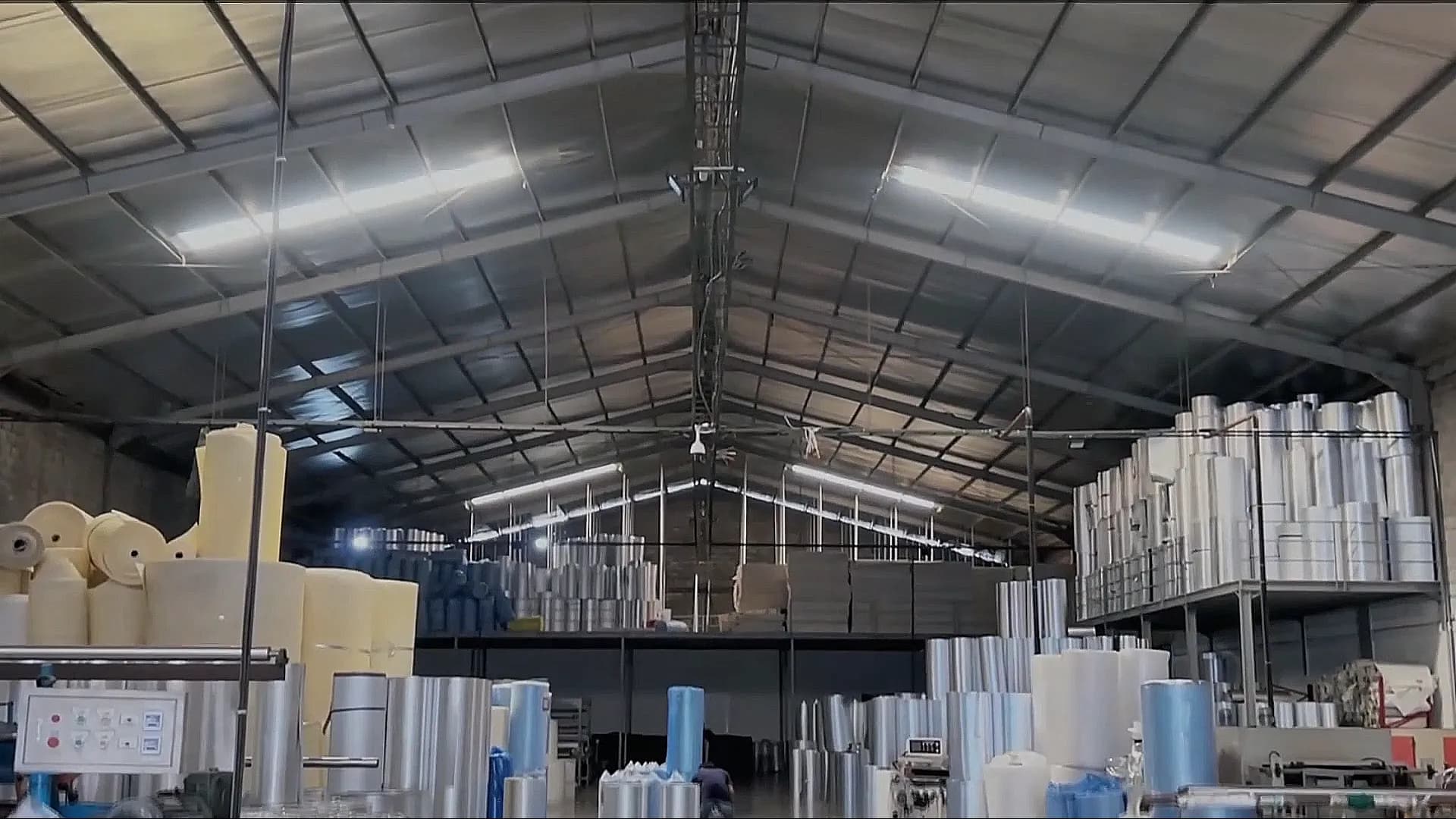
The roof is one of the building components most directly exposed to solar heat. In homes, warehouses, workshops, factories, and other buildings with large roof areas, heat absorbed by the roof surface can be transferred into the space below and affect indoor thermal comfort.
One way to control this heat transfer is by using roof insulation.
However, roof insulation is not limited to one type of material. There are aluminium foil systems, bubble foil, polyethylene foam, XLPE foam, glass wool, rock wool, polyurethane, and insulated panels.
Each material has different thermal characteristics, operating principles, thickness options, and recommended applications.
So, which type of roof insulation should you choose? And is thicker insulation always better?
This guide explains the fundamentals.
What Is Roof Insulation?
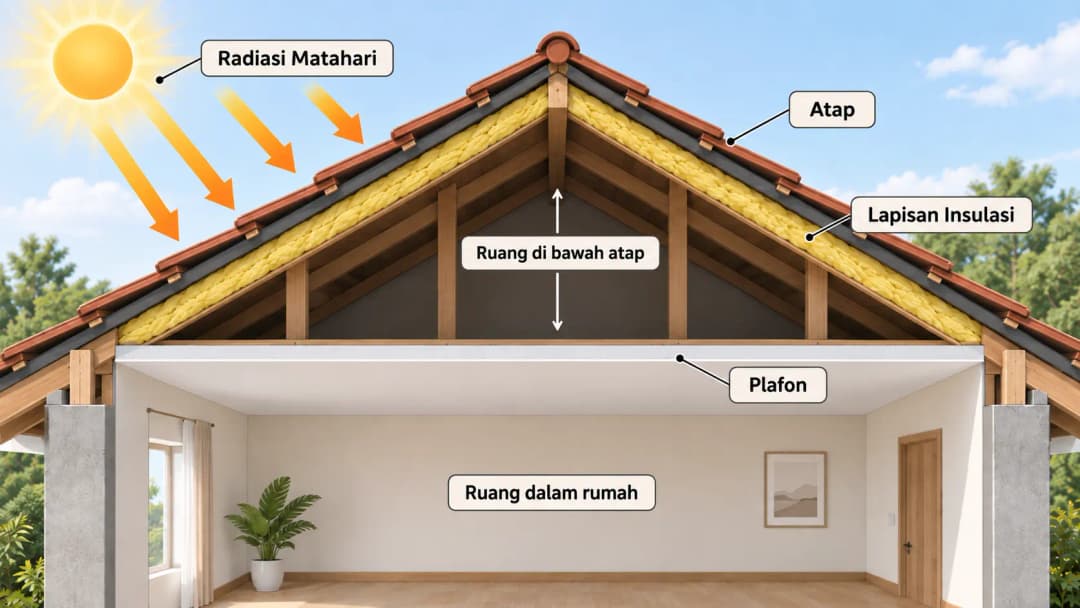
Roof insulation is a material or system installed as part of a roofing assembly to help reduce heat transfer between the exterior and interior of a building.
Depending on the roof structure and insulation type, the material may be installed directly beneath the roof covering, above the ceiling, between structural members, or integrated into a roofing panel.
In general, roof insulation is used to:
reduce heat entering through the roof;
help maintain more stable indoor conditions;
improve thermal comfort;
help reduce the load on cooling systems;
and, depending on the material, help reduce roof-related noise.
Because different materials work in different ways, the term roof heat insulation can refer to several heat-control mechanisms.
How Does Heat Enter Through a Roof?
Before choosing insulation, it is useful to understand how heat moves.
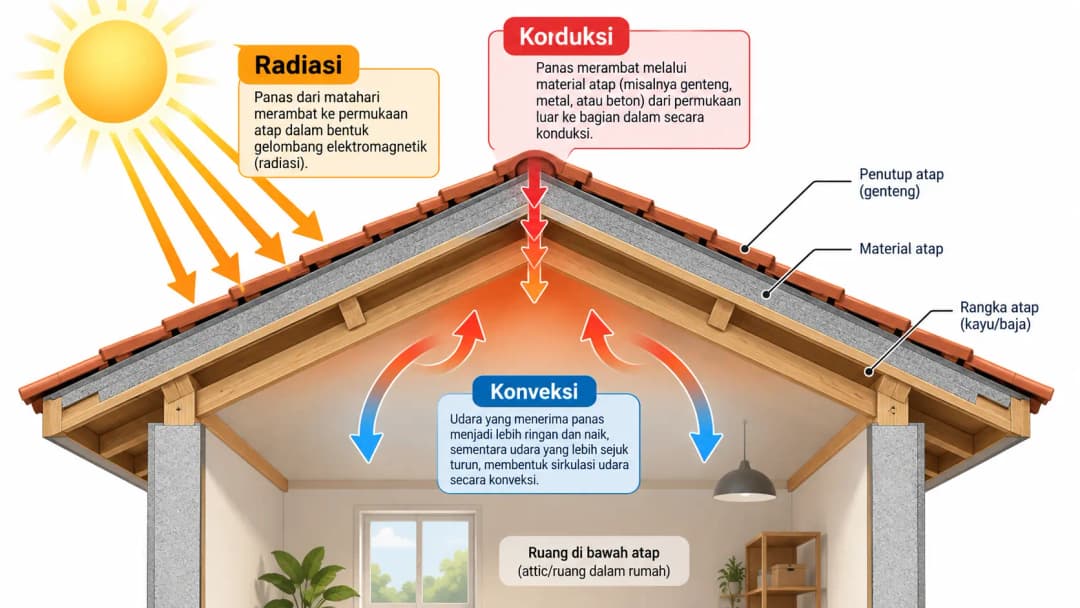
There are three main heat-transfer mechanisms: radiation, conduction, and convection.
1. Radiation
Solar energy reaches the roof surface. Once the roof becomes hot, part of that energy can be radiated toward the space below.
Reflective materials such as aluminium foil are commonly used to help reduce radiant heat transfer.
2. Conduction
Heat can also travel through solid materials.
A hot roofing sheet transfers heat into other materials or structural components that are in contact with it. Insulation materials with low thermal conductivity help slow this process.
3. Convection
Air can carry heat as it moves.
Air circulation inside the roof cavity therefore also affects the thermal conditions of a building.
This means effective roof insulation does not depend on only one material. Roof type, air spaces, ventilation, insulation material, and installation method all work together as a system.
Reflective Insulation and Thermal Insulation Are Not the Same
This is one of the most commonly misunderstood points.
Aluminium foil primarily works as a reflective surface that helps reduce radiant heat transfer.
Foam, glass wool, and rock wool, on the other hand, primarily work by resisting heat flow through the material itself.
Reflective surfaces generally perform most effectively when facing an air space. When a reflective foil surface is directly pressed against another solid material, it does not function in exactly the same way as a radiant barrier facing an air gap.
This is why some roof insulation products combine aluminium foil and foam.
The foil helps manage radiant heat, while the foam layer adds resistance to conductive heat transfer.
Types of Roof Insulation
There is no single insulation type that is automatically suitable for every building.
Below are several commonly used roof insulation materials.
Aluminium Foil
Aluminium foil is used as a reflective layer to help reduce radiant heat transfer.
It is lightweight and widely used in metal roofing systems, houses, warehouses, and light commercial buildings.
However, performance is not determined only by how reflective or shiny the surface looks. Installation configuration, surface condition, and the presence of an air space also matter.
Common applications: houses, shops, warehouses, and metal-roof buildings.
Bubble Foil
Bubble foil combines a reflective surface with an enclosed air-bubble layer.
The material is lightweight, flexible, and relatively easy to install. It is commonly used in lightweight roof systems where both a reflective layer and an additional air-containing structure are required.
Common applications: homes, shops, lightweight warehouses, and selected metal-roof applications.
Polyethylene Foam / XLPE Foam
Polyethylene foam contains numerous small air cells that help slow heat transfer.
One development of this material is Cross-Linked Polyethylene, or XLPE foam, in which the polymer structure has undergone a cross-linking process to produce a more stable foam structure.
Closed-cell foam has enclosed cell structures, which gives it different characteristics from fibrous insulation.
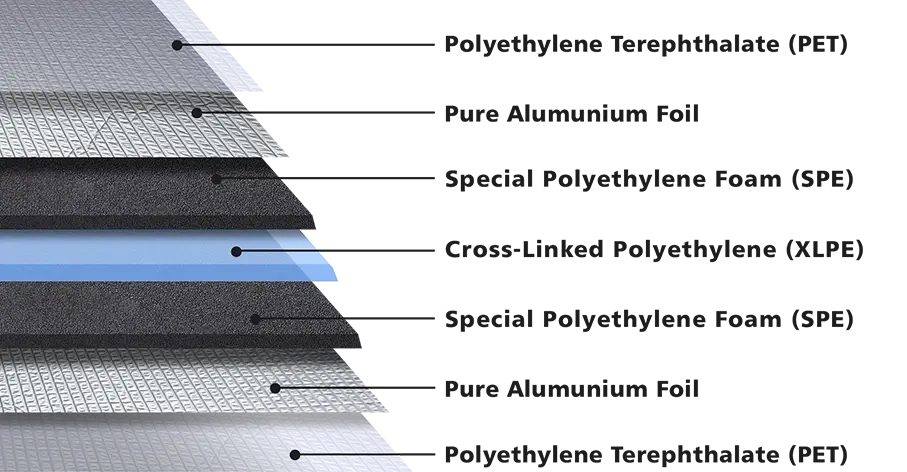
In some systems, XLPE foam is combined with aluminium foil. This allows the product to address two mechanisms at once: the foam helps reduce conductive heat transfer, while the foil helps manage radiant heat.
Common applications: warehouses, workshops, commercial buildings, factories, and metal roofing.
Glass Wool
Glass wool is made from glass fibres and is widely used for thermal and acoustic insulation.
Air trapped between the fibres helps resist heat flow.
Glass wool is available in different densities, thicknesses, and forms, so its specification should be matched to the building system.
Common applications: commercial buildings, warehouses, offices, and applications requiring both thermal and acoustic control.
Rock Wool
Rock wool is a mineral-fibre insulation material.
In addition to thermal insulation, rock wool is commonly used where acoustic performance or specific fire-related requirements are important.
It is available in different densities and configurations, so selection should be based on project requirements.
Common applications: industrial facilities, plant rooms, factories, commercial buildings, and technical spaces.
Polyurethane and PIR
Polyurethane, or PU, can be used as spray foam or as the insulating core of a panel system.
Another related foam-based material is PIR, or polyisocyanurate.
These materials are commonly used when high thermal resistance is required within a relatively limited thickness.
Common applications: industrial buildings, insulated panels, temperature-controlled spaces, and specialised roof systems.
Sandwich Panels
A sandwich panel is a complete panel system consisting of two outer layers with an insulation core between them.
Because the insulation is integrated into the panel itself, this system is widely used in modern industrial and commercial construction.
Common applications: factories, warehouses, modular buildings, and temperature-controlled facilities.
Quick Comparison of Roof Insulation Types
| Type | Main Principle | Characteristics | Common Application |
|---|---|---|---|
| Aluminium foil | Radiant heat reflection | Thin and lightweight | Houses, warehouses, metal roofs |
| Bubble foil | Reflection + trapped air layer | Flexible and lightweight | Houses, shops, warehouses |
| PE/XLPE foam + foil | Thermal resistance + reflection | Flexible, closed-cell | Warehouses, workshops, factories |
| Glass wool | Fibre-based heat resistance | Fibrous | Buildings, warehouses |
| Rock wool | Thermal and acoustic insulation | Mineral fibre | Industrial and technical facilities |
| PU/PIR | High thermal resistance | Foam / rigid panel | Industrial and conditioned spaces |
| Sandwich panel | Integrated insulated system | Rigid panel | Warehouses and factories |
Insulation should not be selected based on the material name alone.
Thermal conductivity, thickness, roof construction, building requirements, and installation method should all be evaluated together.
What Does Insulation Thickness Mean?
Thickness is one factor that affects the ability of insulation to resist heat flow.
For the same material under the same conditions, a thicker insulation layer will generally provide greater thermal resistance.
However, this does not mean that selecting the thickest available material is always the best solution.
Other factors must also be considered.
Thermal Conductivity
Materials with lower thermal conductivity transfer heat more slowly.
Material Structure
Closed-cell foam, fibrous insulation, reflective insulation, and rigid boards behave differently.
Installation Quality
Gaps, poorly sealed joints, compressed insulation, and incorrect installation can reduce system performance.
Air Space
For reflective surfaces in particular, an air gap may be an important part of controlling radiant heat.
Therefore, instead of simply asking:
“What insulation thickness is best?”
A better question is:
“What thickness is appropriate for this material, roof construction, heat load, and building use?”
Example of XLPE Foam Thickness Options
As an example, Karpinux Roof Insulation uses an XLPE foam-based system and is available in several thicknesses.
5 mm — Light
Suitable for applications requiring a relatively thin insulation layer, such as renovations, lightweight buildings, or areas with limited installation space.
8 mm — Balanced
A middle-range option for broader applications, including warehouses, workshops, and commercial buildings.
10 mm — Heavy Duty
A thicker foam layer intended for factories, work areas, and buildings with higher heat-control requirements.

Karpinux lists a thermal conductivity of 0.030 W/m·K and combines XLPE foam with aluminium foil.
The product is available in 1 × 25 metre rolls and in single-side or double-side configurations.
These specifications can be used as one parameter when comparing materials. Actual thermal performance, however, still depends on the complete roof assembly and installation method.
How to Choose the Right Roof Insulation Thickness
A practical starting point is to consider the building type.
Renovations and Lightweight Buildings
When installation space is limited and the objective is to add a heat-control layer without significantly increasing the thickness of the roof assembly, thinner insulation may be sufficient.
Warehouses and Workshops
Warehouses often have large roof areas and commonly use metal roofing such as spandek or galvalume.
The insulation requirement therefore depends not only on outdoor temperature, but also on roof size, building height, ventilation, and activities inside the building.
Foam insulation combined with reflective foil can be considered for large-span roof applications because it is relatively lightweight.
Factories
Factories usually have more complex thermal conditions.
In addition to heat from outside, production machinery and industrial processes may generate significant internal heat.
For that reason, insulation thickness should not be selected based only on roof area.
Internal heat load and ventilation should also be considered.
Air-Conditioned Buildings
In conditioned buildings, insulation is not only intended to make the room feel less hot.
It also helps reduce heat transfer through the building envelope.
Better roof insulation can help reduce the heat load that must be handled by the cooling system compared with the same roof without insulation.
How to Choose the Right Roof Insulation
Before purchasing insulation, several parameters should be evaluated.
1. Identify the Roofing Material
Spandek, galvalume, tiles, and concrete roofs require different approaches.
An insulation system designed for metal roofing may not be the best solution for a concrete roof, and vice versa.
2. Determine the Building Function
Houses, shops, warehouses, workshops, and factories have different thermal conditions and comfort requirements.
The larger and more complex the building, the more important it becomes to view insulation as part of the entire roofing system.
3. Check Thermal Conductivity
Thermal conductivity is usually expressed in W/m·K.
It describes how readily a material conducts heat.
When comparing similar insulation materials under the same conditions, lower thermal conductivity generally means better resistance to heat flow.
4. Do Not Judge by Thickness Alone
Two insulation materials with the same thickness do not necessarily provide the same thermal performance.
The material type and thermal conductivity must also be considered.
5. Consider Moisture and Condensation
Condensation can become an important issue in certain roof systems.
Differences in temperature and humidity may cause moisture to form on particular surfaces inside the roof assembly if the layer configuration is not designed properly.
Ventilation, vapour-control layers, and insulation position should therefore be considered according to the building condition.
6. Check the Installation Method
Good insulation can still lose much of its effectiveness if it is installed with large gaps, poorly sealed joints, or in a configuration that differs from its intended application.
Installation quality is an important part of overall thermal performance.
7. Consider Project Scale
For large projects, also consider:
roll or sheet dimensions;
number of joints;
material weight;
transportation requirements;
installation speed;
maintenance requirements;
and total roof area.
Single Side or Double Side?
Some foam insulation products are available in single-side and double-side foil configurations.
Single-side products have reflective foil on one side, while double-side products have reflective layers on both sides.
However, double-side foil should not automatically be assumed to provide twice the performance.
Reflective insulation performance is affected by the position of the reflective surface relative to the air space and other layers in the roof assembly.
Therefore, the final configuration should follow the roof design and recommended installation method.
Roof Insulation for Spandek and Metal Roofing
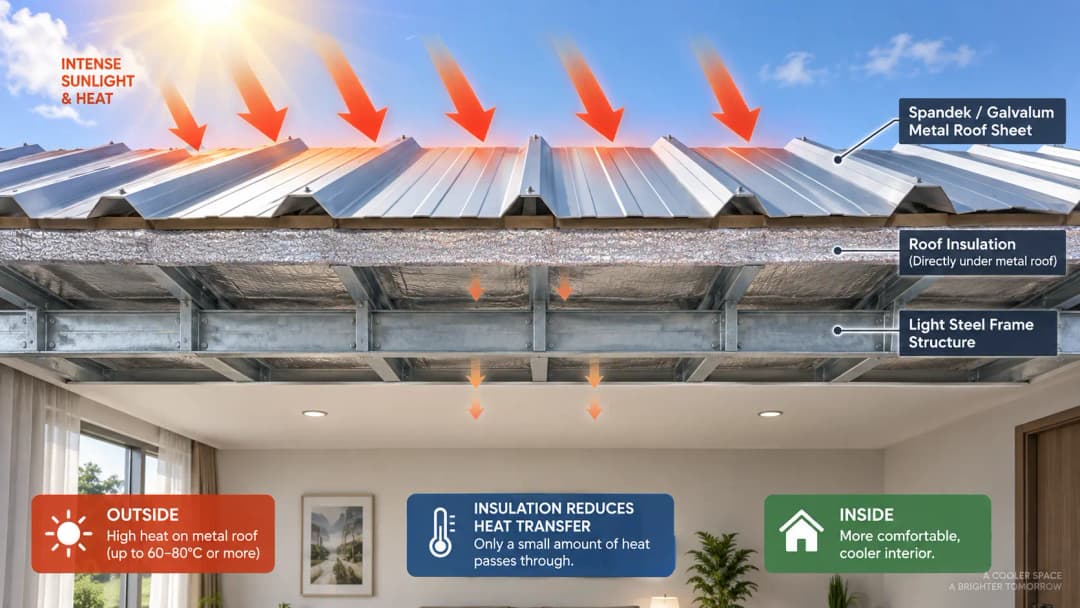
Metal roofing is widely used in warehouses, workshops, and factories because it is lightweight and suitable for large-span structures.
However, metal roof surfaces can become very hot when exposed to solar radiation.
For this type of construction, a foam + reflective foil system is often considered because it is lightweight and can follow the shape of the roofing area.
Where acoustic control or other technical requirements are also important, additional materials such as glass wool or rock wool may be incorporated into the roof system according to project design.
Common Mistakes When Choosing Roof Insulation
One common mistake is assuming that all products with aluminium foil provide the same performance.
In reality, the core material, thickness, foil properties, and installation method may differ significantly.
Another mistake is choosing insulation based only on price per square metre.
A lower material price does not always produce the lowest total project cost once installation, joints, maintenance, and service life are considered.
Another common mistake is simply choosing the thickest available product.
Thickness should always be evaluated together with material type, thermal conductivity, and roof construction.
Poor installation can also reduce performance.
Unsealed joints and gaps may create unwanted heat-transfer paths through the system.
Which Roof Insulation Should You Choose?
There is no single answer that applies to every building.
Start with four questions:
What is the building used for?
A house, warehouse, workshop, and factory all have different requirements.
What type of roof does it use?
Metal roofs, tiled roofs, and concrete roofs have different construction systems.
What is the main problem?
Is the main concern radiant heat, conductive heat, roof noise, condensation, or a combination of several factors?
How large is the installation area?
The total roof area will influence material quantities and installation methods.
After answering these questions, compare the core material, thermal conductivity, thickness, reflective layer, foil configuration, and installation method.
With this approach, insulation is selected according to actual building requirements rather than simply choosing the thickest or cheapest option.
XLPE Foam as One Roof Insulation Option
One option for metal-roof buildings is an insulation system based on closed-cell XLPE foam combined with aluminium foil.
Karpinux Roof Insulation from PT Karya Pilar Nusantara uses this configuration and is available in 5 mm, 8 mm, and 10 mm thicknesses.
These options allow the insulation specification to be adjusted for applications ranging from renovations and lightweight buildings to warehouses, workshops, and industrial facilities.
Before selecting a thickness, first determine the roof area, roofing material, and operating conditions of the building.
This makes it easier to choose an insulation system that is not only suitable in size, but also appropriate for the building's overall thermal requirements.